


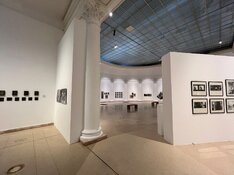

@Ardpatrick my apologies for failing to follow-up on your interesting and thoughtful message (#23). I thought about it some more, but I think we might simply disagree on the second part of your post. But perhaps this disagreement stems from a failure on my end to follow your line of reasoning, which I would (perhaps haphazardly) summarize as: because technology is central in the typologies that the Bechers made, it follows that technique in the photographic process is relevant. If that is part of your argument, then we must disagree - as I think this would be too weak a connection to justify focus on questions surrounding e.g. capture technique, film development etc.
What I do not contest is that these typologies do indeed revolve around technology, and specifically in my understanding research into the question to what extent a 'dominant design' is inevitable if man-made structures serve essentially the same function. The answer (with the facility of hindsight, since they did all the legwork over the course of decade) might be summarized as: to a large extent, there's a convergence in these architecture, that involves a form-follows-function logic. At the same time, all photographed objects are undeniably unique. In a way, the evolution of man-made structures mimics the clustering of variety within the same species resulting from biological evolution. I suppose these insights, as well as several more that can be distilled from the Bechers' typologies, are sufficiently generic or universal that they lend themselves well to reflections on parallels between many kinds of different contexts.
I also acknowledge that the aesthetic choices by sheer necessity had to support this analytical function underlying these typologies. This is regardless of the question whether the Bechers very intentionally designed the project this way, or that it "sort of happened" as an amalgam of artistic drive/necessity/urge, experimentation and reflection. Either way, they converged onto a clear methodology, which was undoubtedly informed also by Hilla's training. One of the requirements of this methodological approach is to be able to recognize and indeed emphasize the inherent characteristics of the objects they took stock of, while systematically removing as much "faff" as possible (sometimes quite literally, as shown in the charming video shared earlier in the thread). The featureless skies are a logical consequence. I remain of the position that the question how to make the skies featureless was really not that relevant in understanding the nature of the work or the conceptual exercise. The question why they were featureless, I find more interesting, although as argued in the past few sentences, I think it's kind of an obvious (and in a way, inescapable) choice. Still, the discussion of the 'why' I think is relevant for its own sake, and it also offers plenty of opportunity to explore the 'how'.
As to the 'how' - again, taking the question at face value I remain unconvinced of its relevance, but I do acknowledge that it might be interesting, fun or stimulating to try to understand the specific approach Hilla (it would have been mostly her decision, I assume) chose within the context of her training and it was embedded in a particular tradition. In my mind, the 'nuggets' to be found in that investigation would relate more to that photographic tradition (how it came to be, how it might have felt to Hilla, how it affected future developments, how it different from other contemporary 'communities of practice), or perhaps Hilla herself and her views (was she a traditionalist or an innovator, or both; did she attribute particular intrinsic value to technical considerations or were they more of a pragmatic issue, etc).
In short, once the technical execution is viewed in a certain context, I can see merit in exploring it (other than "just for the heck of it", which is fine by me as well). But still, as a quasi-causal consequence of the technical nature of the subject matter - that would be a bit too much of a philosophical stretch for me.
What I do not contest is that these typologies do indeed revolve around technology, and specifically in my understanding research into the question to what extent a 'dominant design' is inevitable if man-made structures serve essentially the same function. The answer (with the facility of hindsight, since they did all the legwork over the course of decade) might be summarized as: to a large extent, there's a convergence in these architecture, that involves a form-follows-function logic. At the same time, all photographed objects are undeniably unique. In a way, the evolution of man-made structures mimics the clustering of variety within the same species resulting from biological evolution. I suppose these insights, as well as several more that can be distilled from the Bechers' typologies, are sufficiently generic or universal that they lend themselves well to reflections on parallels between many kinds of different contexts.
I also acknowledge that the aesthetic choices by sheer necessity had to support this analytical function underlying these typologies. This is regardless of the question whether the Bechers very intentionally designed the project this way, or that it "sort of happened" as an amalgam of artistic drive/necessity/urge, experimentation and reflection. Either way, they converged onto a clear methodology, which was undoubtedly informed also by Hilla's training. One of the requirements of this methodological approach is to be able to recognize and indeed emphasize the inherent characteristics of the objects they took stock of, while systematically removing as much "faff" as possible (sometimes quite literally, as shown in the charming video shared earlier in the thread). The featureless skies are a logical consequence. I remain of the position that the question how to make the skies featureless was really not that relevant in understanding the nature of the work or the conceptual exercise. The question why they were featureless, I find more interesting, although as argued in the past few sentences, I think it's kind of an obvious (and in a way, inescapable) choice. Still, the discussion of the 'why' I think is relevant for its own sake, and it also offers plenty of opportunity to explore the 'how'.
As to the 'how' - again, taking the question at face value I remain unconvinced of its relevance, but I do acknowledge that it might be interesting, fun or stimulating to try to understand the specific approach Hilla (it would have been mostly her decision, I assume) chose within the context of her training and it was embedded in a particular tradition. In my mind, the 'nuggets' to be found in that investigation would relate more to that photographic tradition (how it came to be, how it might have felt to Hilla, how it affected future developments, how it different from other contemporary 'communities of practice), or perhaps Hilla herself and her views (was she a traditionalist or an innovator, or both; did she attribute particular intrinsic value to technical considerations or were they more of a pragmatic issue, etc).
In short, once the technical execution is viewed in a certain context, I can see merit in exploring it (other than "just for the heck of it", which is fine by me as well). But still, as a quasi-causal consequence of the technical nature of the subject matter - that would be a bit too much of a philosophical stretch for me.
