• Welcome to Photrio!
    Registration is fast and free. Join today to unlock search, see fewer ads, and access all forum features.
    Click here to sign up

Baseboard....which type of wood to go with?

Recent Classifieds

Forum statistics

Threads
203,402
Messages
2,854,155
Members
101,819
Latest member
Mark J Tudyk
Recent bookmarks
0

fvs!

Member
Allowing Ads
Joined
Aug 6, 2012
Messages
1
Location
Phoenix, AZ
Format
Multi Format
I've got my hands on a Beseler 23CII-XL enlarger. It currently doesn't have a baseboard. What type of wood should i buy for the baseboard. I will most likely be going to the local Home Depot or Lowes since i don't own any tools. Any advice/help would be greatly appreciated. thanks!
 
2 pieces of 5/8 or 3/4 plywood with Elmer's glue between them would be perfect. Spread on your glue, and park a car tire on it all night. You'll have a baseboard that'll never bow and let your enlarger get out of parallel.
 
Form ply @ 5/8 thick cut and two pieces glued together. You can even add an edge strip if you wish. This will handle the humidity of the darkroom better than MDF
 
Dear fvs!

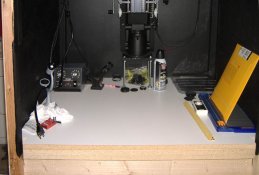
I used 3 layers of 1" melamine coated particle board. I love it.

Neal Wydra

New Enlarger Baseboard.jpg
 
You have all great answers here, and I'm not being snarky. But if you just happen to have a slab of marble or granite... That would make an excellent enlarger base.
 
Why do you want a separate base? Drill a hole in your worktop and fix the enlarger column there.
 
Marble or granite would be great. Maybe a counter shop has some left over pieces for a good price. I used 3/4 birch surfaced cabinet plywood left over from one of my projects. The core is particle board, so warping is very unlikely (it
s been six years since I made it, and all is well). I gave it a couple of coats of good varnish to seal it.
 
Probably anything made for enlargers in the last 30 years has been MDF with a melamine white surface, both sides, likely 1 inch or more thick.
 
Probably anything made for enlargers in the last 30 years has been MDF with a melamine white surface, both sides, likely 1 inch or more thick.

Sometimes with a strip each side of angled metal to minimise bending caused by the constant pressure of the leaning enlarger head.
 
Sometimes with a strip each side of angled metal to minimise bending caused by the constant pressure of the leaning enlarger head.

The OP mention he had a Beseler 23CII-XL and I looked at my Beseler 23CII-XL, which had no such metal and is 3/4inch thick. Nor does my very large Durst 4x5 although it is 1.25 in thick. However, on my Beseler 4x5, the whole frame is attached to angle iron which then attaches to either (3/4 inch thick) wood or MSD, depending on the vintage of the enlarger.
 
You have all great answers here, and I'm not being snarky. But if you just happen to have a slab of marble or granite... That would make an excellent enlarger base.

Any granite counter top finishing company will have a bin of scraps. Plus there's all those sink cutouts.

But drilling it to attach an enlarger column would be difficult (doable, but a pain).
 
I've seen some particle board baseboards warp over time. Plywood may be more rigid. Rather than using really thick plywood, consider two layers of relatively thin plywood separated by a properly designed and glued pattern of wood strips to function much like an I-beam. It can be stiffer than a solid baseboard of equal weight, but thicker.

If the base of the column has a small area of contact with the baseboard, it can compress the wood fibers and cause the column to tilt slightly. A metal plate to distribute the pressure can reduce this.
 
Photrio.com contains affiliate links to products. We may receive a commission for purchases made through these links.
To read our full affiliate disclosure statement please click Here.

PHOTRIO PARTNERS EQUALLY FUNDING OUR COMMUNITY:



Ilford ADOX Freestyle Photographic Stearman Press Weldon Color Lab Blue Moon Camera & Machine
Top Bottom