• Welcome to Photrio!
    Registration is fast and free. Join today to unlock search, see fewer ads, and access all forum features.
    Click here to sign up

B&W Pinhole Reciprocity Question

Forum statistics

Threads
203,248
Messages
2,851,979
Members
101,747
Latest member
Tallphotographer
Recent bookmarks
0

5stringdeath

Member
Allowing Ads
Joined
Feb 10, 2010
Messages
600
Location
St. Louis
Format
35mm
Being a handheld shooter most of my life, I've never had to deal with receiprocity much, although I understand the basic concepts.

So if I shoot 8x10 film in a pinhole, do I have to compensate with exposure or just development? I know for color films you have to do exposure compensation, but I'm confused as to B&W sheet film whether I have to do both or just the decrease in development time.

Thanks.
 
All depends on the length of your exposure, and what type of B&W film you are using.

I suggest testing according to the manufacturer's specs for reciprocity to learn if you like the results. I've had situations where the exposure time is short enough that no reciprocity factor had to be added into the exposure time. With pinhole work each situation, each camera/film combination is a new learning curve. Haven't found "one formula" that fits every situation. Good luck. Test your materials.
 
Dear 5stringdeath,

"do I have to compensate with exposure or just development?"

You must compensate with exposure. Further, you may want to compensate with development, but I find that the change in contrast can be handled in printing. As noted above, start with the manufacturer's recommendations.

Good luck,

Neal Wydra
 
Each film mfr. publishes the info you are after on there web site. On the other hand you can use a system, e.g., BTZS which while using a PDA makes all the necessary adjustments seamlessly . A bit of a learning curve but once you're there LG :smile: ....
 
Type of film is important, yes. Tmax 100 and Acros 100 are very forgiving.
 
Manufacturers reciprocity adjustment numbers are notoriously off the mark. If you do any research, you'll find that adjustment suggestions from most films and most manufacturers are stuck in about 1970.

Newer films typically have less reciprocity failure than stated by Kodak or Ilford, and many now don't require adjustments to development time to control contrast.

See: http://www.willwilson.com/articles/0403Bond_Reciprocity2.pdf for a 2003 article with info on 5 B&W films from a very thorough test.

There are also a number of long and mostly informative threads on reciprocity failure here on APUG if you want to take the time to look.

Lee
 
Lee posted a valuable article. You cannot go wrong with Howard Bond.

As others have said already, reciprocity failure is best compensated through an adjustment in exposure time. Extending the exposure has an affect on contrast, but as Neil said, it's easy to compensate for that during printing, if you use VC papers.

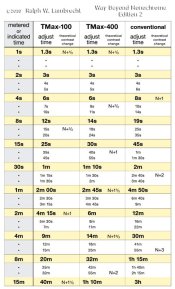
I also like to offer the attached reciprocity table, which is based on data I received from Howard Bond and John Sexton, as well as my own tests.

Feel free to check my website for the pdf version of this file and more exposure aids and pinhole photography tools.

Dead Link Removed
 

Attachments

  • Reciprocity.jpg
    Reciprocity.jpg
    76 KB · Views: 132
Ralph,

Does 'conventional' mean any 'non-tabular' grain film, such as FP4+ and Tri-X?

- Thomas
 
There are also a number of long and mostly informative threads on reciprocity failure here on APUG if you want to take the time to look.

Lee

Yep, thanks, I just read a long and mostly-over-my-head thread but it was helpful. Now I have a place to start and will adjust to the particular camera / film / developer.
 
Ralph,
Would these hold true for Delta 100 & 400? My experience with up to 3sec has been that no adjustment was necessary after comparing the same subject taken with none and with adjusting. Both presented no difficulty printing albeit on Ilford multigrade fb using an Aristo 4500mc lamp.
Jeff
 
Ralph,
Would these hold true for Delta 100 & 400? My experience with up to 3sec has been that no adjustment was necessary after comparing the same subject taken with none and with adjusting. Both presented no difficulty printing albeit on Ilford multigrade fb using an Aristo 4500mc lamp.
Jeff

Yes, they will, but I can mirror your experience.
 
Hi 5stringdeath - I have just posted an article on reciprocity by Phil Davis for our D-Max Newsletter. Please note exposures longer than 1 second, reciprocity begins. Phil Davis loved night photography and I think that is why he did all the reciprocity testing in that article. At all the BTZS workshops Phil and I did together we always did night photography one night of the workshop. To me it was one of the most fun time at the workshop, especially seeing all the well exposed the negatives were.

Fred
 
I am surprised that as long as you guys and I have been on APUG, none of you knows my work on this subject. Look in www.unblinkingeye.com for the article "LIRF is Lurking at Your f-stop." That stands for Low Intensuty Reciprocity Failure.
 
I am surprised that as long as you guys and I have been on APUG, none of you knows my work on this subject. Look in www.unblinkingeye.com for the article "LIRF is Lurking at Your f-stop." That stands for Low Intensuty Reciprocity Failure.

Patrick

Thanks for the reminder.
 
As noted above Fuji Acros has no need for Reciprocity correction for up to 2 minutes and then needs only about 1/3 stop additional. Please check before using because I am relying on memory here. I have used it for up to 40 minute exposures with excellent results. Problem is it is not easily available in 8x10 (it may be available in that size in Japan only) unless I misunderstood your film format.
 
Well I can use either 8x10 or 4x5 but honestly if I'm going to enter the contact printing/LF world I'd rather have the bigger neg :smile:

Thanks for the film info.
 
Hi 5stringdeath

The two best film and developer combinations for long exposures are HP5+ and 400 T-Max-2 (the new one) processed in Ilford DDX film developer. See the article I posted by Phil Davis from the D-Max Newsletter on Reciprocity.

Fred Newman
 
Photrio.com contains affiliate links to products. We may receive a commission for purchases made through these links.
To read our full affiliate disclosure statement please click Here.

PHOTRIO PARTNERS EQUALLY FUNDING OUR COMMUNITY:


Ilford ADOX Freestyle Photographic Stearman Press Weldon Color Lab Blue Moon Camera & Machine
Top Bottom