
• Welcome to Photrio!
    Registration is fast and free. Join today to unlock search, see fewer ads, and access all forum features.
    Click here to sign up

Ascorbate/Pyrocatechin Chemistry

Recent Classifieds

Forum statistics

Threads
202,062
Messages
2,834,549
Members
101,094
Latest member
not_cal
Recent bookmarks
0

Alan Johnson

Subscriber
Allowing Ads
Joined
Nov 16, 2004
Messages
3,384
I made up 3 developers as given in the following formula,except that as developing agent one had sodium ascorbate only,the second had pyrocatechin only and the third was as given.All had 5g Carbonate.

Sodium Ascorbate.......................10g
Pyrocatechin...............................0.2g
Sodium Carbonate anh...................5g
Water to.....................................1L

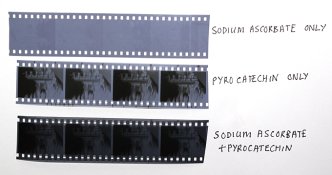
Fomapan 400 was developed 12m 21C ag 10s/min.Resulting negatives are shown in fig 1 attached.

With sodium ascorbate alone there was insignificant development.
Pyrocatechin alone gave a contrasty image with tanning of the emulsion (verified by bleaching in ferricyanide/bromide and fixing to give the relief image).
Pyrocatechin plus ascorbate gave the densest image.There was no tanning.

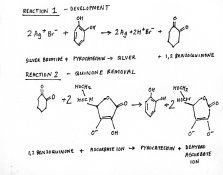
Referring to fig 2,reaction 1 explains development by pyrocatechin.It is the quinone that causes tanning.

How to explain the greater density and lack of tanning with pyrocatechin plus ascorbate?
My explanation is that lack of tanning is due to absence of quinone.This also increases the density by driving reaction 1 to the right.Absence of quinone is attributed to its reaction with ascorbate .It is regenerated to pyrocatechin.Ascorbate is converted to dehydroascorbate.This is shown as reaction 2,fig 2.

Thanks for comment.
 

Attachments

  • CP fig 1.jpg
    CP fig 1.jpg
    214.8 KB · Views: 165
  • CP fig 2.jpg
    CP fig 2.jpg
    183.2 KB · Views: 144

Hologram

Member
Allowing Ads
Joined
Oct 17, 2006
Messages
158
Location
Switzerland
Format
Traditional
For quite a while there's been a pretty popular ultra-fine grain developer (for holographic emulsions) around, based on Ascorbate and Catechol. It's called CWC2. It's a two-part developer:

Part A
Catechol.....................................10g
Ascorbic acid................................5g
Sodium sulfite..............................5g
Urea.........................................50g
Water....................................500ml

Part B
Sodium carbonate.....................30g
Water..................................500ml
 

Ian Grant

Subscriber
Allowing Ads
Joined
Aug 2, 2004
Messages
23,418
Location
West Midland
Format
Multi Format
There's also a version of Sandy King's Pyrocat that uses ascorbic acid instead of Metabisulphite

Pyrocat-MC

Stock A
Propylene Glycol at 150F 750ml
Pyrocatechin 50 g
Metol 2.5g
Ascorbic Acid 4.0g

Stock B
Distilled Water 750 ml
Potassium Carbonate 750 g
Distilled Water to make 1000ml

Typical use is 1 part A + 1 part B + 100 parts water.

Ian
 

Rudeofus

Member
Joined
Aug 13, 2009
Messages
5,119
Location
EU
Format
Medium Format
If you look at the original ascorbate developer patent from Kodak, you'll see that ascorbate is a powerful developer preservative (they used it instead of sulfite with Metol and Phenidone IIRC), so there is a good chance that it restores the Pyrocatechin, too.

@Ian: Once in aqueous solution, what is the difference between ascorbate and ascorbic acid, especially at these alkali carbonate levels?
 

Gerald C Koch

Member
Allowing Ads
Joined
Jul 12, 2010
Messages
8,131
Location
Southern USA
Format
Multi Format
If you wish a staining developer you will have to leave out the ascorbate or keep it at a very low level as it combines with the oxidation products of the pyrocatechin. In this respect it acts like sulfite.

Developers which contain only ascorbate have a very long induction period where no development seems to take place. Pyrocatechin and ascorbate form a super-additive combination and so you should see the most development with this mixture.
 
Last edited by a moderator:

Photo Engineer

Subscriber
Allowing Ads
Joined
Apr 19, 2005
Messages
29,018
Location
Rochester, NY
Format
Multi Format
Alan;

It seems to me that your reasoning is correct. From old data, Ascorbate did decrease oxidation and did react superadditively with other developing agents.

However, your equation as drawn in figure 2 is just an ionization when it must involve a redox reaction to be drawn correctly. To go from the quinone to the hydroquinone is a reduction, but to go to the dehydro ascorbate as drawn, there is only an ionization step.

PE
 
OP
OP

Alan Johnson

Subscriber
Allowing Ads
Joined
Nov 16, 2004
Messages
3,384
PE,
In fig 2 my ascorbate ion has an H attached to its bottom right foot which it loses to react with an O from benzoquinone,hope that will do.

I don't think Photo researchers got around to investigating regeneration of quinones by ascorbate but others have reported some near misses.The link (need to register to read the full free paper) refers to the production of hydroquinone at pH up to 4.87 (I used 10.6) by the reaction of 1,4 benzoquinone with ascorbic acid.
http://pubs.rsc.org/en/content/articlelanding/1997/p2/a701072i/unauth

My developer had about 250 times as much ascorbate as Pyrocat MC but it is not entirely out of the question that shorter development times reported with MC compared with Pyrocat HD might be due to ascorbate acting on quinones.I believe ascorbate makes Caffenol more active as well (I have not tried it),possibly for the same reason.
 

Photo Engineer

Subscriber
Allowing Ads
Joined
Apr 19, 2005
Messages
29,018
Location
Rochester, NY
Format
Multi Format
Alan;

You are correct in theory, but in practice, a covalent bond ph=O is not reduced by H+. H+ is already oxidized and so Asc-OH cannot go to Asc-O- and H- and reduce the ph=O to ph-OH. Hydrogen gas, a strong reducing agent, will do that trick nicely but H" is in the wrong oxidation state.

Someone else chime in here if I am wrong!

PE
 
OP
OP

Alan Johnson

Subscriber
Allowing Ads
Joined
Nov 16, 2004
Messages
3,384
PE,
Thank you for noting this.I think it is needed to register and download the paper in the link to get what is probably the correct version of fig 2, given in the paper as scheme 1, and of course it has to be altered from production of hydroquinone to production of pyrocatechin.It's still reduction of quinone by ascorbate ion though,so my other comments are not changed.
 

Photo Engineer

Subscriber
Allowing Ads
Joined
Apr 19, 2005
Messages
29,018
Location
Rochester, NY
Format
Multi Format
Oh, I agree. Your comments are undoubtedly correct, but the schematic diagram is off a bit. The reaction needs 2e + 2H+ but your scheme has only supplied 2H+.

PE
 
Photrio.com contains affiliate links to products. We may receive a commission for purchases made through these links.
To read our full affiliate disclosure statement please click Here.

PHOTRIO PARTNERS EQUALLY FUNDING OUR COMMUNITY:


Ilford ADOX Freestyle Photographic Stearman Press Weldon Color Lab Blue Moon Camera & Machine
Top Bottom