• Welcome to Photrio!
    Registration is fast and free. Join today to unlock search, see fewer ads, and access all forum features.
    Click here to sign up

ASA developer

man arguing 1972

A
man arguing 1972

  • 2
  • 0
  • 8
Got milk

H
Got milk

  • 0
  • 0
  • 7

Recent Classifieds

Forum statistics

Threads
203,013
Messages
2,848,633
Members
101,598
Latest member
emmes
Recent bookmarks
0

Harold33

Member
Allowing Ads
Joined
Jan 15, 2012
Messages
76
Format
Multi Format
I have some questions about the ASA (American Standards Association) developer used to determine and specify film speeds of black-and-white negative films from the 1940s to the 1960s.

-- what is the exact formula ? It's said to be close to the Adox Standard, but I never saw it ?
-- did anybody tried it with modern films ?

Best regards.
 
Im not actually sure of the answer, but its likely D76. Kodak was king in that time, and D76 is generally their standard developer against which all others are compared in the texts I have read.
 
Im not actually sure of the answer, but its likely D76. Kodak was king in that time, and D76 is generally their standard developer against which all others are compared in the texts I have read.

It wasn't D76 that doesn't give the true ASA/ISO. It was a formula very close to Adox Borax MQ. I have the formula somewhere along with the one used for the DIN standard.

The ASA formula and Adox Boraax MQ work very well with modern emulsions, about 1/3 stop more speed than D76, excellent fine grain, better sharpness and because it's cleaner working excellent tonality.

Ian
 
Last edited by a moderator:
There is no reason to believe that this developer would do any better with pictorial subjects than any conventional developer. It's was designed to measure film speed and was not intended as a general purpose developer. As far as the slight speed increase reported this can be easily obtained with a phenidone based developer.
 
Last edited by a moderator:
I'd like to see some formulas if anyone wishes to post

Did you see this thread?
(there was a url link here which no longer exists)
 
Acufine Substitute

Suggested by Paul Farber in Photographic (Oct 1984).

Distilled water (50°C) …………………………………………… 750 ml
Phenidone ……………………………………………………………………………… 0.28 g
Sodium sulfite (anhy) ……………………………………………… 60.0 g
Hydroquinone ……………………………………………………………………… 5.0 g
Sodium carbonate …………………………………………………………… 2.5 g
Borax ………………………………………………………………………………………… 2.75 g
Potassium bromide ………………………………………………………… 0.9 g
Distilled water to make ………………………………………… 1.0 l

Ilford Autophen

Distilled water (50°C) …………………………………………… 750 ml
Sodium sulfite (anhy) ……………………………………………… 100 g
Hydroquinone ……………………………………………………………………… 5.0 g
Borax (deca) ……………………………………………………………………… 3.0 g
Boric acid …………………………………………………………………………… 3.5 g
Phenidone ……………………………………………………………………………… 0.2 g
Potassium bromide ………………………………………………………… 1.0 g
Distilled water to make ………………………………………… 1.0 l
 
Last edited by a moderator:
There is no reason to believe that this developer would do any better with pictorial subjects than any conventional developer. It's was designed to measure film speed and was not intended as a general purpose developer. As far as the slight speed increase reported this can be easily obtained with a phenidone based developer.

Actually it's close to other formulae in commercial production before the ASA speed system and it's chosen test developer were agreed on, Agfa 44 / Agfa Ansco (GAF) 17 is one of them. As you wrote in another thread 75-80gm per litre Sodium Sulphite is the optimum maximum level. When I used Adox Borax MQ commercially in the 1980's I supplied it to 2 commercial/advertising photographers who felt it was slightly better than D76.

A Phenidone versions would give an increase over Adox Borax MQ, ID-68/Microphen fits into this category, that's 2 steps from D76.

Ian
 
AUTOPHEN

That needs correcting it's the Axford Kendal PQ Fine Grain photo-finishing developer sold by Ilford as Autophen. It's a PQ variant of D76/ID-11 and had two different replenishers one for topping up and the other for bleed systems.

Ian

Ilford AUTOPHEN

Distilled water (50°C) …………………………………………… 750 ml
Sodium sulfite (anhy) ……………………………………………… 100 g
Hydroquinone ……………………………………………………………………… 5.0 g
Borax (deca) ……………………………………………………………………… 3.0 g
Boric acid …………………………………………………………………………… 3.5 g
Phenidone ……………………………………………………………………………… 0.2 g
Potassium bromide ………………………………………………………… 1.0 g
Distilled water to make ………………………………………… 1.0 l
 
Thanks Ian, I've corrected my notes.
 
There is no reason to believe that this developer would do any better with pictorial subjects than any conventional developer (...)

You are certainly right. But I'm curious to see the formula.

I have the formula somewhere along with the one used for the DIN standard (...)

If you could find them, I would be gratefull.
 
Thanks Ian, I've corrected my notes.

It's one of those mistakes from the Photo Lab Index that was perpetuated by countless other US publications. There were a series of articles in the BJP in the late 1950's early 60's that essentially chart the the evolution of Autophen from an early simpler PQ version of D76, the buffering was varied a few times before the final product. The articles were about things like testing effects of bromides, and the exhaustion so that they could design far better replenishment systems.

Microphen must have come from the same research but Ilford claimed that it was an entirely new developer, rather than a simple PQ version of an MQ developer. ID-68 is inter changeable with Microphen.

Microphen was sold in powder form with a replenisher, and in a wide range of sizes (mixed capacity), Autophen was available in larger sizes as a powder or as a liquid developer. Both were available in the same mid sized powder sizes. The recommended developing times were different and Microphen was stated to give an increase on the box speed.

Ian
 
You are certainly right. But I'm curious to see the formula.


If you could find them, I would be gratefull.


My notes say the ASA developer was the same as Adox Borax MQ, however there may have been a slight variation due to weight conversions. (numbers getting rounded up or down.

When the ASA film speed system was being set up there were a few US film manufacturers and all would have had some input. Agfa Asco was by then under Government control, there was also Dupont (who later took over Adox). Presumably there were others.

Ian
 
There is no reason to believe that this developer would do any better with pictorial subjects than any conventional developer. It's was designed to measure film speed and was not intended as a general purpose developer. As far as the slight speed increase reported this can be easily obtained with a phenidone based developer.

It might not be better pictorially, but it's interesting to me to note that it may account for 1/3 stop speed difference when it comes to calibrating a sensitometer.

But if we generally develop in D-76 1:1 instead of the standard ASA developer, wouldn't that mean we are generally losing 1/3 stop speed, and shouldn't we adjust our light meters accordingly?

And as for the standard formula, if that is what one really needs for lab testing purposes, anyone is welcome to know it exactly by paying for the published standard document.
 
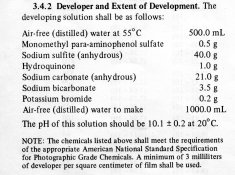
This is the formula from ANSI PH2.5 - 1979.

ASA Dev - 1979.jpg

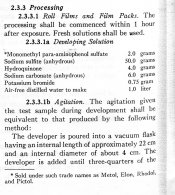
This is the formula for the Fractional Gradient Method as described in the Aug 1943 paper American Standard Method for Determining Photographic Speed and Speed Number, Journal of the Optical Society of America.

Fractional Gradient - Dev - 1943.jpg

BTW, I'd like to see someone substantiate the 1/3 stop speed statement. Let's try to support statements with facts and help reduce the propagation of myths and hearsay.
 
You are certainly right. But I'm curious to see the formula.


If you could find them, I would be gratefull.[/QUOTE
---------------------------------------------------------------

Ian had sent me the following formula for Adox Borax MQ developer a couple of years ago.

Name: Adox Borax MQ


Use/Discription: Prefered over D-76
Additional recommendation: Dilute 1 + 1.5

Mixing Order To make:1 Liter or
Distilled Water 52-c To Make: 750 mL
Metol 2.00 g
Sodium Sulphite (anhyd) 80.00 g
Hyudroquione 4.00 g
Borax 4.00 g
Potassium Bromide 0.50 g

Water to make Liter 1000.00 mL
Dev times are 10-20% longer, but there is a touch more speed 1.3 to 1/2 a stop. Ian
---------------------------------------------------------------------------------------------
 
I sense all the "testanistas" salivating new that the formula has be disclosed. :smile:
 
Last edited by a moderator:
monomethyl p-aminophenol sulfate is what the rest of us call Metol - have I understood that correctly?
 
It's generally forgotten that many years ago, when the ASA system came into existence, roll films, sheet films and plates were routinely developed in faster working and more contrasty developers like D61a, D163 (UK), D72 (US) rather than D76, Adox Borax MQ etc. So it's no co-incidence that the developer Steven Benskin posted from 1943 is close to diluted (roughly 1+1) D61a.

It was my understanding that Adox Borax MQ was very closely related to the ASA developer for "Miniature" films, and the formula Steven posted says it's for testing Roll film & film packs.

Somewhere I have an article (probably in a book) discussing the merits of the ASA & DIN testing methods and listing both formulae.

Ian
 
monomethyl p-aminophenol sulfate is what the rest of us call Metol - have I understood that correctly?

Yes you did, the name is the correct chemical name for Metol or Elon.
 
My notes say the ASA developer was the same as Adox Borax MQ, however there may have been a slight variation due to weight conversions. (numbers getting rounded up or down.

It's true that Adox MQ was used (among others) to control the speed of films. But it's not the same than the ASA dev.
According to Anchell & Troop, FDC , 42, the ASA included carbonate and bicarbonate as buffer.
 
Photrio.com contains affiliate links to products. We may receive a commission for purchases made through these links.
To read our full affiliate disclosure statement please click Here.

PHOTRIO PARTNERS EQUALLY FUNDING OUR COMMUNITY:


Ilford ADOX Freestyle Photographic Stearman Press Weldon Color Lab Blue Moon Camera & Machine
Top Bottom