
• Welcome to Photrio!
    Registration is fast and free. Join today to unlock search, see fewer ads, and access all forum features.
    Click here to sign up

Aquarium circulation pump for print holding bath

Recent Classifieds

Forum statistics

Threads
202,920
Messages
2,847,560
Members
101,535
Latest member
photomorg
Recent bookmarks
2

Mainecoonmaniac

Member
Allowing Ads
Joined
Dec 10, 2009
Messages
6,295
Format
Multi Format
As all of you probably know, California is in a severe drought. I'm wondering if I used a circulation pump in my holding bath for my prints will help in removing fixer from my prints. I usually have a tray siphon with water running to keep the water fresh and help remove some of the fixer. The moving water also helps the prints moving and keep them from sticking together. I wonder if I used a aquarium circulation pump without any running water will help do the same. My final wash is to put my prints in an archival print washer for about 1/2 hour for the final wash. Any thoughts?
 
I don't see where any pumping is necessary, I sold off all my siphons years ago. I can see where you may want to use one if you are making multiple prints, probably a good idea. I use the washing guide for the HCA I purchased, or I follow the Kodak washing instructions in the manual.
 

Attachments

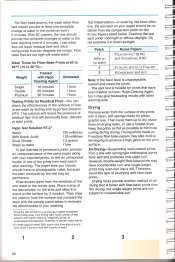
  • 001.jpg
    001.jpg
    440.3 KB · Views: 145
  • 002.jpg
    002.jpg
    390 KB · Views: 159
There is no need for a pump. The water in the bath has momentum and will continue to circulate for some rime when given an occasional swirl. You can prove this with a drop of ink and watching what happens.
 
Disagreeing respectfully with G.C.Koch, I believe (with many others) that elimination of fixer from a print results from two factors:
- ratio (volume of water) / (amount of paper); that fixes the dilution ratio of fixer at equilibrium; but that equilibrium is reached by diffusion, which is promoted by:
- agitation
Continuous flow provides agitation at the expense of large overkill in the renewal of water. See the Ilfod method for negative wash.

Last year I printed a series of photos in 12"x16". I did not feel confident I could maintain proper agitation with 2, 3, or 4 12"x16" prints being washed (not held) in a nominal size tray. Neither would I accept wasting a continuous flow of water during 1 hour. My solution: a 22"x30" industrial storage crate (PVC) sitting on top of my bathtub. Fill with 4" of water; aquarium pump keeps water circling; adjust position so that prints are naturally shuffled.

Full process:
- Holding bath up to 6 prints
- HCA; actually 2% sodium sulfite 5 min, intermittent manual agitation
- 3 times 10min in the plastic crate with the aquarium pump; renewing water each time of course; except water from third wash is good enough for the first wash of next batch.
- Photo-Flo 1:600; squeege, hang to dry
Verified that after 2x10min a blank print passes the HT-2 test; third 10-min wash is for good measure.
 
Correction to my previous message. The beginning of the OP's message mentions a holding bath. In which case I stand corrected: circulation is not useful in a holding bath. But, at the end of same sentence, the OP states "removing fixer from my prints". Which is not the function of a holding bath. And then my suggestion(s) might apply.
 
Agitation with an aquarium pump can't hurt. It may help. So, why not?
 
Holding bath is just for holding

Correction to my previous message. The beginning of the OP's message mentions a holding bath. In which case I stand corrected: circulation is not useful in a holding bath. But, at the end of same sentence, the OP states "removing fixer from my prints". Which is not the function of a holding bath. And then my suggestion(s) might apply.

But I wonder if the prints circulate and not stick together will open up stagnant areas of concentrated fix between prints? :confused:
 
Using a two bath fix I always put prints in a holding tray after fix #1. There they remain, sometimes for two or three days while I finish printing. Fiber or rc, I have never, ever, ever, ever had any problems. I know there have been times that the prints have stayed in the bath for an entire week with no problems. Not ever. Not in drying or sticking or delaminating or toning or mounting. Not ever.

The beauty is, the second fix bath takes a fraction of darkroom time as the first because many prints can be fixed at once (per tray capacity.)

The idea of setting up, printing, fixing, cleaning, drying prints for every session is not realistic for me. And like Bernard said, the purpose of a holding bath is not to remove fixer.
 
But I wonder if the prints circulate and not stick together will open up stagnant areas of concentrated fix between prints? :confused:

If that is a concern, then by all means use the pump to circulate the water. You should change the water every five minutes to remove fixer, this equates a running change. You can always test for residual fixer to be sure what you do is correct.
 
Agitation with an aquarium pump can't hurt. It may help. So, why not?

A concern with an AC device with water in which the worker periodically sticks his hand poses a shock risk. This would depend on the construction of the pump.

As pointed out this is a holding bath and not part of the wash cycle so it really doesn't matter whether there is circulation or not.
 
A concern with an AC device with water in which the worker periodically sticks his hand poses a shock risk. This would depend on the construction of the pump.

As pointed out this is a holding bath and not part of the wash cycle so it really doesn't matter whether there is circulation or not.

Ground fault receptacle. Agreed, if just a holding bath and not part of the wash, then there's no point.
 
Not a substitute for scientific testing, but an easy trick when setting up any new wash system: put food coloring in the water and see how it
moves around, disperses, and hopefully clears.
 
There is a long thread on washing after fixation here on APUG. In it, I have included the differential equations and simple explanation offered by Mason in his text book on photography, drawing from the chapter on the wash process. In the mean time, I have done experiments showing that I can achieve 15" wash with good keeping for over 5 years. My keeping tests are still going. This only works with RC paper. FB paper requires a lot more time.

PE
 
True

Ground fault receptacle. Agreed, if just a holding bath and not part of the wash, then there's no point.

But the whole thread is water conservation. My theory is if the holding is circulating water, there should be less hypo in the print therefore shortening the wash time. To complicate this thread, how about a holding bath with a weak circulating bath of HCA? Before the drought, I used to wash prints for a long time just to make sure the print is well washed. Now I don't have that luxury. :sad:
 
It can't hurt. Just make sure its plugged into a ground fault receptacle.
 
My strategy is simple. Yes I soak the prints in a big tray prior to formal washing in my archival slot washers. But I also use TF4 fixer, and
most importantly, simply hope El Nino will bring us a lot of rain next year!
 
Martin Reed, who used to own for many many years Silverprint - London's leading analogue shop since the 1990s, did a thorough investigation of all matters pertaining to washing prints.

His exhaustive tests are available on the UK analogue website:

http://www.film-and-darkroom-user.org.uk/forum/showthread.php?t=296

http://www.film-and-darkroom-user.org.uk/forum/showthread.php?t=344

Once you have read this, all should be clear about what strategies may be of help to you.

Please do not pass this information on without duly crediting both Martin and the UK analogue website together with Les McLean who collated and published this information of FADU..

Bests,

David.
www.dsallen.de
 
Using a two bath fix I always put prints in a holding tray after fix #1. There they remain, sometimes for two or three days while I finish printing. Fiber or rc, I have never, ever, ever, ever had any problems. I know there have been times that the prints have stayed in the bath for an entire week with no problems. Not ever. Not in drying or sticking or delaminating or toning or mounting. Not ever........

I have had a different experience. Paper left in water for several days had emulsion coming away. Presumably mine was a different paper (Agfa Brovira in the graded paper days).
 
Alright, here is a point to consider.

Any "clearing bath" is a solution of salts that speed up the removal of hypo and silver complexes. As such, you must wash the "clearing bath" OUT of your paper instead of the mix of hypo and silver complexes. This takes less time and less water of course, but if you do a poor job, you can be in just as much of a problem as if you had poorly washed prints with no clearing bath.

Remember, salt in = salt out + any extras. This, as Mason says is dC/dT or the change in concentration with time and that requires flowing or changing water or you leave salts in the print.

PE
 
As all of you probably know, California is in a severe drought. I'm wondering if I used a circulation pump in my holding bath for my prints will help in removing fixer from my prints. I usually have a tray siphon with water running to keep the water fresh and help remove some of the fixer. The moving water also helps the prints moving and keep them from sticking together. I wonder if I used a aquarium circulation pump without any running water will help do the same. My final wash is to put my prints in an archival print washer for about 1/2 hour for the final wash. Any thoughts?
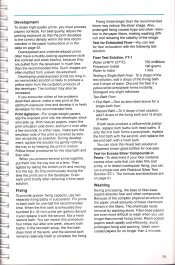
Since washing a photographic print is a soaking out process, five one minute soaks in freshwater will do more good. I had prints tested by a professional chemist and found this to be washing process which removed the fixer residue better than any washer. It is also much more conservation of precious water. A 3- minute run in an "archival" washer does not do as good a job.
 
The hypo laden water tends to sink so a syphon should draw from the bottom of a tray or tank cause the diffusion is two way.
The pueblo people practiced water conservation but had to move and leave their houses...
Our population density v average rainfall is higher than some of the gulf states...
We are getting more than average currently.
The greenhouse effect means a drought may be bad but shorter term ie more erratic weather.
We need both bigger catchments and better run off.
Our politicians are interested in better nuclear weapons.
 
Remember the tests by Ctein (posted on-line) that show some hypo must be present for optimum image stability.

PE
 
If you use FB paper and are worried about water usage then consider RC paper. Today's papers are very, very good.
 
Photrio.com contains affiliate links to products. We may receive a commission for purchases made through these links.
To read our full affiliate disclosure statement please click Here.

PHOTRIO PARTNERS EQUALLY FUNDING OUR COMMUNITY:


Ilford ADOX Freestyle Photographic Stearman Press Weldon Color Lab Blue Moon Camera & Machine
Top Bottom