

• Welcome to Photrio!
    Registration is fast and free. Join today to unlock search, see fewer ads, and access all forum features.
    Click here to sign up

Any clue as to what Aurora 800 actually is or wil be?

Tied to the dock

D
Tied to the dock

  • 4
  • 0
  • 61
Running in the Snow

H
Running in the Snow

  • 1
  • 2
  • 76

Recent Classifieds

Forum statistics

Threads
203,083
Messages
2,849,608
Members
101,651
Latest member
CVR
Recent bookmarks
0

cmacd123

Subscriber
Allowing Ads
Joined
May 24, 2007
Messages
4,336
Location
Stittsville, Ontario
Format
35mm
I checked the home page of Flic Film... https://flicfilm.ca/ and see a banner for "coming soon, Aurora 800." (yes, I habitually check several pages about once a week)

googling the name, I found a Coming soon at https://gosselinphoto.ca/en/aurora-800-color-film-35mm-roll-film-36-exposures-8851999

which has this decription "
Aurora 800 is a fine grained high speed daylight balanced film that produces sharp natural toned images. It can be pushed to ASA 1600 while maintaining shadow and highlight details. An excellent film for long lens, low light or indoor photography.
This film is a purpose manufactured C-41 process film, not a re-purposed cine film.
Available in 35mm plastic non-DX coded cassette
"

Another dealer has https://studioargentique.ca/products/flic-film-aurora-800-color-c41-35mm-36ex

"C-41 800 asa T-grained film produced by a major manufacturer. It is a professional grade film"

Now many folks would like a real 800 ASA colour film. But where is this one from? I am confident that there is not a full scale coating line blooming in Alberta....
 
Either Gold/MAX 800 aka disposable camera film and lomo800, or the manufactured without remjet variant of 500t that cinestill seems to be getting direct from kodak at this point (technically a purpose made film that isnt a cine film, but 500t derived). MAX800 doesn't push that well so might honestly be manufactured-without-remjet vision3 film. Or maybe even kodak has the capabilities of special order producing 500t with a silver anti halation layer?
 
Either Gold/MAX 800 aka disposable camera film and lomo800, or the manufactured without remjet variant of 500t that cinestill seems to be getting direct from kodak at this point (technically a purpose made film that isnt a cine film, but 500t derived). MAX800 doesn't push that well so might honestly be manufactured-without-remjet vision3 film. Or maybe even kodak has the capabilities of special order producing 500t with a silver anti halation layer?

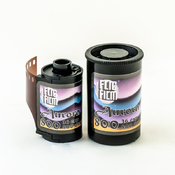
Now that i look at the product page, if the film in the promotional can is the actual film, seems to have an awfully familiar yellow-green emulsion. Would InovisCoat classify as a "major manufacturer"? Can't imagine them really making anything that could be classified as a "professional film" and that wouldn't be coarser than sandpaper at 800. Lomo color '92 represents the current pinnacle of what InovisCoat can make and it's technically speaking worse than ColorPlus and barely has a real speed of 250 iso.
 
Would InovisCoat classify as a "major manufacturer"?

Current InovisCoat is not a manufacturer as long they don't own any production facility. They have a contract coating agreement with Polaroid Film at Monheim.


https://silvergrainclassics.com/en/2023/11/state_of_photochemical_industry_in_2023/ (Orwo chapter)
 
Presumably Kodak Gold 800. It's the stuff they (used to?) put into their FunSaver disposable cameras.
but if Kodak was selling that, would they not insist on also doing the conversion step? the film in the picture seems to be in what are becoming common "snap Together" cassettes.
 
but if Kodak was selling that, would they not insist on also doing the conversion step?

I think Kodak can quite easily be persuaded to leave the finishing to the customer. They, after all, pay the bill...
Moreover, 35mm finishing has long been and perhaps still remains a bit of a bottleneck in production capacity. It's very well possible that Kodak actually found it attractive that the customer would do this themselves.
 
Assuming that the information on Gosselin is correct, then it can't be the 500T variant since aurora would be an 800D film. This is what intrigues me most: that it is an explicitly daylight balanced film which I have only seen from cinema film. Cinestill has produced their own custom daylight balanced film, Cinestill 400D, so perhaps Flicfilm has done something similar here. In any event, I hope that it is a true 800 rated film instead of a 500 rated film that pushes really well. There is a serious lack of highly rated color films, so having a color film that could easily push to 1600 would be wonderful thing to have.
Either Gold/MAX 800 aka disposable camera film and lomo800, or the manufactured without remjet variant of 500t that cinestill seems to be getting direct from kodak at this point (technically a purpose made film that isnt a cine film, but 500t derived). MAX800 doesn't push that well so might honestly be manufactured-without-remjet vision3 film. Or maybe even kodak has the capabilities of special order producing 500t with a silver anti halation layer?
 
My understanding was that that was the case for the 800T and 50D film stocks, but not for the 400D.


It's technically not a motion picture stock and never was due to the lack of remjet. It's just lawyer speak saying that they made the film without remjet, rather than removing the remjet after manufacture like cinestill did in the early days. (now all of cinestills films are manufactured specially in this way and technically arent repackaged motion picture film, you can tell by the fact that it exists in 120 and that the 35mm films have normal sprocket holes. Just because it isn't technically repackaged motion picture film with remjet removed but vision3 custom made without remjet doesn't change the fact that the photosensitive and dye forming layers likely are identical to motion picture vision3.
 
explicitly daylight balanced film which I have only seen from cinema film.

You mean the specific wording? Afaik all still color films in production are daylight balanced as well. I believe tungsten balanced color still films were made as well, historically.
 
I'd take anything Cinestill says with a grain of salt. The firm started as and continues to be a marketing operation and is particularly adept at making statements of... questionable veracity. It's great that they've found a way to get Kodak products into the hands of more photographers but the stance on their films' provenance (and applicable copyrights) only serve to muddy the water, confuse newcomers to film photography, and annoy the people who know better.

As for the origins of Aurora 800, the proof is in the processing. 'Authentic' C-41 still films utilize a silver anti-halation layer ala Kodak's professional line, Fuji C200, XP2 Super, etc.
 
'Authentic' C-41 still films utilize a silver anti-halation layer ala Kodak's professional line, Fuji C200, XP2 Super, etc.

How are you going to see this in/during/after processing? Regardless if it's ECN2 or C41 film, you're still using a similar dev-bleach-fix process. I've processed lots of ECN2 as well as C41 and I've never noticed anything about a silver anti-halo layer and frankly, I wouldn't know what to look for, either. Maybe some excess density if you do bleach bypass, but that gives 'funny' negatives anyway.
 
How are you going to see this in/during/after processing? Regardless if it's ECN2 or C41 film, you're still using a similar dev-bleach-fix process. I've processed lots of ECN2 as well as C41 and I've never noticed anything about a silver anti-halo layer and frankly, I wouldn't know what to look for, either. Maybe some excess density if you do bleach bypass, but that gives 'funny' negatives anyway.

Yeah silver AH layer gets removed by any bleach-fix process including both C41 and ECN2. the presence or absence of it can only really be seen if you bleach bypass the film and the base looks really dark, almost like heavily fogged film.
 
Yeah silver AH layer gets removed by any bleach-fix process including both C41 and ECN2. the presence or absence of it can only really be seen if you bleach bypass the film and the base looks really dark, almost like heavily fogged film.

Both C-41 & ECN-2 stocks form a negative silver image but there is an additional silver AH layer in C-41, E-6, and certain b&w films designated for reversal (Foma R100). You'll get much cleaner results from bleach bypass of ECN-2 than C-41 as a result.

How are you going to see this in/during/after processing?

I often inspect the film in room light after an acid stop bath. The image on the emulsion vs it's visibility from the base side, especially noticeable in color stocks, indicates the manner and degree of anti-halation.
 
IIRC, some colour films use a carey lea silver layer as a yellow filter, under the blue sensitive layer. Perhaps that's what you're talking about?
 
Indeed. I think colloidal silver is used as an anti-halation measure as well, though. The difference might be visible on the film prior to bleaching.

Yes, fix a piece of unprocessed film, then cut in half. Bleach and fix one half and see what the difference looks like.
 
FWIW, Flic is now showing the Aurora as "available" and still with no clue as to the ultimate source. they do make it clear that it is A C-41 film. Film Experience, where I normally buy Flic products has not listed it yet.
 
One store in Canada now has a price of CDN$23.70 a 36 exp roll.

they say "Aurora 800 is a fine grained high speed daylight balanced film that produces sharp natural toned images. It can be pushed to ASA 1600 while maintaining shadow and highlight details. An excellent film for long lens, low light or indoor photography at an affordable price. This film is a purpose manufactured C-41 process film, not a re-purposed cine film."

still no hints at from whence it originates...

or if it has a mask, or what sort of anti-halo if any.
 
they say "Aurora 800 is a fine grained high speed daylight balanced film that produces sharp natural toned images. It can be pushed to ASA 1600 while maintaining shadow and highlight details. An excellent film for long lens, low light or indoor photography at an affordable price. This film is a purpose manufactured C-41 process film, not a re-purposed cine film."

If all that is true, as @real_liiva already said, I can see it being anything else than what is in Kodak disposable cameras (Kodak GT 800-5) and what Lomo CN 800 is.
 
If all that is true, as @real_liiva already said, I can see it being anything else than what is in Kodak disposable cameras (Kodak GT 800-5) and what Lomo CN 800 is.

They just updated the product image and it no longer shows a film with a green emulsion. It is almost certainly Kodak disposable/Lomo 800 film.
 

Attachments

  • DSC_0024.jpg
    DSC_0024.jpg
    332.1 KB · Views: 201
That would be in line with Flic Film's modus operandi of selling cheaper repackaged film. I've been satisfied with their Fomapan.
 
Photrio.com contains affiliate links to products. We may receive a commission for purchases made through these links.
To read our full affiliate disclosure statement please click Here.

PHOTRIO PARTNERS EQUALLY FUNDING OUR COMMUNITY:


Ilford ADOX Freestyle Photographic Stearman Press Weldon Color Lab Blue Moon Camera & Machine
Top Bottom