

• Welcome to Photrio!
    Registration is fast and free. Join today to unlock search, see fewer ads, and access all forum features.
    Click here to sign up

Another Safelight Question.

Recent Classifieds

Forum statistics

Threads
202,985
Messages
2,848,423
Members
101,578
Latest member
Gear_monkey
Recent bookmarks
0

gone

Member
Allowing Ads
Joined
Jun 14, 2009
Messages
5,502
Location
gone
Format
Medium Format
I have a lot of these red LED clip on taillights from my old bikes. Can they be used as darkroom safelights? They're pretty darned bright, but you can disable the individual bulbs one by one in the taillight to get less light.

I'm not real familiar w/ proper red LED safelights, but these are clear when they're off, then give off red light when you give 'em the juice. They appear white in the photo, but it's just how my little digicam captured them. Not sure why the camera didn't "see" that to my eye, the light is totally red, which has me concerned about their usefulness in a darkroom.
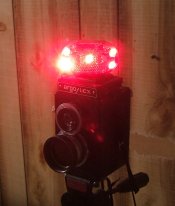
DSCF0248.JPG
 
Last edited by a moderator:
In a completely darkened room, reflect the red LED light off the surface of a CD/DVD disc. Look carefully at the reflected light for any faint bands of non-red color, such as blue or green. If you see any, consider filtering the red LED light through a single layer of red Rubylith graphic arts film. If you don't see any, consider giving them a try in a darkroom without filtration.

Always follow up with a proper pre-flashed paper fogging test, just to be sure.

The brightness level of the correct color of red doesn't matter. Problems arise when incorrect colors are present, usually too faint for the eye to see, but not too faint for the paper to see over the course of a few minutes exposure.

Ken
 
Do a proper safelight test and see if there is any fogging on paper. A couple of layers of rubylith would improve them considerably.
 
For what it is worth, I have tried five different types and brands of those relatively bright (modern) red LED panels and bulbs, and they were all safe at best for 1-2 minutes in my darkroom, some not even for 1 minute, as tested using the Kodak safelight test. They all showed prominent green and blue components using the CD test. I have also run this safelight test in several darkrooms of other photographers, almost universally finding that bare, modern red LEDs are not safe for their papers and working conditions.

However, after filtering and dimming two of those LED panels with a sandwich of two Lee lighting gels, number 019 and 106, I now have a fairly comfortable reddish darkroom light, nowhere near as bright as what it started as, but which is safe with Ilford Warmtone Fibre to 11 minutes, which is more that sufficient for my needs. CD test shows nothing but red and a hint of orange. I've been printing with this safelight for just over two years.
 
Last edited by a moderator:
Ken, I read a description of this technique by Ralph Lambrecht somewhere, which said to flex the CD when looking at the reflection. It would separate the different colors into fringes (similar to a rainbow) and would be easier to identify the unwanted colors. I tried it and it worked just like he described it. Just thought I'd mention it.

Yes, that original suggestion has certainly made its way around.

Note also that the CD/DVD test can be performed on a low pressure sodium sodium vapor safelight, such as the now discontinued Thomas Duplex, or the still available (as far as I know) Sebastian Darkroom Products Model OC-012 safelight.

In every case you will also find faint unwanted bands of blues and greens buried in the otherwise overwhelming brilliant orange of the twin sodium doublet emission lines. Again, too faint to detect with the unaided eye, but still present.

In the LEDs the unwanted colors are the result of various dopants intentionally introduced during manufacture. In the LPS lamps the extra color come from the intentional addition of Penning gases (neon and argon) to facilitate the initial striking of the lamp. These gases cause that weird reddish-purplish glow one sees at the beginning before the sodium has vaporized and begun emitting its characteristic orange.

The bottom line is that no light source is completely photo-safe. They all require some form of filtration to help stretch out the usable "safe" timeframe.

Rubylith is an excellent and inexpensive solution for red LEDs, as it completely blocks the blues and greens, but passes virtually all of the useful red. My filtered 635nm red LEDs have been tested safe beyond 60 minutes for Ilford MGIV.

Ken
 
Last edited by a moderator:
See this thread:

(there was a url link here which no longer exists)

In post #5, there are links to even older, more extensive threads about LED safelights. The bottom line is you have to test! And test properly.
 
Photrio.com contains affiliate links to products. We may receive a commission for purchases made through these links.
To read our full affiliate disclosure statement please click Here.

PHOTRIO PARTNERS EQUALLY FUNDING OUR COMMUNITY:


Ilford ADOX Freestyle Photographic Stearman Press Weldon Color Lab Blue Moon Camera & Machine
Top Bottom
