

• Welcome to Photrio!
    Registration is fast and free. Join today to unlock search, see fewer ads, and access all forum features.
    Click here to sign up

Another look at 50mm

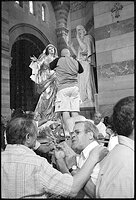
Procession

A
Procession

  • 0
  • 0
  • 18
Millers Lane

A
Millers Lane

  • 3
  • 2
  • 47

Recent Classifieds

Forum statistics

Threads
202,896
Messages
2,847,172
Members
101,531
Latest member
F2_User
Recent bookmarks
0
So many posts online about how the 50mm is not a portrait lens. People can get quite irate about it. Their reasoning is that when you move closer to the subject, you get distortion. Especially headshots. I know myself that full body or American cut looks fine, to my eyes. Besides, what if you liked the distortion? 28 and 35 are regularly used in street photography and up close you get much more distortion but that is part of the look. Distortion can oddly create intimacy. Anyone else notice that?
85mm can look a bit too... perfect.. especially if all you do is shoot at the widest aperture to separate the subject from the background and get nice bokeh.
I know any lens can be used for portraits. I am just interested to hear your thoughts on the 50. If you use it for portraits and how you use it.
adhering to the idea that 'normal' focal length is equal to negative diagonal, normal for 35mm should really be 43mm. That is interestingly a;mostright in the middle between35 and 50mm. Tat may explain why so many folks prefer one or the other. For headshots, I prefer 2-times normal.somy 85 gets a lot of use for that. Other than that 50mm is a very practical all-around focal length and typically economical as well as of excellent optical quality
 
50mm in 35mm system terms is definitely NOT a portrait lens.
Sure, you can use even a 28mm lens if you wish. But all your portraits will always be inproved with a proper lens, which is >85mm.

Before some people who have shot 0.01% of my total body of work get offended, I would like to underline my pedigree, so far:

Over 400 weddings.
Over 10,000 films shot and developpes
Over 10,000 darkroom prints.
Numerous awards
Numerous exhibitions
Numerous publications.

:laugh: I really do hope that people who have shot 100 shots in 4 weddings do not get offended by the above. I also know plenty of very successful and famous wedding photographers who use a standard lens for the vast majority of their shots. Anyways.

So how can you show them they are wrong without soundig like a a'hole because their little feelings are hurt?

I suppose if you start by not considering yourself superior and the other person's feelings "little" might help to not make you sound like that hole.
 
Other than that 50mm is a very practical all-around focal length and typically economical as well as of excellent optical quality
Very much indeed. I don't know if it has been the historical great amount made or a simpler manufacture that makes them more economical.

I never do headhsot portraits thiugh, it's often more environmental, so it does not bother me.
 
A trained eye will always see the extremely annoying distortion a 50mm does to a face.

But I'm not here to teach anyone. The theory behind focal lengths and distance is clear.

The seeing part comes with extensive practice and a sensitivity to see things as they are.
There is a tremendously high percentage of bad photography on the net, all shared by people who think it's good. So how can you show them they are wrong without soundig like a a'hole because their little feelings are hurt?

I simply gave up. Who cares.

Interesting to show all you have done in your career to back up your point. I am surprise you dismissed 50mm totally even for full body. Never heard that before in my life, to be honest. To be convinced I'd rather see scientific evidence or even better great works of art taken by great photographers in history using the 50 for portraits. They do actually exist too. Also, have you totally overlooked the environmental portrait? Why so totally black and white about it? When I started the thread I said that 85 was the norm with experienced people but it looks too ''perfect'' to me sometimes. Have an 85 and have used it and see clearly how perfect it is. You don't need 50 years of experience to see that. I also see that 50 is not so good at head and shoulders but it does create an effect that interests me. If nobody did anything different in art, we would all be cookie cutter photographers.
 
When a photo is good, you can't say the focal length is wrong. It's like saying HCB's photos were blurry.
Exactly. There are no right or wrong lenses for creative photography - production line shots are a different subject. There used to be a lot of jobbing portraiture work around, one step up from passport photography. The subject sat in the same place lit by the same light and shot on a camera at the same aperture and shutter speed. Depending on the size of your studio an 85mm to 105mm lens was fine. So long as the eyes had a catch light and the conk wasn't casting any shadows, the subject went home happy. The only creativity was in the charm of the man pressing the shutter, the rest was farm work.

There's a famous portrait of the industrialist whose factory was responsible, among other things, for making the WW2 gas chambers. He's lit symmetrically with a shadow down the centre and shot on a wide angle lens. He looks like a goat so the photographer got the job done. Takuma Nakahira the famous Japanese "street" photographer favoured a 100mm lens on his Canon F1 when most people were shooting 28's. Whatever gets the job done.
 
I'm only superior in the sheer number of things.
Shooting 250k shots in a year Is superior to shooting only 210K or a measly 30K.

And 400 weddings is superior to 375, for example.

For the feeling of superiority, I wouldn't be so sure. There are days where I wish I wouldn't touch the damned camera. But still, I NEVER make the mistake of distorting someone's face with a 50. Never.


:laugh: I really do hope that people who have shot 100 shots in 4 weddings do not get offended by the above. I also know plenty of very successful and famous wedding photographers who use a standard lens for the vast majority of their shots. Anyways.


I suppose if you start by not considering yourself superior and the other person's feelings "little" might help to not make you sound like that hole.
'm
 
Yes the famous portrait of the Nazi Industrialist in question exactly proves my point: It was so distorted it made him look evil.
The jewish photographer hated the man with a revenge.
The whole point was to destroy the man's face. And the theory/legend behind that photograph is exactly that: use an improper portrait lens for a face you want to destroy.

You hate your wife? Go on with a 50 (or 28) up close and show her your love by taking a few exquisite portraits of her. Then put them on facebook. She'll love you a lot in return.


Exactly. There are no right or wrong lenses for creative photography - production line shots are a different subject. There used to be a lot of jobbing portraiture work around, one step up from passport photography. The subject sat in the same place lit by the same light and shot on a camera at the same aperture and shutter speed. Depending on the size of your studio an 85mm to 105mm lens was fine. So long as the eyes had a catch light and the conk wasn't casting any shadows, the subject went home happy. The only creativity was in the charm of the man pressing the shutter, the rest was farm work.

There's a famous portrait of the industrialist whose factory was responsible, among other things, for making the WW2 gas chambers. He's lit symmetrically with a shadow down the centre and shot on a wide angle lens. He looks like a goat so the photographer got the job done. Takuma Nakahira the famous Japanese "street" photographer favoured a 100mm lens on his Canon F1 when most people were shooting 28's. Whatever gets the job done.
 
Yes the famous portrait of the Nazi Industrialist in question exactly proves my point: It was so distorted it made him look evil.
The jewish photographer hated the man with a revenge.
The whole point was to destroy the man's face. And the theory/legend behind that photograph is exactly that: use an improper portrait lens for a face you want to destroy.

You hate your wife? Go on with a 50 (or 28) up close and show her your love by taking a few exquisite portraits of her. Then put them on facebook. She'll love you a lot in return.
Is there a prohibition on posting the name "Alfried Krupp"?
 
You hate your wife? Go on with a 50 (or 28) up close and show her your love by taking a few exquisite portraits of her. Then put them on facebook. She'll love you a lot in return.
If you make money from traditional portraiture by removing anything that might offend the person paying, then flattening facial perspective is a good idea. That doesn't mean other focal lengths can't be employed to interesting effect. A tiny proportion of professional photographers make their money with film cameras, and a smaller percentage of those do so from the 35mm format. So by and large professional portraits with flat perspective and receding focus shot on 35mm film are not a mainstay of this forum.
 
If you make money from traditional portraiture by removing anything that might offend the person paying, then flattening facial perspective is a good idea. That doesn't mean other focal lengths can't be employed to interesting effect. A tiny proportion of professional photographers make their money with film cameras, and a smaller percentage of those do so from the 35mm format. So by and large professional portraits with flat perspective and receding focus shot on 35mm film are not a mainstay of this forum.

I wholeheartedly agree with this.

If you're shooting 35mm in this day and age you're doing it for fun or art or both.

I shoot what I feel regardless if it's right or wrong. 50mm does fine for portraits for me. Why not? Step back a bit, open the aperture and you got a nice photo. There's no wrong.

Is 80 on a 120 wrong?
 
Guys, we know what a Portrait is.

If you insist that other forms of photography are called portraots, such as "full length", "environmental portraits" and such, than I will insist that War photography be called "war portrait photography" and Sports photography be called "sport portrait photography".

And why not Architecture and Landscape portraiture? I guess they're all portraits.
 
Guys, we know what a Portrait is.

If you insist that other forms of photography are called portraots, such as "full length", "environmental portraits" and such, than I will insist that War photography be called "war portrait photography" and Sports photography be called "sport portrait photography".

And why not Architecture and Landscape portraiture? I guess they're all portraits.
That would mean all photographs of people in the street are street photography. Is all portraiture confined to head and shoulders shots? The National Gallery should be told.
 
Well Why TF are we even having this discussion, then? This validates even a 15mm lens for portrait photography.

What a lousy conversation.
 
Well Why TF are we even having this discussion, then? This validates even a 15mm lens for portrait photography.

What a lousy conversation.
Good conversation. It proved you don't need a short tele to take a portrait.
 
My only problem with the conversation is its "focus" on lens focal lengths.
IMHO, the focal length question is one you address only after addressing the question of your choice of working distance (and the perspective that results from that).
If you are stuck with no lens choices, then the question becomes how best to make use of what you have.
 
Perspective is only created by camera/lens position respective to the subject. Use whatever focal length lens that gives you images you like. You don't have to please anyone but yourself. That's how art works.

It is impossible to prove or disprove an opinion--that's why we have both opinions and facts.
 
Last edited:
I love doing full length with a 35mm equivilant focal length of 32mm. (65mm with my RB67) It definitely distorts! I don't shoot commercially and anyone who wants me to take their portrait wants that look - moderate wide lens with the camera somewhere around thigh high. It elongates the face but mostly makes any limb you throw at it bigger. Typically, it makes the person look tall with more powerful legs and a more slender/slight upper body. Not fisheye style madness, but definitely distorted! Guess I don't have a future in corporate portraiture. :wink:

Oh, and Joel Grimes uses a wide for celebrity portraits all the day long.
 
50 x 2 is real portrait and -15 to 50x2 is also good.
 
adhering to the idea that 'normal' focal length is equal to negative diagonal, normal for 35mm should really be 43mm. That is interestingly a;mostright in the middle between35 and 50mm. Tat may explain why so many folks prefer one or the other. For headshots, I prefer 2-times normal.somy 85 gets a lot of use for that. Other than that 50mm is a very practical all-around focal length and typically economical as well as of excellent optical quality

50mm is kind of in a "sweet spot" for 35mm format from an optical design standpoint. It is difficult to explain, but relates to the relative height of the marginal ray to the required image circle diameter.

-Jason
 
Perspective is only created by camera/lens position respective to the subject. Use whatever focal length lens that gives you images you like. You don't have to please anyone but yourself. That's how art works.

It is impossible to prove or disprove an opinion--that's why we have both opinions and facts.

If you're making portraits as a business, you'd better please the customer, and that usually means lenses in the 80mm to 100mm range (on 35mm format).

As for "proving or disproving" an opinion, an opinion that is indefensible is worthless.
 
[QUOTE="E. von Hoegh, post: As for "proving or disproving" an opinion, an opinion that is indefensible is worthless.[/QUOTE]
Or, more likely, it disagrees with your opinion. Opinions do not require a defense. The level of intolerance in the world today is completely intolerable. We should stamp that out.:D
 
Photrio.com contains affiliate links to products. We may receive a commission for purchases made through these links.
To read our full affiliate disclosure statement please click Here.

PHOTRIO PARTNERS EQUALLY FUNDING OUR COMMUNITY:


Ilford ADOX Freestyle Photographic Stearman Press Weldon Color Lab Blue Moon Camera & Machine
Top Bottom
