
Somewhere around here I have a review from 1954 of the introduction of Tri-X. No mention of a prior sheet film version. I need to do some research to see what the earliest mention of Plus-X I can find is.
-
Welcome to Photrio!Registration is fast and free. Join today to unlock search, see fewer ads, and access all forum features.Click here to sign up
You are using an out of date browser. It may not display this or other websites correctly.
You should upgrade or use an alternative browser.
You should upgrade or use an alternative browser.
ancestors of plus-x?
-
A
- Thread starter pierods
- Start date


Recent Classifieds
-
For Sale 4 vintage 35mm metal film canisters: Ilford, Kodak, Ansco, Adox
- Started by Jon Shiu
-
Sold SOLD! RW Vacuum Fidelity Elite 4x5 (5 units) & 8x10 (4 units) Film Holders
- Started by B.S.Kumar
-
Sold Cable Release Adapters for Leica, Nikon, Yashica, Rollei
- Started by Jon Shiu
-
Free Stoesser Pin Registration Punch
- Started by Roger Thoms
Forum statistics

I think it was available as movie stock from 1938
http://www.cinetech.com/html/stocktimeline.html
Plus X replaced Super X in 1938 both nitrate later they slowly changed to safety film from 1948.
I think the Plus X was introduced in 1955.
Mark
http://www.cinetech.com/html/stocktimeline.html
Plus X replaced Super X in 1938 both nitrate later they slowly changed to safety film from 1948.
I think the Plus X was introduced in 1955.
Mark

FWIW - I just looked at my 1953 negatives. I was using SuperXX and PlusX both having the words safety film on the edge. Seems the nitrate went before then.
The reference:
http://www.cinetech.com/html/stocktimeline.html
doesn't mention TriX as such around 1938 for cine film. Maybe it was there but un-named. Neither does it tell us when they went to safety film with PlusX etc.
Murray
The reference:
http://www.cinetech.com/html/stocktimeline.html
doesn't mention TriX as such around 1938 for cine film. Maybe it was there but un-named. Neither does it tell us when they went to safety film with PlusX etc.
Murray
Murray it clearly states Plux X was introduced in 1938 to replace super X.
I never mentioned Tri x.
Kodak had a policy of slowly changing all their stock from nitrate to safety film from 1948 onwards.
I believe that the 1955 introduction was plus-x-pan.
Mark
I never mentioned Tri x.
Kodak had a policy of slowly changing all their stock from nitrate to safety film from 1948 onwards.
I believe that the 1955 introduction was plus-x-pan.
Mark
- Joined
- Sep 8, 2006
- Messages
- 484
- Format
- 35mm RF
Plus-X was always panchromatic. Verichrome was the last Kodak orthchromatic consumer film.
My 1945 Kodak Films data book has Tri-X, but only in sheet film. It was twice the speed of Super-XX. The other fast sheet film was Super Panchro-Press, Sports type. Same 200 speed in daylight, but like Super Sensitive Pan it was quite red-sensitive, so that it was also 200 speed in tungsten light, where Tri-X fell to 100 speed in tungsten light.
Now, the Tri-X that came out in 1954 was probably a new formulation, probably finer grain so that it would be acceptable in roll film sizes.
My 1945 Kodak Films data book has Tri-X, but only in sheet film. It was twice the speed of Super-XX. The other fast sheet film was Super Panchro-Press, Sports type. Same 200 speed in daylight, but like Super Sensitive Pan it was quite red-sensitive, so that it was also 200 speed in tungsten light, where Tri-X fell to 100 speed in tungsten light.
Now, the Tri-X that came out in 1954 was probably a new formulation, probably finer grain so that it would be acceptable in roll film sizes.

The curve above in post #21 illustrates several points.
1. Kodak's release process for years was D-76 so all data refer to it.
2. The actual 9' curve continues out to a density of at least 3.0 but is not shown.
3. The bump in the 15 minute curve can be due to either a 2 component emulsion blend beginning to break or to a polydisperse emulsion beginning to break.
In addition, I have most Kodak films and curves from the 50s - 60s era and a list of all films available in 1940.
I may get around to posting some of this someday.
PE
1. Kodak's release process for years was D-76 so all data refer to it.
2. The actual 9' curve continues out to a density of at least 3.0 but is not shown.
3. The bump in the 15 minute curve can be due to either a 2 component emulsion blend beginning to break or to a polydisperse emulsion beginning to break.
In addition, I have most Kodak films and curves from the 50s - 60s era and a list of all films available in 1940.
I may get around to posting some of this someday.
PE

Lovely things, them Kodak curves.
Yup. My Handbook for Kodak Tech Reps (1950) has a chart of film notching codes and Super-XX and Tri-XX are there. And Panatomic-X - but no Plus-X, curiously. Must've been only for roll film by then??
Mark Anthony, nothing personal, merely commenting that 'I' couldn't see Tri-X listed on the Kodak site before 1954. Looking at the other columns it is apparent they are referring to 16mm and 35mm films. The juxtapositioning of our posts can be confusing because the last one may not be the one you're replying to. Sorry.
"Mark Antony Murray it clearly states Plux X was introduced in 1938 to replace super X. I never mentioned Tri x."
Murray
Mark Anthony, nothing personal, merely commenting that 'I' couldn't see Tri-X listed on the Kodak site before 1954. Looking at the other columns it is apparent they are referring to 16mm and 35mm films. The juxtapositioning of our posts can be confusing because the last one may not be the one you're replying to. Sorry.
"Mark Antony Murray it clearly states Plux X was introduced in 1938 to replace super X. I never mentioned Tri x."
Murray
Plus-X was always panchromatic. Verichrome was the last Kodak orthchromatic consumer film.
My 1945 Kodak Films data book has Tri-X, but only in sheet film. It was twice the speed of Super-XX. The other fast sheet film was Super Panchro-Press, Sports type. Same 200 speed in daylight, but like Super Sensitive Pan it was quite red-sensitive, so that it was also 200 speed in tungsten light, where Tri-X fell to 100 speed in tungsten light.
Now, the Tri-X that came out in 1954 was probably a new formulation, probably finer grain so that it would be acceptable in roll film sizes.
Well, there you go! Like Johnnie Walker - still going strong. Nearly as old as I am. Thanks for settling that. Plus-X was only halfway thru its life in the 60-70s.
I wonder if the EF Pan is one of the forefathers of TP? Mentions thin emulsion.
Murray
I wonder if the EF Pan is one of the forefathers of TP? Mentions thin emulsion.
Murray
Here is an advert from the Kodak section in the 1940 BJP Almanac.
I don't have the Almanac from 1939, and it does not appear in 1938.
Plus-X advertising also appears in "Popular Photography", July, 1940
but not in 1939.
I wonder if the EF Pan is one of the forefathers of TP? Mentions thin emulsion.
NOW you've gone and done it, Murray !
NOW you've gone and done it, Murray !

Interesting thing from that ad is that Plus-X is only available in 35mm and 828 (the "Bantam" format). In the later years, there was a product called "Plus-X Professional".
In my 1974 Darkroom Dataguide, "Plus-X" is only for 35mm, 70mm, and 3 1/2in rolls.
There are three "Plus-X Professional":
* "Plus-X Professional" in rollfilm and packs
* "Plus-X Professional 2147 (Estar base)" for 35mm and 70mm
* "Plus-X Professional 4147 (Estar thick base)" for sheets and 3 1/2in rolls
Finally there is a "Plus-X Portrait 5068" available in 35mm and 70mm.
In my 1974 Darkroom Dataguide, "Plus-X" is only for 35mm, 70mm, and 3 1/2in rolls.
There are three "Plus-X Professional":
* "Plus-X Professional" in rollfilm and packs
* "Plus-X Professional 2147 (Estar base)" for 35mm and 70mm
* "Plus-X Professional 4147 (Estar thick base)" for sheets and 3 1/2in rolls
Finally there is a "Plus-X Portrait 5068" available in 35mm and 70mm.
The different designations sometimes indicate curve shape, spectral sensitivity and other factors which optimize a film for a given format or use. A good example would be a film intended for portraiture which might be softer in gradation and more tungsten balanced at that time. Most studios used tungsten.
Some films, intended for strobe, had curves balanced for the extremely short exposures by strobe lighting, as the older films had worse reciprocity than modern films.
So, unless you can compare curves and sensitivities etc. of these films it is difficult to speculate nowdays on products gone by.
PE
Some films, intended for strobe, had curves balanced for the extremely short exposures by strobe lighting, as the older films had worse reciprocity than modern films.
So, unless you can compare curves and sensitivities etc. of these films it is difficult to speculate nowdays on products gone by.
PE
Also, in my 1953 Master Photoguide, "Plus-X Panchromatic" is available in rolls, packs, 35mm and 828, but not in sheets. 50 ASA daylight; 40 ASA tungsten.
Re: the 1974 available Plus-X: all have the same ASA in daylight and tungsten of 125, so I guess the differences are based mostly on curve shape and base.
My 1990 copy of the F-5 publication "B&W Films" shows that the Plus-Xes (both pro and not pro) available in 35mm and rolls has a midtones-pronounced curve (like Tri-X 400, for example), whereas the Plus-X Pro available in sheets has an upswept curve (like Tri-X 320).
Re: the 1974 available Plus-X: all have the same ASA in daylight and tungsten of 125, so I guess the differences are based mostly on curve shape and base.
My 1990 copy of the F-5 publication "B&W Films" shows that the Plus-Xes (both pro and not pro) available in 35mm and rolls has a midtones-pronounced curve (like Tri-X 400, for example), whereas the Plus-X Pro available in sheets has an upswept curve (like Tri-X 320).
Michel
I think there is a way to simplify the Plus-X family, it has been consistent over time. Only the 35 & 120 remain in the catalog. There is a lot of the sheet film in my freezer, however.
Plus-X (PX): 35mm
Plus-X Pro (PXP) (120): Same as 35mm, except on a thinner base (to accommodate the paper roll). Has a retouching tooth.
Plus-X / Sheets & 70mm: retouching tooth, and upswept curve, a studio film. I think a different color response than the 35 & 120. As you said, like TX v TXP.
I think there is a way to simplify the Plus-X family, it has been consistent over time. Only the 35 & 120 remain in the catalog. There is a lot of the sheet film in my freezer, however.
Plus-X (PX): 35mm
Plus-X Pro (PXP) (120): Same as 35mm, except on a thinner base (to accommodate the paper roll). Has a retouching tooth.
Plus-X / Sheets & 70mm: retouching tooth, and upswept curve, a studio film. I think a different color response than the 35 & 120. As you said, like TX v TXP.
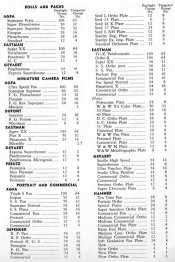
Early document of B&W films
Dear all;
Here is a copy of a document which lists sheet and roll films available world wide in the 1940 - 1941 era.
I hope it helps with this discussion. Remember that the speeds are not current values (ISO) or even ASA.
PE
Dear all;
Here is a copy of a document which lists sheet and roll films available world wide in the 1940 - 1941 era.
I hope it helps with this discussion. Remember that the speeds are not current values (ISO) or even ASA.
PE
Attachments
Plus-X (PX): 35mm
Plus-X Pro (PXP) (120): Same as 35mm, except on a thinner base (to accommodate the paper roll). Has a retouching tooth.
Plus-X / Sheets & 70mm: retouching tooth, and upswept curve, a studio film. I think a different color response than the 35 & 120. As you said, like TX v TXP.
Yes, I think this is logical. What I found interesting and did not notice at first is that there are two 35mm Plus-X. One was on acetate base, sold in cassettes and rolls. The other is sold in long rolls only, on an Estar base. I suspect this might have been for technical or copying applications, in long-rolls cameras. I presume they were the same emulsion.
So there are 2 emulsions, 2 bases, and a variety of formats.
I found the reference to 'thin' emulsion (Kodak EF Pan) interesting. I had always thought of Dr. C. Schleusner and Adox as the man who introduced such films but it must have been an idea brewing widely, as is usually the case. A zeitgeist.
Thanks PE for the pdf. file of films - long forgotten. Probably more manufacturers and variations than one could reasonably be expected to work one's way thru untill you found just the right one for you. I setled on ADOX KB14 and 17 and R14 sliced for the Minolta 16. With that and a Beutler developer I was as happy as Larry.
Murray
Thanks PE for the pdf. file of films - long forgotten. Probably more manufacturers and variations than one could reasonably be expected to work one's way thru untill you found just the right one for you. I setled on ADOX KB14 and 17 and R14 sliced for the Minolta 16. With that and a Beutler developer I was as happy as Larry.
Murray
| Photrio.com contains affiliate links to products. We may receive a commission for purchases made through these links. To read our full affiliate disclosure statement please click Here. |
PHOTRIO PARTNERS EQUALLY FUNDING OUR COMMUNITY:  |