
• Welcome to Photrio!
    Registration is fast and free. Join today to unlock search, see fewer ads, and access all forum features.
    Click here to sign up

Ana's photographic kitchen: Crowdfunding campaign

Dump Truck Hat Trick

D
Dump Truck Hat Trick

  • 0
  • 0
  • 19
Street-Lamp

A
Street-Lamp

  • 2
  • 2
  • 72

Recent Classifieds

Forum statistics

Threads
204,300
Messages
2,866,875
Members
102,218
Latest member
333Ford
Recent bookmarks
0
Joined
Sep 4, 2014
Messages
9
Format
Multi Format
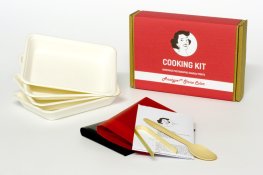
Ana’s Photographic Kitchen has launched a crowdfunding campaign to raise money for the first production of Ana's Photographic Cooking Kit, and for developing an educational kit for schools.

Ana’s Photographic Cooking Kit is a kit for effortless photographic darkroom experience at home. It is based on a new photographic process called Anatype™. This method enables darkroom processing using solely edible ingredients. With it, you can develop silver gelatin paper in a clear solution in less than an hour.

The aim of our product is to introduce analog photography and darkroom techniques to those who are unfamiliar with it, so that the analog photographic field will grow and be preserved.

Contribution and/or by promotion of the campaign would be much appreciated.
You can donate as much (or as little) as you want, get the Anatype™ recipe or Ana’s Photographic Cooking Kit.

More information on Dead Link Removed.
 
"chemical free"?

you do know that everything is made of chemicals don't
you?
 
I think what you are doing is wonderful, but it is certainly not chemical free, nor is it photographic chemical free.

I have and use everything listed below, which is a list of ingredients from your web site, in my darkroom and my kitchen.

Salt = Sodium chloride

Vinegar = Acetic acid

Baking powder = Sodium bi-carbonate

Washing Soda = Sodium carbonate

Vitamin C = Ascorbic acid

I wish you well with the venture, but I do think, asking a school teacher to say we are going to use a chemical free solution, is a bit too much.

Perhaps there is a better way to say what I believe you are trying to say, which is:- user friendly chemistry, or kitchen chemistry.............

Mick.
 
"chemical free"?

you do know that everything is made of chemicals don't
you?
Wot! I refuse to believe that the best Armagnac or Malt Whisky aren't pure and therefore chemical free and thus healthy:D

On a more serious note it might help if we were told what these "harmless" ingredients are. Generally if the OP wants help I would have thought that a more detailed introduction to the idea is warranted

pentaxuser
 
Y'know, it's not that I wish to discourage people being offered new "friendly" ways to do film photography, but this sort of approach just smacks of feeding the anti-science anti-fact pro-stupid narratives that seems to infest the world these days.

"Chemicals = BAD" seems to be the message, without even stopping at the station that says "EDUCATION HERE".

also, I have a cold and I ache all over.
 
You do know that nothing at all is "chemical free" right? Including you and I and everybody on APUG. I agree with pdeeh. "Chemicals = BAD" seems to be the message.

I do applaud your efforts, but please get the message right and don't supply false information.
 
You do know that nothing at all is "chemical free" right? Including you and I and everybody on APUG. I agree with pdeeh. "Chemicals = BAD" seems to be the message.

I do applaud your efforts, but please get the message right and don't supply false information.

By the way, I have a Ph.D. in chemistry.
 
You forgot hydrogen oxide. That's nasty stuff.

Assuming the process uses some of the "household chemicals" suggested by Mick Fagan above, I can't see that there is anything new with the process (salt fixing, acid stop, ascorbic acid dev ? ). There's been at least 150 years of photographic years of research so far, so I guess there's no new miracle processes waiting to be discovered in anyone's kitchen !

I'm more concerned by any implication that regular photographic chemicals are something evil. I made my first contact prints at the age of 7 (with my Dad's encouragement and initial supervision, together with advice on the simple care needed with the dev and fix liquids.). The school Camara Club taught me film processing, enlarging and, eventually, color developing.

We've already lost the use of many photo chemicals through well-meaning but over-enthusiastic "Health and Safety". Yet we can buy and use numerous household products, cleaners (caustic soda for drains?), paints, etc.. Not to mention a certain highly flammable liquid which we put in our cars.....if something similar were used in a lab, we'd need appropriate fire precautions, protective clothing, and probably a government permit !
 
Well, you have my money. I like the idea of making darkroom work accessible, even though you're using photograms and not enlargers or contact copies.
I also like the idea of trays scaled for 10x15cm. Makes it easier to set up when I can fit everything on top of the washing machine :smile: I'll probably go the easy route and use ordinary paper chemicals, though.
 
Last edited:
Ana's photographic kitchen just announced a technique to develop and fix silver gelatin paper shade prints just with edible products. They are working on a "cooking kit" for schools to bring back analogue photography to schools, without the need of a professional equipped darkroom.

I think this is a really great project. Providing unique results for those who love to experiment.
Check it out and support the project campaign on Dead Link Removed.


I really enjoy the idea of introducing the analogue process in a simple way like cooking and think it is worth to support this project to fascinate a future generation for analogue photography.


Here you find an example of print developed by the Anatype(TM) recipe

APK1_LR.jpg


Check it out:
Dead Link Removed
 

Attachments

  • PCK_CONTENT_LR.jpg
    PCK_CONTENT_LR.jpg
    504 KB · Views: 180
Last edited:
  • Toan
  • Toan
  • Deleted
You might be right from the first impression - But it is a process with silver gelatin paper. So it is no exposure in sunlight and no coating of paper. It works with silver gelatin paper. Developer and fixer are prepared with edible products.
 
they'll probably be using salt fixer, which works slowly and not very well
 
very slowly.
and not very well at all
 
You might be right from the first impression - But it is a process with silver gelatin paper. So it is no exposure in sunlight and no coating of paper. It works with silver gelatin paper. Developer and fixer are prepared with edible products.
Isn't silver the most hazardous of the ingredients in the traditional process? If it is "greenness" that one is looking for, why not just do anthotypes?
 
Isn't silver the most hazardous of the ingredients in the traditional process? If it is "greenness" that one is looking for, why not just do anthotypes?
Good point.
But it is mostly meant to be a process which can be done at home or in school, for people who have no darkroom experience at all. Anthotypes are nice of course - and it is a green process - BUT you do not experience the "image-appearing effect" at all. To teach and show analogue photography with silver-gelatin paper it is a really good way I think.
I know this is a forum for analogue photographers, but I think it still can be interesting for some people here, to experiment themselves. And also if there are people beyond us who want to teach the analogue process to young people. Today there is hardly any grandparents and parents around turning their bathroom into a darkroom showing children the analogue way of photography.

I think most people reading this forum have experienced the "image appearing" on their own, and supporting this project we can share this experience with a new generation that will keep film alive.
 
I can still remember watching my first images appear, though I don't remember what the images were. It definitely was a big part of the draw for me at a young age.
 
Welcome to Apug, Ulrike!

The initiator has a week ago started a thread on it:
(there was a url link here which no longer exists)
 
Photrio.com contains affiliate links to products. We may receive a commission for purchases made through these links.
To read our full affiliate disclosure statement please click Here.

PHOTRIO PARTNERS EQUALLY FUNDING OUR COMMUNITY:


Ilford ADOX Freestyle Photographic Stearman Press Weldon Color Lab Blue Moon Camera & Machine
Top Bottom