
• Welcome to Photrio!
    Registration is fast and free. Join today to unlock search, see fewer ads, and access all forum features.
    Click here to sign up

Analog... or silver-based?

Forum statistics

Threads
203,625
Messages
2,857,279
Members
101,936
Latest member
f100r
Recent bookmarks
1
IIRC, Sean chose "Analog" Photographers User Group because it was reasonably distinctive, sufficiently understandable as being distinct from Digital, and because most of the other possibilities were unavailabe :smile:.
It is sort of like Kodak - a phrase (word) chosen to mean something.
 
But Bob I shoot on plates and paper too, and that's not film.... :blink:

I understand, but isn't that closer to antique photography :cool: that was also an obtuse jab at people who are under the impression a digital camera is 100% digital. Being in IT for a few decades, I remember and have worked with a few analog computers as well, both electronic and mechanical ones, (K&E rules). :smile:

BTW, your images are captured with a light sensitive film on a non flexible or opaque backing. Modern photographic film is a light sensitive film coating on a reasonably dimensionally stable flexible backing material.

So film photography still works. :smile: It's all in the daffynitions isn't it. :D
 
I understand, but isn't that closer to antique photography :cool: that was also an obtuse jab at people who are under the impression a digital camera is 100% digital. Being in IT for a few decades, I remember and have worked with a few analog computers as well, both electronic and mechanical ones, (K&E rules). :smile:

BTW, your images are captured with a light sensitive film on a non flexible or opaque backing. Modern photographic film is a light sensitive film coating on a reasonably dimensionally stable flexible backing material.

So film photography still works. :smile: It's all in the daffynitions isn't it. :D

Also, if you really want to warp peoples' minds, tell them that all photography is black and white. It is only through chemistry, dyes, filters and electronics that we can create the illusion that the photograph is in true color. Take out the dye couplers or develop in the wrong chems and you will have a black and white rendition of your subject on supposedly color film. Pull the color filters out of a Technicolor 3-strip camera and you've got nothing. Without the Bayer filter, your digicam is no better at capturing color than Tri-X.

It makes peoples' hair smoke when you tell them it's all just a trick. :wink:
 
With respect to instruction in photography, I agree that one needn't spend money to learn.

My parents put the idea of photography into my cranium at a young age. Each of them taught me what they knew about it that, while not encyclopedic, got me started. I supplemented that instruction with reading to learn more, chiefly from the set of encyclopedias we had, and making mistakes.

The only time I paid money for instruction was a darkroom B&W course in college, whose lessons continue to serve me.

One "tool," if you will, that I use to this day is self-criticism. Any time any photo was bad, I asked myself what went wrong, and figured out what to do in the future to keep it from happening again. In time, the errors diminished, and I now self-critique less frequently. (Of course, I still learn, chiefly new techniques and the like.)

Dieter
 
They also don't understand when you tell them the image from a Bayer filtered device is not a real colour image, but a mathematical approximation of what the lens projected on the image plane. :smile:


Tri-X is good, but I personally prefer Neopan 400, sniff, :sad:

You should read some of the threads on some other forums about Nikon's latest, the hand wringing that the camera can, gasp, out resolve most current lenses, plus Nikon stating that to get the best results you should use a tripod.

Who would'a thunk that the world isn't made up of nice tiny perfectly formed coloured squares. :D


BTW, APUG is a great acronym, thanks Sean.
 
Who said you had to pay to have somebody teach you photography? Neither does it have to be formal, book learning either. :smile:
My first photography teacher was my father. My first photography lesson was when I was ten years old where he handed me a loaded camera and said, "If you break this camera, I'll break you! Now get out of here and don't come back until number in this little window says '36.'"

Further, you're here. Aren't you? APUG counts for something. Doesn't it?
Last I heard, all sorts of traditionally trained photographers were teaching others about photography right here at this forum.

Good point!
 
I simply call it film photography and refer to analog prints as real darkroom prints, never being touched by a computer. I never got a formal education in photography either, was told not to even bother after I showed my portfolio to a well known shooter who was doing a book project that I wanted to assist him with by hauling his gear around. I ended up co-illustrating the book and went on to join his stock agency.

I did take two classes though in 1991 at Moorpark Community College with the prolific John Grey, advanced darkroom techniques and beginning Photoshop using version 2.0.....18 years of using D_g_tal cameras and 21 years in digi period....damn that seems like a long time!
 
Sorry, I am going to be very frank here, If you have time to worry about this, get a hobby. This is like trying to make Snake your new nick name.

Just call me Snake :smile:
 
Well if your just referring to capture on film maybe but then subsequent analog prints could be alternative processes plat/palladium, iron based, etc.

Ian

You are right on the broad spectrum of photographic print making, but as in all (I think) cases the original neg' is silver halide based, even Daguerreotype, so I feel silver based is a good description, better than "maybe"

John
 
Film and electronic should be the names, both systems capture an analog image, the electronic one converts the recorded voltages to digital data after the shutter closes and the electronic device is read.

As it was over 50 years ago I did school chemistry I am open to correction - But doesn't a crystal of silver halide being bashed around by a gang of photons do something with electrons and orbits and things?

I use the terms photography and digiography, in a slightly derogatory tone

However, digiography is superb in many ways, it allows images of cameras and lenses I have for sale to be sent to APUG and LFPF for display

The problem for me with digiography is there are too many pictures made and kept, but this problem is solved every time a computer hard drive crashes and the images disappear in an p'toof of blue smoke

John
 
Ok, to truly warp the digicammers, point out that traditional photography is actually digital, not analog: silver grains are either exposed or not, they are on or off, thus digital. On the other hand, what everyone calls "digital photography" is actually analog - the CCD chip in a digicam is an analog device - it is only after being processed by the internal circuitry that the analog signals from the CCD are converted to a discrete digital approximation.

So, welcome all, to the world of traditional, digital, photography! :tongue:
 
If you want to set a dark mood for your pesky digicammer, remind them: only those of us with fully mechanical cameras (or beer cans and duct tape) will be able to visually document the dystopic future after the apocalypse. And all those computer stored digital images that documented the period from about 1998 to the apocalypse will be gone. Only our metal based images will survive. Bwaaaaa haaa haaa haaaaaaa!
 
If you want to set a dark mood for your pesky digicammer, remind them: only those of us with fully mechanical cameras (or beer cans and duct tape) will be able to visually document the dystopic future after the apocalypse. And all those computer stored digital images that documented the period from about 1998 to the apocalypse will be gone. Only our metal based images will survive. Bwaaaaa haaa haaa haaaaaaa!

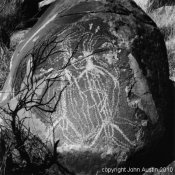
We will be too busy trying to make tools out of old car bodies and wishing we had learned how to fish, hunt and grow food - Then is the problem of making livable shelters from the crap lying around - I doubt if anyone will have time to make cameras, or even chip drawings into rocks

jbaphoto851025C8.jpg

Like this one
 
To keep it simple I just say photography.

To wind things up a bit I say I make pictures out of light-sensitive materials. That's the key, the "out of" bit. It's a unique and infallible test to distinguish photography from all other picture-making processes.

To really rev things up I say there is no such thing as "digital photography" (sic). To merely use the term is a de facto concession that the oxymoron might have real existence. It hasn't. I always say "digital picture-making" and so far in many articles, conversations, and lectures no one seems to be confused about what I mean.

Digital picture-making works quite differently to photography and I'm surprised that it is called by the same name. Perhaps the cause is the "language of the market-place" where things, cameras, software, printers, etc get called "photographic" to maximise sales to people who are ignorant of the difference and just want "pitchers".

Photography is a narrow and technically constrained way of making pictures but it seems to have extraordinary (unwarranted?) prestige. People who have never in their lives made a picture out of light-sensitive materials still crave the title photographer. And some of them get quite bellicose when challenged. It's almost as if they have been caught out in a lie.
 
Last edited by a moderator:
Irony: Those fancy chips in digicams are fabricated using a traditional photographic process (photo lithography).
 
The thing is, the bloke down the road probably doesn't know that film uses silver. One could say 'silver-gelatin', I suppose, but I just say 'I use film', which is good enough for most folk to understand (to numpties it's 'fillum') - if they want more info they'll ask. If I were using plates or paper I'd probably still say 'film' because technically it's still true because the chemicals lie upon a thin film of gelatin or collodion.

I like the sound of 'numérique' though. If I had 'un camera numérique', I might be tempted to say 'It's a trigital camera. It uses zeroes, ones *and* twos! It's the next big thing and it's more betterer than digital!' Imagine the gasps of wonder and amazement! :-D

Cheers,
kevs.
 
Last edited by a moderator:
I now use "chemical photography". I agree that analog is no good as a descriptor, but then again, silver is too confining as well.

I don't understand people's beef with analog.

In pro audio/recording, any non-digital process such as tape or cutting to vinyl is wholeheartedly referred to as analog. Film, silver, chemical development, etc. It's all analog photography.

If it's not using an A/D convertor to transfer one signal source to another, then it IS analog.
 
The word analog rubs me the wrong way because it means that a process that has existed for more than a century and a half is now being named in opposition to something else. I suppose "film photography" is probably clearer to the average person in the street than analog or silver-based photography. In any event, to follow up on a previous poster's comment, fixer by any other name...
 
Analog versus digital far predates digital photography, so don't shun that sort of classification.

As a long time electronics hobbyist, analog is reasonable description of non-digital photography. Film is too (but film can also be part of a hybrid mix, but a subset of people here are the only ones in the whole world to whom that distinction matters).

A vs. D has been in telecom since the late 1950's in telecom (digital T-carrier lines could carry more traffic more distance without loss). Digital music wasn't common till sometime way later. Early computers could be analog or digital. In the lower levels of this, it's not one is inherently better, but one is different and meets a need a new way. People remember analog cell phones; the sound quality was much nicer than the digital ones that replaced them (for better battery life and security.) It's not just music that analog is applied to.
 
The stuff I buy and put in my camera is called "film". I don't buy rolls of analogue. So, "film photography" seems like an appropriate description to me. To name my preferred photographic method by reference to another, later, form, is like expecting a classical musician to call themselves a "non-popular" musician, to signify they don't play "pop music".
 
The stuff I buy and put in my camera is called "film". I don't buy rolls of analogue. So, "film photography" seems like an appropriate description to me. To name my preferred photographic method by reference to another, later, form, is like expecting a classical musician to call themselves a "non-popular" musician, to signify they don't play "pop music".

Okay so running with this we would call digital cameras instead "sensor cameras?" Seems quite specific doesn't it? Yes you don't buy rolls of analog, you buy film that is analog. Implementation vs method.

Analog photography - I have zero issue with it. Further defining what kind within there (film, plate, cyano, etc) is perfectly fine just the same as people talking about their CMOS and CCD sensors.
 
Photrio.com contains affiliate links to products. We may receive a commission for purchases made through these links.
To read our full affiliate disclosure statement please click Here.

PHOTRIO PARTNERS EQUALLY FUNDING OUR COMMUNITY:


Ilford ADOX Freestyle Photographic Stearman Press Weldon Color Lab Blue Moon Camera & Machine
Top Bottom