
-
Welcome to Photrio!Registration is fast and free. Join today to unlock search, see fewer ads, and access all forum features.Click here to sign up
You are using an out of date browser. It may not display this or other websites correctly.
You should upgrade or use an alternative browser.
You should upgrade or use an alternative browser.
AMMONIUM CHLORIDE
-
A
- Thread starter PDL45
- Start date



Recent Classifieds
-
For Sale Berning Robot lenses and accessories
- Started by Manual Camera
-
For Sale Berning Robot Motor Recorder 24B + Schneider Xenon 50/1.9 _ rare German camera
- Started by Manual Camera
-
For Sale FS: Toyo Long Loupe 3.6X
- Started by B.S.Kumar
-
For Sale Berning Robot II + Carl Zeiss Jena Tessar _ vintage German motor drive 35mm camera
- Started by Manual Camera
Forum statistics
removedacct1
Member
Ammonium chloride is used for making salt POP paper.
mshchem
Subscriber
There's old Kodak formulas, F8 is one. Ammonium Chloride is very hygroscopic. Difficult to weigh, you would need to buy other chemicals.What is Ammonium Chloride used for? Is it for mixing a rapid fixer bath? If so, does anyone have a formula they would like to share? I have 95 grams & would like to use it. Thanks for your help.
mshchem
Subscriber
BTW that's about 90 cents worth of ammonium chloride
RPC
Member
- Joined
- Sep 7, 2006
- Messages
- 1,633
- Format
- Multi Format
Here are some threads relating to this topic:
https://www.photrio.com/forum/threads/rapid-fixer-without-ammonium-thiosulfate.102211/
https://www.photrio.com/forum/threa...stitution-for-potassium-metabisulfite.147271/
https://www.photrio.com/forum/threads/ammonium-hypo-from-sodium-hypo-and-ammonium-chloride.168053/
https://www.photrio.com/forum/threads/rapid-fixer-without-ammonium-thiosulfate.102211/
https://www.photrio.com/forum/threa...stitution-for-potassium-metabisulfite.147271/
https://www.photrio.com/forum/threads/ammonium-hypo-from-sodium-hypo-and-ammonium-chloride.168053/

grainyvision
Subscriber
It's biggest known use is for making POP emulsions, salt prints, and other alt-process work. I've successfully used it for formulating a special warm brown tone print developer that works on modern papers... but otherwise I'm unsure of any other use. In alkali solution it'll quickly turn smelly (of ammonia)


I would say the main use is to speed up Sodium Thiosulfate based fixers. If you do not have a stash of cheap Sodium Thiosulfate, a scale and the will to mix your own fixer, then it probably won't do much for you. The same thing applies to salt prints: if you don't have all the other ingredients to pursue this, then Ammonium Chloride is an unlikely reason to do it anyway.
Since it lasts forever and poses no immediate danger, I would store it in some jar until a need arrives. If it's in your way, use it instead of rock salt to get the ice&snow off your side walk.
Since it lasts forever and poses no immediate danger, I would store it in some jar until a need arrives. If it's in your way, use it instead of rock salt to get the ice&snow off your side walk.

juan
Subscriber
I use it as the salt in my albumen prints.
Actually the first use that comes to my mind is as deoxidizer insoft-soldering. Actually it takes off the complete Metal Oxide, not just the Oxygen. But only to be used for mechanical soldering, where the part and the surrounding can be cleaned afterwards. Do not use it for electronic soldering.

relistan
Member
I bought it to mix up @Rudeofus 's fixer: https://www.photrio.com/forum/resources/a-neutral-quick-fixer-formula.357/ using the big jar of sodium thiosulfate I already have.
removed account4
Subscriber
- Joined
- Jun 21, 2003
- Messages
- 29,810
- Format
- Hybrid
I’m going to use some to make retina prints

glbeas
Member
As a side note it has the interesting property of turning to vapor when heated which will condense on nearby cooler surfaces. I think it dissociates into ammonia and hydrochloric acid which recombines upon cooling.

bnxvs
Member
I use it like this:
- Sodium Thiosulfate - 200g
- Ammonium Chloride - 86g
- Water to make 1 liter
- Sodium Thiosulfate - 200g
- Ammonium Chloride - 86g
- Water to make 1 liter
Alan Johnson
Subscriber
- Joined
- Nov 16, 2004
- Messages
- 3,456
https://www.photrio.com/forum/threads/ammonium-hypo-from-sodium-hypo-and-ammonium-chloride.168053/
Of the formulae given in post 5 in the link I mixed Agfa 304 but found it became cloudy after one film, probably due to the deposition of sulfur at the rather acidic pH.
So it may be better than 304 to go with one of the formulae that has a higher pH, I did not try it.
Of the formulae given in post 5 in the link I mixed Agfa 304 but found it became cloudy after one film, probably due to the deposition of sulfur at the rather acidic pH.
So it may be better than 304 to go with one of the formulae that has a higher pH, I did not try it.

Murray Kelly
Member
With Iron Chelate (from the garden section) and pH adjustment with ammonia it makes a cheap bleach. Difficult to get the usual ingredients here (Australia)
relistan
Member
With Iron Chelate (from the garden section) and pH adjustment with ammonia it makes a cheap bleach. Difficult to get the usual ingredients here (Australia)
This is presumably a rehalogenating bleach since there is chloride? Do you use this in place of e.g. ferricyanide bleach?

Trask
Subscriber
Add it to your developer! Per "The Nikon Manual - A Complete Handbook of 35mm Technique" (1957) page 283: Chemical-Physical D-76: The addition of 1 1/2 oz. per quart (40 grams/liter) ammonium chloride causes D-76 to behave partly as a physical developer: silver dissolved from the emulsion by the sodium sulfite is redeposited on the developing image as exceedingly minute particles and the (medium-speed film) negative will be virtually grainless. Reduce preferred E.I. settings on page 276 by 50%, increase development to twice normal."
I've attached a couple of photos developed per the above guidance. The bicycle photo was shot with a Minolta w/85mm f/1.7 lens on Arista Premium 400 (Tri-X) at ISO 200. The store and the newsstand were, I believe, shot with a Nikon FM2 on Arista Premium 400. The photo of the church was shot with a Canon T90 w/28mm lens on Efke 100 rated at ISO 40.


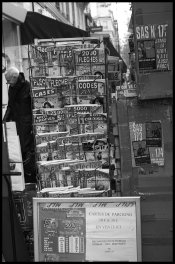

I've attached a couple of photos developed per the above guidance. The bicycle photo was shot with a Minolta w/85mm f/1.7 lens on Arista Premium 400 (Tri-X) at ISO 200. The store and the newsstand were, I believe, shot with a Nikon FM2 on Arista Premium 400. The photo of the church was shot with a Canon T90 w/28mm lens on Efke 100 rated at ISO 40.
Murray Kelly
Member
Yes. I got the basic idea from Crawley (the soium salt) and it works fine.It does work with KBr but it was out of stock so I tried this combo.This is presumably a rehalogenating bleach since there is chloride? Do you use this in place of e.g. ferricyanide bleach?

Anon Ymous
Member
Depending on the composition of the iron chelate, it can be remarkably close to E6 and early C41 bleach. Substitution of ammonium chloride with bromide will get you an almost identical bleach if it is EDTA based and pH is corrected.This is presumably a rehalogenating bleach since there is chloride? Do you use this in place of e.g. ferricyanide bleach?
Murray Kelly
Member
In the BJP Annual 1975 the formula for Kodacolor II bleach isDepending on the composition of the iron chelate, it can be remarkably close to E6 and early C41 bleach. Substitution of ammonium chloride with bromide will get you an almost identical bleach if it is EDTA based and pH is corrected.
Sequestrine Na Fe ...... 100g
KBr ......50g
Ammonia 20% 6ml
Water to 1L
pH 5.9 - 6.1 4m20sec @38C +-3C
I use strong household ammonia (cloudy) and the Manutec iron chelate is the cheap EDTA sodium salt at USD10 for 300g.
I substituted NH4Cl for the KBr and I think it is faster .
As an aside, Copper sulfate and Ammon Chloride would make a good rehalogenating bleach too. In this case a substitute for NaCl.
Last edited:
relistan
Member
Depending on the composition of the iron chelate, it can be remarkably close to E6 and early C41 bleach. Substitution of ammonium chloride with bromide will get you an almost identical bleach if it is EDTA based and pH is corrected.
In the BJP Annual 1975 the formula for Kodacolor II bleach is
Sequestrine Na Fe ...... 100g
KBr ......50g
Ammonia 20% 6ml
Water to 1L
pH 5.9 - 6.1 4m20sec @38C +-3C
I use strong household ammonia (cloudy) and the Manutec iron chelate is the cheap EDTA sodium salt at USD10 for 300g.
I substituted NH4Cl for the KBr and I think it is faster .
As an aside, Copper sulfate and Ammon Chloride would make a good rehalogenating bleach too. In this case a substitute for NaCl.
This is pretty interesting. I also started to wonder a bit because it contains ammonia. I was thinking of @Athiril 's copper sulfate B&W reversal bleach where he leverages the different solubility of silver chloride and silver bromide in ammonia. Silver chloride is soluble in concentrated ammonia, but silver bromide and silver iodide are not. "concentrated" turns out not to be all that concentrated: 2% household ammonia apparently works (I have not done it). I guess in this bleach the ammonia is not concentrated enough to dissolve the silver chloride. Or maybe a little does dissolve? Anyway thanks for sharing, I learned some stuff and have some things to think about.
relistan
Member
Add it to your developer! Per "The Nikon Manual - A Complete Handbook of 35mm Technique" (1957) page 283: Chemical-Physical D-76: The addition of 1 1/2 oz. per quart (40 grams/liter) ammonium chloride causes D-76 to behave partly as a physical developer: silver dissolved from the emulsion by the sodium sulfite is redeposited on the developing image as exceedingly minute particles and the (medium-speed film) negative will be virtually grainless. Reduce preferred E.I. settings on page 276 by 50%, increase development to twice normal."
I've attached a couple of photos developed per the above guidance. The bicycle photo was shot with a Minolta w/85mm f/1.7 lens on Arista Premium 400 (Tri-X) at ISO 200. The store and the newsstand were, I believe, shot with a Nikon FM2 on Arista Premium 400. The photo of the church was shot with a Canon T90 w/28mm lens on Efke 100 rated at ISO 40.
View attachment 264078 View attachment 264079 View attachment 264080View attachment 264083
Very cool! Will try.
Regular E-6 bleach contains Ammonium Ferric EDTA and either Ammonium Bromide or Potassium Bromide, so obviously the Ammonium does not hurt. It also does not hurt, if some of the silver gets dissolved in the bleach, in fact PE once mentioned, that the best bleaches are weak BLIXes.This is pretty interesting. I also started to wonder a bit because it contains ammonia. I was thinking of @Athiril 's copper sulfate B&W reversal bleach where he leverages the different solubility of silver chloride and silver bromide in ammonia. Silver chloride is soluble in concentrated ammonia, but silver bromide and silver iodide are not. "concentrated" turns out not to be all that concentrated: 2% household ammonia apparently works (I have not done it). I guess in this bleach the ammonia is not concentrated enough to dissolve the silver chloride. Or maybe a little does dissolve? Anyway thanks for sharing, I learned some stuff and have some things to think about.
I am surprised, though, that the chloride ion is enough of a counter anion to make bleaching complete. Bromide anion would shift the chemical balance much further towards the right side, because Silver Bromide is much less soluble than Silver Chloride.
@Murray Kelly : can you tell us, how long you have to bleach C-41 and E-6 stock to get full bleaching?
| Photrio.com contains affiliate links to products. We may receive a commission for purchases made through these links. To read our full affiliate disclosure statement please click Here. |
PHOTRIO PARTNERS EQUALLY FUNDING OUR COMMUNITY:  |