
-
Welcome to Photrio!Registration is fast and free. Join today to unlock search, see fewer ads, and access all forum features.Click here to sign up
You are using an out of date browser. It may not display this or other websites correctly.
You should upgrade or use an alternative browser.
You should upgrade or use an alternative browser.
Amber Glass Bottles
-
A
- Thread starter Rinthe
- Start date

Recent Classifieds
-
For Sale Mint Nikon Lenses
- Started by Barlow
-
For Sale 3 Mint Nikon D2X Camera Bodies
- Started by Barlow
-
For Sale Minolta SR Extension Tube Set
- Started by Jon Shiu
-
For Sale Job Lot of Out of Production B&W Paper - UK only.
- Started by Gary Holliday
-
Sold Rollei RPX 135-36
- Started by Roger Thoms
Forum statistics

I guess you are all missing the point of my post.
Amber glass bottles are NOT NEEDED. A darkroom is sufficiently dark to keep your developers safe in ordinary glass or heavy plastic. So, why waste money?
PE
Amber glass bottles are NOT NEEDED. A darkroom is sufficiently dark to keep your developers safe in ordinary glass or heavy plastic. So, why waste money?
PE

Sparky;
Unless your darkroom is light at least 8 hours per day and uses a lot of UV, there is NOTHING in a developer solution that is overly light sensitive. You would have to BLAST it with high intensity light to cause a problem with keeping the developer around.
The big problem is AIR. Oxygen and Carbon Dioxide are your enemies.
PE
Exactly. I think you're paying too much attention to the 'amber' part of it - and not to the 'glass' part of it. Clear glass would work just as well, I'm sure. I think my experiences with plastic has been with 'too cheap, too thin' stuff.

I guess you are all missing the point of my post.
Amber glass bottles are NOT NEEDED. A darkroom is sufficiently dark to keep your developers safe in ordinary glass or heavy plastic. So, why waste money?
PE
My darkroom doubles as a laundry room. On an ordinary day, the room gets lots of light from a window. In my case, the brown bottles preserve my chemicals.
My darkroom doubles as a laundry room. On an ordinary day, the room gets lots of light from a window. In my case, the brown bottles preserve my chemicals.
Ok people, ante up. Show me a photo textbook that illustrates a photolytic reaction with a developer that does not take blasting with UV or sunlight!
We used clear glass and thick plastic bottes with corks or screw caps to store our developers. Our lab storage areas were brightly lit with fluorescent lights for 8 hours / day. There was NO PROBLEM.
PE
OP
OP

Ok people, ante up. Show me a photo textbook that illustrates a photolytic reaction with a developer that does not take blasting with UV or sunlight!
We used clear glass and thick plastic bottes with corks or screw caps to store our developers. Our lab storage areas were brightly lit with fluorescent lights for 8 hours / day. There was NO PROBLEM.
PE
Amber is $1.86, clear is $1.80. I can spend $0.06 more for the darker one. Plus it looks better than clear imo
Yep, and it is harder to make sure that it is clean of grunge next time you want to use the amber bottle.
And, you cannot see clearly if there are suspended particles or if the solution is all completely dissolved of particulate matter. If it has gone bad, you cannot see if it has discolored.
BTDT.
Buy 10 clear bottles and save the 60 cents for your next roll of film.
PE
And, you cannot see clearly if there are suspended particles or if the solution is all completely dissolved of particulate matter. If it has gone bad, you cannot see if it has discolored.
BTDT.
Buy 10 clear bottles and save the 60 cents for your next roll of film.
PE
I use wine bottles, but not for the green glass. I use Vacuvin stoppers and the pump they come with to pump out some of the air. The resulting partial vacuum makes a good seal. Developer is a reducing agent, and as PE has already said, you want to keep it away from oxygen in the air. This might be overkill, but the stoppers were cheap and have lasted for years.
Mark
Mark

The big problem is AIR. Oxygen and Carbon Dioxide are your enemies.
PE
Would something like 'finish preserve' (argon) http://www.leevalley.com/wood/page.aspx?c=1&p=30268&cat=1,190,44133&ap=1
be suitable for displacing air in containers?
I've used this stuff when recapping varnish etc., tins, and it does the trick.
Personally, I'm using some old lab amber bottles, some apothecary style glass-stoppered ones that I inherited (very cool looking!), and Nalgene water containers.

Valerie
Subscriber
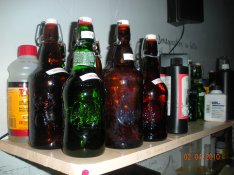
I use Grolsch Beer bottles that are dark green with rubber stopper "flip top" caps....and besides I get to drink the beer first!! They also come in a variety of sizes. cheers!
Another vote for the Grolsch bottles. If you can find Fischers' beer, the bottles are a little larger and brown.
Party anyone?
Attachments
Would something like 'finish preserve' (argon) http://www.leevalley.com/wood/page.aspx?c=1&p=30268&cat=1,190,44133&ap=1
be suitable for displacing air in containers?
I've used this stuff when recapping varnish etc., tins, and it does the trick.
Personally, I'm using some old lab amber bottles, some apothecary style glass-stoppered ones that I inherited (very cool looking!), and Nalgene water containers.
Finish Preserve is Argon gas and is very well suited to preserving Developer in any type of container!
PE

Exactly...I keep my dektol in a clear glass jar and I can easily see if it's getting a bit too dark brown even for proof prints. If the bottle was brown, I wouldn't be able to tell.Yep, and it is harder to make sure that it is clean of grunge next time you want to use the amber bottle.
I like the wire-bail beer bottles because one can't lose the lids, but it's difficult to pour back into them without a funnel, so I've been transitioning to wide-mouth salsa bottles for print chemistry.
Also I have never found a good 2L glass container, so I'm storing my D23 in PET cranberry juice bottles. No problem so far, but the inside of the plastic gets a strange dirt-like coating on it after a couple months. I never noticed this forming on glass bottles. You can wipe it off; it really looks like dirt and forms an even coating on the inside of the bottle. I threw out my last batch out of caution, but it happened with my current 3 month old batch too. The developer seems to work fine still but it's a bit puzzling.
OP
OP
ah alright, i think i'll get the clear ones then!
Speciality bottle, as mentioned by others in this thread, is the best place to buy amber bottles. They have it in all sizes up to 32oz and the prices are not that high.


I'm going to place a large order at the end of this week for about 40 bottles. 5 each 16 and 32 ounce and 10 each 1, 2, and 4 ounce. I figure that adding more bottles doesn't really up my shipping much and it isn't like they expire. This way I have enough for if I decide I really like this alternative process junk and I want to try others.  I got amber, but I know I could get clear for the developers...I just like the look of amber better.
I got amber, but I know I could get clear for the developers...I just like the look of amber better.
Thanks PE for crushing this old "amber" myth that lives too well! Clear bottles indeed are so much better because you can see the color of the liquid and if there's any crud.
Now, I would like to know if PET plastic bottles "breathe". I would say; NO. If they would, it would also be problematic to store soft drinks for a year or so. AFAIK, thin LDPE is problematic, but thicker HDPE bottles as well as PET bottles (even the thinner ones) should be as good as glass. After all, almost all photo chemistry is sold in HDPE bottles.
I might be wrong but if I am I would like to have it proved to me.
When air is your enemy, many people think that plastic bottles breathe too much and use glass bottles; trapping much more air in the bottle than the plastic bottle (than can be squeezed tightly) would ever breathe. I've also found in my simple, controlled experiment that it's not easy to displace all the air with a preservative spray gas without proper equipment. Squeezing the plastic bottle or adding marbles to glass bottle is definitely more reliable.
Now, I would like to know if PET plastic bottles "breathe". I would say; NO. If they would, it would also be problematic to store soft drinks for a year or so. AFAIK, thin LDPE is problematic, but thicker HDPE bottles as well as PET bottles (even the thinner ones) should be as good as glass. After all, almost all photo chemistry is sold in HDPE bottles.
I might be wrong but if I am I would like to have it proved to me.
When air is your enemy, many people think that plastic bottles breathe too much and use glass bottles; trapping much more air in the bottle than the plastic bottle (than can be squeezed tightly) would ever breathe. I've also found in my simple, controlled experiment that it's not easy to displace all the air with a preservative spray gas without proper equipment. Squeezing the plastic bottle or adding marbles to glass bottle is definitely more reliable.
2 liter PET soft drink bottles are pressure vessels that will hold 75psi for months on end, I don't think they breathe much at all. D76 stock mixed with distilled water remains water white after being stored in one for 12 months, RA4 dev easily keeps for 2 months or longer in 2 liter or 500ml thin wall water bottles, what more could you ask for.
D76 stock mixed with distilled water remains water white after being stored in one for 12 months, RA4 dev easily keeps for 2 months or longer in 2 liter or 500ml thin wall water bottles, what more could you ask for.
- Joined
- Dec 10, 2009
- Messages
- 6,295
- Format
- Multi Format
Some pharmacys throw them out so they might be had for free.
I've also found in my simple, controlled experiment that it's not easy to displace all the air with a preservative spray gas without proper equipment. Squeezing the plastic bottle or adding marbles to glass bottle is definitely more reliable.
The gas only makes a super thin barrier to air ingress on the surface of the developer or what-have-you in the bottle. It spreads itself out automatically. You don't need to fill the bottle with it. There's still 'air' inside the bottle - it just cannot get to the chems...
The gas only makes a super thin barrier to air ingress on the surface of the developer or what-have-you in the bottle. It spreads itself out automatically. You don't need to fill the bottle with it. There's still 'air' inside the bottle - it just cannot get to the chems...
This is just what I proved to be a myth. I made four samples: first one was a completely squeezed PET bottle, second one had quite a lot of gas, third one had considerably less gas and the fourth had no gas. Then they were untouched for a month. I used butane. Heavier than air, it should work well as you say.
The squeezed one survived clearly best. There was a great difference between "much gas" and "less gas" samples, which proves my point that it does NOT work like you say. And, last, the one with no gas was the worst.
The results were surprisingly distinct. I measured the density of developed film, but the same results could also be seen in the color of the solution. It was a nice series from clear to yellow with two "midtones" on these four samples. RGB values from scanned film tests were; 56 (squeezed bottle), 63 (much butane), 72 (less butane), 76 (no butane).
The same test also revealed that refrigerating at +5C even with no gas was much better than gas at room temp, as good as squeezing the bottle. Squeezing the bottle and storing at a reduced temperature (but not too low not to precipitate things; +10C is probably completely safe) is ultimate.
Last edited by a moderator:
Glass Boston Rounds
Many sources via Google. Boston Rounds are a standard
for chemical storage. A variety of caps are available.
Wide and narrow mouth. Colorless or amber the
glass is clear; easy content and cleanliness
checks. Sturdy and inexpensive. Dan
I'm trying to find these glass bottles for storing my
developer. Can't find them anywhere.
Many sources via Google. Boston Rounds are a standard
for chemical storage. A variety of caps are available.
Wide and narrow mouth. Colorless or amber the
glass is clear; easy content and cleanliness
checks. Sturdy and inexpensive. Dan
I used butane. Heavier than air, it should work well as you say.
I wouldn't expect Butane to work. It's not inert. It will combine to some degree with your soup. The reason they use a noble or inert gas is because it's ions have zero net valence. So no electron action at all... no mixing, no reaction.But anyway- we're all just splitting hairs here. I'm sure if you used the right kind of plastic - it would work fine. It's just that the problem is that there's a LOT of low grade plastic out there unsuitable for any solution, even of a neutral pH...
| Photrio.com contains affiliate links to products. We may receive a commission for purchases made through these links. To read our full affiliate disclosure statement please click Here. |
PHOTRIO PARTNERS EQUALLY FUNDING OUR COMMUNITY:  |