• Welcome to Photrio!
    Registration is fast and free. Join today to unlock search, see fewer ads, and access all forum features.
    Click here to sign up

Amateur Question Re: B&W Night Pics

Recent Classifieds

Forum statistics

Threads
201,723
Messages
2,829,124
Members
100,913
Latest member
J Holga
Recent bookmarks
0

bobwysiwyg

Subscriber
Allowing Ads
Joined
Mar 28, 2008
Messages
1,627
Location
Ann Arbor, M
Format
Multi Format
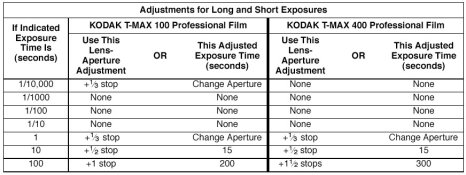
Recently returned to analog photography. The wife and I are heading up to the U.P. (Michigan) for a vacation. I plan to take my Nikons (35mm) and a recently acquired 4x5, shooting B&W only. It has been a l-o-n-g time since I've shot any night pics. and I used to have a little Kodak data reference guide, but can't find it. I'm taking TMAX 100 and TMAX 400 only. Can anyone give me some hints about exposure starting point? There is only one night shot I'm interested in getting. A local general store so to speak, at the north end of the lake, it will be lighted from within and some outside lighting around the store.
 

Ian Grant

Subscriber
Allowing Ads
Joined
Aug 2, 2004
Messages
23,408
Location
West Midland
Format
Multi Format
Tmax100 is great for long exposures as it suffers less adversely from reciprocity than other films, use you meter and double the exposure. The Tmax datasheet is very helpful. You can download it from the Kodak site.

Ian
 

RobC

Member
Allowing Ads
Joined
Nov 5, 2007
Messages
3,880
Location
UK
Format
Multi Format
Use Kodaks reciprocity adjustment figures for your film. Meter from the highlights and not the shadows. This is important as trying to meter from the shadows at night invariably fools you into thinking shadows should be lighter than they should be. It's night after all. So pick a zone 7 or 8 and work out the exposure for that. Then apply your reciprocity adjustment for that highlight value. Sometimes you find you won't need any reciprocity adjustment but I expect you will need a little.
If your standard film development is adjusted to capture 10 stops of range from black to white, then that will work quite well. If it adjusted for only 7 stops of range from black to white, then you may find the shadows are too deep so work out a dev routine in advance to give at least 10 stops of range from black to white. Perhaps 11 or 12 stop range if you think a lot of the image will be in complete blackness but 10 stops works quite well.
It is surprising how much shadow detail is captured at night.
 

Andy K

Member
Allowing Ads
Joined
Jul 3, 2004
Messages
9,420
Location
Sunny Southe
Format
Multi Format
The last time I did night shots I used Ilford HP5+ in an Agfa Isolette 6x6 folder. I made my exposures at f/16 and exposed for 90 seconds. Then I developed in Rodinal at 1+50 for 16 minutes, only agitating for the first minute and then leaving it to stand develop (this prevents any highlights from 'blowing out').

You can see some of my efforts here.

For more information look for Andrew Sanderson's book, Night Photography.
 

thebanana

Member
Allowing Ads
Joined
Nov 4, 2004
Messages
2,666
Location
Manitoba, Ca
Format
Medium Format
Fuji Acros 100 is a nice film for night shooting, with very little in the way of reciprocity failure.
 

Jon Shiu

Subscriber
Allowing Ads
Joined
Dec 2, 2003
Messages
3,298
Location
Mendocino, California
Format
Plastic Cameras
Hi, I find it useful to bracket exposures, ie x, 2x, 4x, 8x, and also cut back on development a bit, say 15 or 20% to keep the brighter areas from blowing out.

Jon
 

kodachrome64

Member
Allowing Ads
Joined
Jun 2, 2008
Messages
301
Location
Dallas, TX
Format
Medium Format
I've found T-Max 100 to be a great film for this too.
 

df cardwell

Member
Allowing Ads
Joined
Jul 16, 2005
Messages
3,358
Location
KY USA
Format
Multi Format
This is the shot that TMX and TMY was designed for. Using them NORMALLY with Xtol, you can capture the shadows and the highlights. When you PRINT the image, you might need to use 2 bath development, but that is easy as pie, find Les McLean's explanation of the technique someplace here at APUG.

The whole trick is that these films are meant to do this with XTOL.

TMY holds a 14 stop LINEAR range, then shoulders off gently.

TMX holds 7 stops before the shoulder, which is remarkable in its own right. If your scene has a 7 stop detailed range, and anything above that can progressively become less detailed, TMX will be great. Most scenes are like this... IF, however, you have a greater range than 7 detailed stops, use the TMY. Most of the techniques of the past were meant to coerce a long range from obsolete films, and sacrifice both speed and normal midrange tonality. The genius of TMax films and XTOL is that you give away nothing. This should be a VERY easy shot. If you have the time, bracket. Make a shadow biased image, then make a highlight biased image. Print them both, and keep the one you like the best.

Bonus points for testing this before leaving home !

Use the Kodak XTOL chart. Straight, or 1+1 will be excellent.; I'd use the 1+1.

 

Attachments

  • Reciprocity TMX TMY.jpg
    Reciprocity TMX TMY.jpg
    107.1 KB · Views: 102

Ian Grant

Subscriber
Allowing Ads
Joined
Aug 2, 2004
Messages
23,408
Location
West Midland
Format
Multi Format
This is the shot that TMX and TMY was designed for. Using them NORMALLY with Xtol, you can capture the shadows and the highlights. When you PRINT the image, you might need to use 2 bath development, but that is easy as pie, find Les McLean's explanation of the technique someplace here at APUG.

The whole trick is that these films are meant to do this with XTOL.

In fact they'll do this with quite a few developers. I've had exceptionally good results with TMX & Rodinal for similar scenes to the OP's question.

Ian
 

Paul Cocklin

Member
Allowing Ads
Joined
Jan 18, 2007
Messages
454
Location
Roseville, C
Format
8x10 Format
Andy, I love your shot, "Night on the seafront at the Halfway House", there's something about it that I keep going back to.

Any suggestions for developing FP4+ in Pyrocat HD for night scenes? I've got a couple of 120 rolls that I've been putting off developing because I was afraid of blowing highlights. I may try that stand development but I'm unsure of total dev time as well as initial agitation time. When shot, I tried to keep the highlights around zone 8, but there were some important shadow details sitting at around Z 2, which I also exposed for. Hence, half the roll has highlights on Z 9 or Z 10.
 

m_liddell

Member
Allowing Ads
Joined
Dec 28, 2004
Messages
209
Format
Medium Format
Acros is the king of low light but tmax 100 is pretty close. Pyro devs do well for night shots since they are high contrast and it is almost impossible to blow the highlights.

The best tip is to remember that many scenes when exposed normally in b&w will often look just like they do in the daytime. What makes photographs look like night shots are the lights on bridges, buildings etc
 

Martin Aislabie

Subscriber
Allowing Ads
Joined
Nov 17, 2007
Messages
1,413
Location
Stratford-up
Format
4x5 Format
I find its good to set up early - much easier when you can see whats going on

Bob, I find my best "night" shots are not actualy at night but as its going through dusk

Cross over light (where inside & outside are about the same exposure value) can be very atractive - as can bright moon light

You clearly know the shot your after but I thought I would throw my 2 cents in anyway

A head torch (flashlight) - the LED sort that has an elsticated band round your head is good - leaves both hands free - but of course messes up you night vision

I've never been to the UP in the summer - I have been more times than I care to remember in January - so I cannot picture it without being knee deep in snow - so post some pics when you get back

Have fun

Martin
 
OP
OP
bobwysiwyg

bobwysiwyg

Subscriber
Allowing Ads
Joined
Mar 28, 2008
Messages
1,627
Location
Ann Arbor, M
Format
Multi Format
Thanks for all the tips and Martin, I'll try to take at least one worth posting.:smile: My wife and I get up there every summer and have talked about going up sometime in the winter. We have been staying at a cottage on Lake Gogebic, west shore. Though still in Michigan, the central time zone line is only about a mile south of the cottage.

 

RobC

Member
Allowing Ads
Joined
Nov 5, 2007
Messages
3,880
Location
UK
Format
Multi Format
Here's three done on HP5 (rated 160) deved in Perceptol 1+2 for 12.5 mins (I think)

Metering was from a highlight and reciprocity calculated using Ilfords reciprocity chart.

Note these very old scans are a little dark. The actual prints show plenty shadow detail.

View attachment 11616

View attachment 11617

View attachment 11618
 
Last edited by a moderator:
Photrio.com contains affiliate links to products. We may receive a commission for purchases made through these links.
To read our full affiliate disclosure statement please click Here.

PHOTRIO PARTNERS EQUALLY FUNDING OUR COMMUNITY:


Ilford ADOX Freestyle Photographic Stearman Press Weldon Color Lab Blue Moon Camera & Machine
Top Bottom