• Welcome to Photrio!
    Registration is fast and free. Join today to unlock search, see fewer ads, and access all forum features.
    Click here to sign up

Albumen Prints

Recent Classifieds

Forum statistics

Threads
202,674
Messages
2,843,950
Members
101,459
Latest member
ldbrousseau
Recent bookmarks
0

Rick

Member
Allowing Ads
Joined
Jan 8, 2003
Messages
23
A couple of year's back, our local art museum had several rooms dedicated to photographic history. They had several Pt. / Pd. prints along with other alternative process prints. Some of these prints were on loan from private collections and were the cream of the crop!
Now the Pt. / Pd. prints were very nice indeed! One could see the extensive amount of time and labor that went into making the prints. I have never been exposed to that specific process. Only from what I've read, have I determined that it is time consuming, expensive, and giving to somewhat of a high rate of hit and miss results. I may be wrong in my thinking in regards to this process, so please forgive my ignorance.
Never the less, the prints that immediately became the love of my photographic life that day, were none other than the Albumen prints. The clarity, tones and warmth were stunning! I always felt that if I were ever to take a workshop in alternative process printing, it would be the Albumen process!
Does anyone out there do Albumen printing? Can you tell me something about the process, cost and rate of repeatability as compared to the other processes? Are the tonality and warmth of the prints a trademark of this process. Do you need the bulletproof looking negative in order to print with this process?
I'd love to do a workshop in this medium! Thanks for your time to my questions.
 
Before starting, Rick, let me say that I've not made albumen prints myself but have read a good fair bit about it in anticipation of trying it out (soon, I hope). So don't take my "advice" as gospel.

To give you a little more insight into this process, check out these good intro videos. http://albumen.stanford.edu/video/munsonhome.html as well as the main page at http://albumen.stanford.edu/

Albumen prints are cheaper to make than platinum prints but you will still need some rather expensive chemicals like gold chloride to tone the prints and silver nitrate to sensitize them. You do need "bullet proof" negs, just like with most alt processes as regular negs just won't cut it. Know too that albumen prints will not last anywhere near what platinum prints will. Being made from egg white, they will yellow and become spotty in fairly short order.

The old albumen prints that you saw have a look all their own that may be hard to duplicate. They were likely taken with wet collodion among other things, so don't be surprised if you're disappointed by totally different feel to your prints. That's where toning plays a critical part - the look and feel of the print depends on your toning to a great extent. Many toners can be used (i.e selenium) but gold is usually the standard with albumen.

As for a workshop, one is scheduled at the APUG conference next May. You may want to look into that.

Good luck.
 
Are you in the New York area? I also like the look of albumen prints and am interested in learning the process. Dave Wooten and I are going to be taking an albumen workshop the weekend of October 8. I believe there are still openings for the workshop, if you're in the neighborhood. Info at http://cfaahp.org/.
 
First, if albumen has stolen your heart, you should go for it. But, let me say that the reputation for the exessive cost and difficulty of pt/pd printing is overstated. It is an easy, repeatable process and is quite economical, especially if you place any monetary value on your time.

But, to answer your question, here are links to two organizations that offer albumen printing workshops:

The Photographer's Formulary
Center for Alternative and Historic Processes

There are probably other opportunities out there as well.

Good luck!
Kerik Kouklis
www.kerik.com
 
Sorry David, I'm in Rockford Michigan.
 
Daniel Grenier said:
... Know too that albumen prints will not last anywhere near what platinum prints will. Being made from egg white, they will yellow and become spotty in fairly short order....

So I can expect that my little collection of albumen prints (1864 - 1895) will start falling apart soon, then?

I'm planning to try this some day soon, I have everything needed. Including negatives that print well on POP, which is similar only less eggy.
 
and remember Ole, those old prints in your collection were all made with eggs laid by happy range free chickens, unlike the unfortunate fowl of today.
 
But I only use free-range eggs when I can't get ecological - and the neighbor is out of fresh eggs from his (very) free-ranging pet flock?
 
Rick, The albumen print process is not difficult to master. I teach albumen printing to my BFA photo students as part of a handmade photography course and several of my students have gone on to a semester of independent study concentrating exclusively on albumen printing and three of my students prepared a working manual as part of their corse work.
If you process your film in a developer such as Pyrocat HD, your negatives do not have to be bullet-proof to produce images with a full range of tones. As for their longevity, last week I brought my students over to the local art museum to look at some albumen prints by Carleton Watkins made in the 1860's. Except for a little yellowing, the prints were in perfect condition and I suspect that they will look that way for another 150 years. If you contact me offline I would be happy to provide more detailed information about the process, materials, equipment etc.
 
Dave and I just finished the albumen workshop today, and we learned a lot and got some great results. Daniel Levin, the instructor, prints albumen for John Dugdale and others, and though he's a young guy, he's a fine printer. His approach is more intuitive and based on experience of what works than it is scientific (he doesn't use a densitometer or print step tablets), but that kind of approach works well in a workshop setting. In a book or over the internet, it makes more sense to talk about density values, because there is no other way to communicate that information effectively, but there's no substitute for working with someone who's "got the eye" and can talk about what negatives will work and when it's ready to pull it from the printing frame, based on how it looks, and who can demonstrate the mechanics of floating the paper in the albumen and then the sensitizer.

I brought five negatives of different density ranges to the workshop, ranging from two negs targeted for Azo around grade 2 to one that took 5-1/2 hours to expose in the UV exposure unit. The best ones (one TMX in D-76 1+1, one TXT in ABC pyro) were negs that printed a little too contrasty in Azo grade 2 with a water bath.

Albumen was the first process that could produce a relatively glossy, sharp print, though you can dial that back by printing on a paper with a less smooth surface (we worked with two surfaces). It's a self-masking printing-out process, so landscapes that would otherwise take a good deal of dodging and burning or a contrast mask to get the sky in the same range as the foreground will print easily in albumen. The effect is much more natural and perfect than an ND grad.

I'm definitely adding it to the repertoire. I'll try to post some scans tomorrow.
 
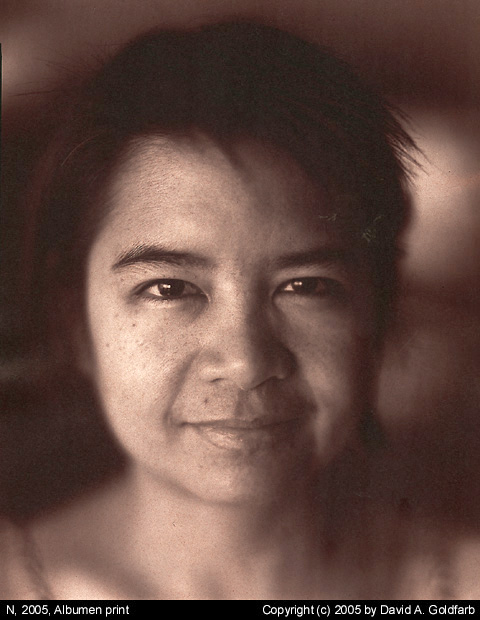
n2005albumen.jpg


Sinar P 8x10", 36cm/f:4.5 Heliar wide open at about 1/15 sec
TXT, ABC Pyro 1+1+1+7, 18 min. at 70-deg F (which would be about N+1, compared to what I would normally do for an Azo grade 2 print, and maybe N+2 compared to what I'd do for a print on enlarging paper).

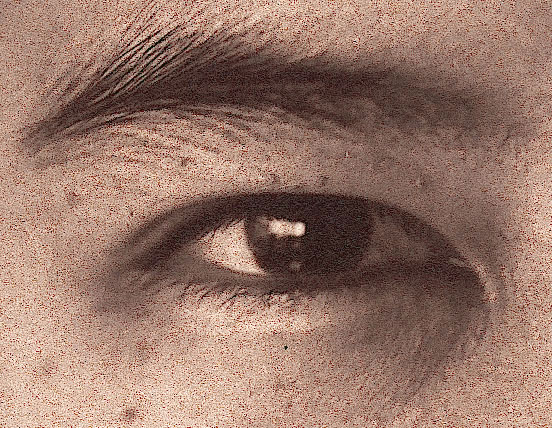
Here's a detail--

n2005albumen,dtl.jpg
 
This is pretty good, is the color of the print this way or was it toned? BTW, did you use the albumen right away or was it denaturated for a while?
 
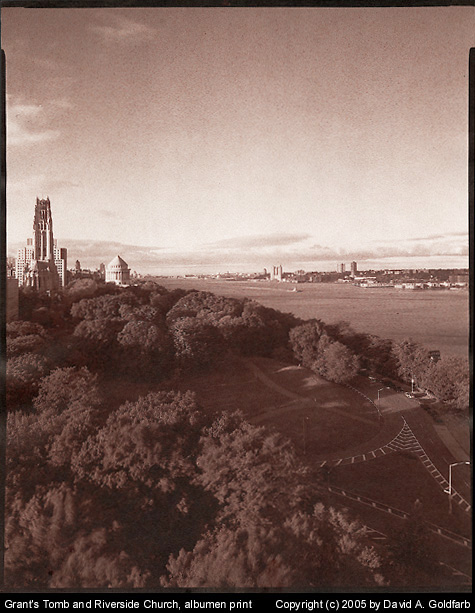
This landscape really shows off the attraction of the self-masking property of albumen printing. There is no way to get all this detail in the sky without losing the shadows on an Azo grade 2 print with a water bath, without also dodging and burning or using a contrast mask. The scan doesn't come close to doing justice to the print, but just to convey a suggestion of it--

grant2005albumen.jpg


8x10" Sinar P, Lee 12 filter (medium-dark yellow), 8-1/4" Gold Dot Dagor, f:32, 1.5 sec
TMX, D-76 (1+1), 16', 75 deg. F (about N+3 compared to what I would normally use for Azo).

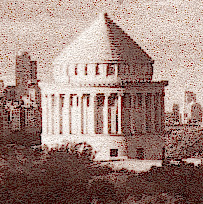
And here's another detail--

grant2005albumendtl.jpg
 
Jorge said:
This is pretty good, is the color of the print this way or was it toned? BTW, did you use the albumen right away or was it denaturated for a while?

Thanks, Jorge. Albumen prints are usually gold toned. Without toning, they disappear. If I print this again, I'll tone it longer to get a less reddish tone. We didn't start experimenting with toning times until the end of the workshop, so this is about 3-4 minutes in a 15% gold chloride solution with 4% citric acid as a preservative. After toning, the prints are fixed in plain hypo, which tends to make them a bit redder, and then the tone can shift again (seems to be cooler) with exposure to heat from the dryer or press.
 
Also we mixed a fresh batch of albumen to learn the process, but we used an aged batch of albumen, but it was only a day or two old, I think. Daniel Levin uses powdered egg white that you can find at a health food store, and he seemed to think that long aging periods were not necessary with the powder, but it might be different if you start from raw eggs.
 
Thanks David, there is an article in Unblinking eye about making your own POP, but it sounds a lot like albumen prints, you might be interested in it.

Anyhow, good job.
 
Thanks guys.
 
David,

Nice! I especially like the portrait. A couple questions:

In the detail of the eye, the image looks grainy. Is this film grain, print grain. or paper texture picked up by the scanner? What paper(s) did you use to print on? Finally, tell me what lens you used for the portrait.

Congrats!
 
Kerik said:
Finally, tell me what lens you used for the portrait.

Figured I could pop in and answer this one. I was wondering the same thing, Kerik. After re-reading the thread a couple of times (I'm quite interested in albumen printing) I actually noticed the blurb underneath the photo:

David A. Goldfarb said:
Sinar P 8x10", 36cm/f:4.5 Heliar wide open at about 1/15 sec

I am also interested in what is causing the graininess of the image.
 
Albumen

Nice job David-I especially like the Portrait. I should have come and done the workshop with you guys. Next time....
Best, Peter
 
Jeremy Moore said:
Figured I could pop in and answer this one. I was wondering the same thing, Kerik. After re-reading the thread a couple of times (I'm quite interested in albumen printing) I actually noticed the blurb underneath the photo:

Sinar P 8x10", 36cm/f:4.5 Heliar wide open at about 1/15 sec
(slaps forehead) D'oh!!
 
Kerik said:
David,

Nice! I especially like the portrait. A couple questions:

In the detail of the eye, the image looks grainy. Is this film grain, print grain. or paper texture picked up by the scanner? What paper(s) did you use to print on? Finally, tell me what lens you used for the portrait.

Congrats!

Thanks Kerik, et al. I guess you've figured out the lens! It's the very one pictured in my avatar.

Grain--well probably all of the above. TXT/ABC Pyro 18 min. is pretty grainy, but the scanner picks up all sorts of stuff. On the other hand, the TMX/D-76 (1+1) neg looks maybe grainier on the scan, which doesn't make sense at all, if it's film grain. The scans are 300 DPI/RGB. Maybe it's print grain plus some surface stuff. Let me know when you're in town for the gum over platinum workshop, and you can see the prints.

We printed mainly with Strathmore 500 Plate-finish single-ply drawing paper, but we also tried another paper with a little more tooth, a little heavier, and with a creamier base. I printed the portrait in both. The tonality of the two prints is a little different in ways you would have to see in person, and the plate-finish paper produces a sharper, glossier result, more like most historical albumen prints.
 
David A. Goldfarb said:
This landscape really shows off the attraction of the self-masking property of albumen printing.

David! I admired this landscape when you first posted it but this print knocks my socks off!

The tonality of oval and triangle formed by the ground are what I call "good enough to eat!" I can only imagine how good it must look like "in person."

Kudos!

-Bob
 
Come by and take a look some time, Bob. Didn't we figure out that your office is two blocks from mine?
 
Photrio.com contains affiliate links to products. We may receive a commission for purchases made through these links.
To read our full affiliate disclosure statement please click Here.

PHOTRIO PARTNERS EQUALLY FUNDING OUR COMMUNITY:


Ilford ADOX Freestyle Photographic Stearman Press Weldon Color Lab Blue Moon Camera & Machine
Top Bottom