• Welcome to Photrio!
    Registration is fast and free. Join today to unlock search, see fewer ads, and access all forum features.
    Click here to sign up

After more than half a century in the darkroom, I think that I have just discovered the wheel.

102391040027-2.jpg

A
102391040027-2.jpg

  • 1
  • 1
  • 8
Just a Sparrow

D
Just a Sparrow

  • 0
  • 0
  • 33

Recent Classifieds

Forum statistics

Threads
201,774
Messages
2,829,902
Members
100,939
Latest member
yoi
Recent bookmarks
1

David Lyga

Member
Allowing Ads
Joined
Nov 25, 2007
Messages
3,445
Location
Philadelphia
Format
35mm
After more than half a century in the darkroom, I think that I have just discovered the wheel.

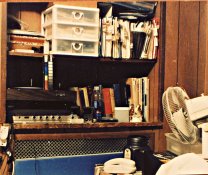
I am placing this into the B&W section because I feel that ALL people will read this, as opposed to only SOME people reading color processing. This information applies to both venues. DSCN1165.JPG
I have decided that, from now on, for both color and B&W printing, I will use only ONE tray. Why? Read on.

For utter consistency, and ease, I use one tray and do not EVER reuse chemistry. How do I do this? First, I have a tray which conforms (approximately) to the paper size. Say I wish to do 5 x 7. I use that type of tray, but one with a flat or almost flat bottom (Cesco-Lite). For 5 x 7, I need only 50mL of each solution (except developer), which I prepare in pudding/applesauce cups (they are less likely to tip over in the dark: I have never used a safelight since I started darkroom in 1964). I line up the stop and fix cups. I also set up, with convenient dark-access, a large plastic storage bin (Walmart) so I can dump the solutions as I proceed. Then I put in 50mL of developer into the tray (no cup needed). I expose in the enlarger, then, face DOWN, I place the print into the tray and rock it gently, but steadily, so it is almost always covered for my standardized two minute development time.

My standardized development time for prints (color or B&W) is two minutes. This assumes an ambient of 80F (26.67 C), as I do not like chilly rooms, (so if you like colder, you might dilute less than I do or give a bit more development time.) After the two-minute development, in full darkness, I gently lift the tray and, over the dump, turn the tray about 90 degrees so all the fluid is released into the dump. I rarely have to hold the print but you might wish to place your index finger onto the edge of the print so it will never exit the tray. Then I place the tray on the table again and pour in the stop. Agitate for about 15 seconds, then dump, then fix for about one minute, then dump that. This covers my B&W procedure. My color process is a bit extended. Read on.

For color prints I do as I said for B&W, using, in both instances, a paper-strength fixer. For B&W prints I use Dektol 1+4, a bit more diluted than Kodak says you have to use it. For color, I use Kodak RA4 RT (roller transport) developer. I mix the way Kodak says to mix it, but do not use it at that strength. (I have defied the Heavenly Yellow Father so many times you would have thought that I would have been excommunicated by now.) My sacrilege follows:

I treat the RA4 developer, as mixed per Kodak, as ‘stock’, and keep it in air-tight PET plastic bottles. For working solution, I mix this ‘stock’ an astounding 1 + 9. That dilution ALSO keeps well in PET plastic, so I can have a prepared reserve supply. Again, I put 50 milliliters of that ‘working solution’ developer into the 5 x 7 tray, and then prepare the stop and fix as before, in cups. It is the same as for B&W up to that point. Then, after fixation, I turn the lights back on, empty the fix into the dump, then (VERY IMPORTANT FOR COLOR) rinse TWICE with 50ml of water (each time) in the tray. Doing that seems to relieve me of any anticipation of staining problems, as, believe it or not, color developer molecules cling to that paper despite the stop and fix steps. After that wash I am ready to blix. 25ml of BLEACH + 25ml of paper strength fixer (NOT the SAME fixer that you used before, as that is ‘contaminated’). This 50ml of blix can be done in full roomlight and serves to slightly lighten and give a warmish hue (slight yellow) to the print. My BLEACH is made as follows: 1 mL of Potassium Ferricyanide makes 200ml of Bleach (for paper). (NOTE: for color negative FILM, mix at twice the strength; i.e., 1 mL PF would make 100 ml film bleach). To make the blix: mix one part bleach to one part paper strength fixer. (AGAIN NOTE: for the film: use the stronger bleach and mix one part to one part FILM STRENGTH fixer.)

So, again, you have 50ml of blix for the paper (25 + 25) and this does not keep well for more than maybe 15 minutes, but, so what, you quickly blix the print in full room light and for about one to two minutes. Then dump the blix and, this time, rinse with THREE 50ml rinses of water to get all that nasty blix out of that tray so you can begin developing the NEXT print in an uncontaminated tray. Obviously, having a few liters of pure water nearby allows this to be done easily.

After doing this for several weeks I report absolutely NO STAIN or FAULTY COVERAGE in processing. It is a new lease on life for me, as there is NEVER a time when that print must be removed from the tray, and dripped completely, until after that final wash. Of course, after removed from the tray you COULD wash again, later, but this one-tray ease has been a godsend to me: (even though the Yellow Father might excommunicate me).


NOTA BENE: Color Negative (C41 Kodak Flexicolor): Mix as per Kodak and consider that as STOCK: Then, for working solution, mix 1 + 7 for use. I use either 100F (8 minutes) or, as in this case that you see, 90F (12 minutes). With the cooler temp you will have a slight difference with filtering in your enlarger (a bit more yellow needed) but either way gives great color, despite the anger and wrath of Yellow Father Kodak. – David Lyga
 

Ko.Fe.

Member
Allowing Ads
Joined
Apr 29, 2014
Messages
3,209
Location
MiltON.ONtario
Format
Digital
Are you saying what for every print you have to dump 50ml of developer, stop and fixer?
If it is reused instead of dump, it is kind of tricky with placing of lets say ten prints somewhere between liquids change.

I have four trays. One for developer, one for stop, one for fix and one for wash. Each is dedicated and I don't have to wash it like the dining dish.
 
OP
OP
David Lyga

David Lyga

Member
Allowing Ads
Joined
Nov 25, 2007
Messages
3,445
Location
Philadelphia
Format
35mm
Yes, I dump after EACH print. I sounds harder than it is: remember that tray is not laden with liquid, so it is quite light. You NEVER have to worry about compromising development times or filtration, as each attempt is with 'new' chemicals. Having the print face down facilitates it being able to move around as you agitate and guarantees that all points of the surface will be reached, efficiently. I have had NOT ONE problem with coverage. For an 8 x 10 I would use 100ml.

marcoifs: It SEEMS that it would be more bother but, remember, there is no dripping print to contend with and that is not touching that print (with tongs or fingers) until it has been washed. I would not trade doing it this way for anything but those who cannot agree are free to continue to do as they are used to doing. - David Lyga
 

OptiKen

Member
Allowing Ads
Joined
Oct 31, 2013
Messages
1,055
Location
Orange County
Format
Medium Format
David, your system makes perfect sense to me especially insuring consistency. I like how clean and efficent it appears. Because of that, it is easy to perform all steps in the dark with no safe light as you do.
I like it and will give it a shot this weekend since I've been putting off printing since my son moved into my darkroom and space for 3 trays is hard to come by without getting liquid on his clothes, etc.

Ken
 

mshchem

Subscriber
Allowing Ads
Joined
Nov 26, 2007
Messages
15,989
Location
Iowa City, Iowa USA
Format
Medium Format
After more than half a century in the darkroom, I think that I have just discovered the wheel.

I am placing this into the B&W section because I feel that ALL people will read this, as opposed to only SOME people reading color processing. This information applies to both venues. View attachment 186684

I have decided that, from now on, for both color and B&W printing, I will use only ONE tray. Why? Read on.

For utter consistency, and ease, I use one tray and do not EVER reuse chemistry. How do I do this? First, I have a tray which conforms (approximately) to the paper size. Say I wish to do 5 x 7. I use that type of tray, but one with a flat or almost flat bottom (Cesco-Lite). For 5 x 7, I need only 50mL of each solution (except developer), which I prepare in pudding/applesauce cups (they are less likely to tip over in the dark: I have never used a safelight since I started darkroom in 1964). I line up the stop and fix cups. I also set up, with convenient dark-access, a large plastic storage bin (Walmart) so I can dump the solutions as I proceed. Then I put in 50mL of developer into the tray (no cup needed). I expose in the enlarger, then, face DOWN, I place the print into the tray and rock it gently, but steadily, so it is almost always covered for my standardized two minute development time.

My standardized development time for prints (color or B&W) is two minutes. This assumes an ambient of 80F (26.67 C), as I do not like chilly rooms, (so if you like colder, you might dilute less than I do or give a bit more development time.) After the two-minute development, in full darkness, I gently lift the tray and, over the dump, turn the tray about 90 degrees so all the fluid is released into the dump. I rarely have to hold the print but you might wish to place your index finger onto the edge of the print so it will never exit the tray. Then I place the tray on the table again and pour in the stop. Agitate for about 15 seconds, then dump, then fix for about one minute, then dump that. This covers my B&W procedure. My color process is a bit extended. Read on.

For color prints I do as I said for B&W, using, in both instances, a paper-strength fixer. For B&W prints I use Dektol 1+4, a bit more diluted than Kodak says you have to use it. For color, I use Kodak RA4 RT (roller transport) developer. I mix the way Kodak says to mix it, but do not use it at that strength. (I have defied the Heavenly Yellow Father so many times you would have thought that I would have been excommunicated by now.) My sacrilege follows:

I treat the RA4 developer, as mixed per Kodak, as ‘stock’, and keep it in air-tight PET plastic bottles. For working solution, I mix this ‘stock’ an astounding 1 + 9. That dilution ALSO keeps well in PET plastic, so I can have a prepared reserve supply. Again, I put 50 milliliters of that ‘working solution’ developer into the 5 x 7 tray, and then prepare the stop and fix as before, in cups. It is the same as for B&W up to that point. Then, after fixation, I turn the lights back on, empty the fix into the dump, then (VERY IMPORTANT FOR COLOR) rinse TWICE with 50ml of water (each time) in the tray. Doing that seems to relieve me of any anticipation of staining problems, as, believe it or not, color developer molecules cling to that paper despite the stop and fix steps. After that wash I am ready to blix. 25ml of BLEACH + 25ml of paper strength fixer (NOT the SAME fixer that you used before, as that is ‘contaminated’). This 50ml of blix can be done in full roomlight and serves to slightly lighten and give a warmish hue (slight yellow) to the print. My BLEACH is made as follows: 1 mL of Potassium Ferricyanide makes 200ml of Bleach (for paper). (NOTE: for color negative FILM, mix at twice the strength; i.e., 1 mL PF would make 100 ml film bleach). To make the blix: mix one part bleach to one part paper strength fixer. (AGAIN NOTE: for the film: use the stronger bleach and mix one part to one part FILM STRENGTH fixer.)

So, again, you have 50ml of blix for the paper (25 + 25) and this does not keep well for more than maybe 15 minutes, but, so what, you quickly blix the print in full room light and for about one to two minutes. Then dump the blix and, this time, rinse with THREE 50ml rinses of water to get all that nasty blix out of that tray so you can begin developing the NEXT print in an uncontaminated tray. Obviously, having a few liters of pure water nearby allows this to be done easily.

After doing this for several weeks I report absolutely NO STAIN or FAULTY COVERAGE in processing. It is a new lease on life for me, as there is NEVER a time when that print must be removed from the tray, and dripped completely, until after that final wash. Of course, after removed from the tray you COULD wash again, later, but this one-tray ease has been a godsend to me: (even though the Yellow Father might excommunicate me).


NOTA BENE: Color Negative (C41 Kodak Flexicolor): Mix as per Kodak and consider that as STOCK: Then, for working solution, mix 1 + 7 for use. I use either 100F (8 minutes) or, as in this case that you see, 90F (12 minutes). With the cooler temp you will have a slight difference with filtering in your enlarger (a bit more yellow needed) but either way gives great color, despite the anger and wrath of Yellow Father Kodak. – David Lyga
Brilliant, absolutely consistent, economical, and boldly defying orthodoxy. How many people have looked at darkroom work and never tried because of the 100F +/- 0.5 F 45s +/- 5s including drain time etc. People spend thousands of dollars on Jobo, roller transport .................

I am a dinosaur, I started printing color with fiber based Ektacolor professional paper. When I was in high school I picked up a Kodak Rapid color processor, basically what you are doing. I use some safelighting, Thomas with color filters, but for decades I worked in total darkness. These machines work for color and black and white perfectly. SAME AS YOU I USE 50-60 ML of each solution. No washing tubes, no 4 trays. I start with water in the processor tray, go through Dev. Stop, Blix, wash for 1.5 min . Processor is clean and ready to go for next print.
Everyone makes fun of this humble little unit. I use it over a small sink .
Your system takes all the baloney out of the process. This is how every kid should start printing, to learn be consistent and don't be overwhelmed by equipment and technology.
Well done! The Force is Strong in You!
Best Mike
 

MattKing

Moderator
Moderator
Joined
Apr 24, 2005
Messages
55,143
Location
Delta, BC Canada
Format
Medium Format
David:
In my more traditional darkroom, I use relatively light 11x14 trays nested in slightly heavier 12x16 trays. The resulting tray sandwich ends up being much easier to pour from, and the larger outer tray catches most splashes.
You may find it useful to try something similar.
 
OP
OP
David Lyga

David Lyga

Member
Allowing Ads
Joined
Nov 25, 2007
Messages
3,445
Location
Philadelphia
Format
35mm
I waste less than using the traditional way. Remember, only 50ml of water per rinse. NOT selfish. - David Lyga
 

Ko.Fe.

Member
Allowing Ads
Joined
Apr 29, 2014
Messages
3,209
Location
MiltON.ONtario
Format
Digital
OK! With my ESL it takes longer time to read and get it. But I get it now. 50ml of working solution per one print. To develop. I mix 1L of working solution and dump it at the end. Same.

But how about stop and fixer? Here is absolutely no reason to dump it, instead of re-using. 1L of stop and fixer have more than just twenty prints capacity.
 

removed account4

Subscriber
Allowing Ads
Joined
Jun 21, 2003
Messages
29,832
Format
Hybrid
david
you don't flip the print to make sure it is fully covered/immersed ?
while i have heard of people getting great results ( like you ) like that
i have also heard of people having problems of uneven development
mottling and all sorts of problems ...
hope i didn't jinx your streak of good luck !
 

john_s

Member
Allowing Ads
Joined
Nov 19, 2002
Messages
2,205
Location
Melbourne, A
Format
Medium Format
You can do single tray processing without wasting out the used solutions. A couple of links on this rather ancient but still useful web site (also some very nice portraits elsewhere on his site)

http://heylloyd.com/technicl/technicl.html

I have done his style of single tray processing for very large prints for which I made a single large tray.
 

NedL

Subscriber
Allowing Ads
Joined
Aug 23, 2012
Messages
3,417
Location
Sonoma County, California
Format
Multi Format
You can do single tray processing without wasting out the used solutions. A couple of links on this rather ancient but still useful web site (also some very nice portraits elsewhere on his site)

http://heylloyd.com/technicl/technicl.html

I have done his style of single tray processing for very large prints for which I made a single large tray.

+1
 
OP
OP
David Lyga

David Lyga

Member
Allowing Ads
Joined
Nov 25, 2007
Messages
3,445
Location
Philadelphia
Format
35mm
Brilliant, absolutely consistent, economical, and boldly defying orthodoxy. How many people have looked at darkroom work and never tried because of the 100F +/- 0.5 F 45s +/- 5s including drain time etc. People spend thousands of dollars on Jobo, roller transport .................

I am a dinosaur, I started printing color with fiber based Ektacolor professional paper. When I was in high school I picked up a Kodak Rapid color processor, basically what you are doing. I use some safelighting, Thomas with color filters, but for decades I worked in total darkness. These machines work for color and black and white perfectly. SAME AS YOU I USE 50-60 ML of each solution. No washing tubes, no 4 trays. I start with water in the processor tray, go through Dev. Stop, Blix, wash for 1.5 min . Processor is clean and ready to go for next print.
Everyone makes fun of this humble little unit. I use it over a small sink .
Your system takes all the baloney out of the process. This is how every kid should start printing, to learn be consistent and don't be overwhelmed by equipment and technology.
Well done! The Force is Strong in You!
Best Mike

Besides being a candidate for assassination (how dare you entertain an unorthodox method?) you have given me much peace. In the 60s I declined even attempting color because the guy at the counter told me that the temp tolerances would not be able to be achieved.

NOW, I develop C41 at either 100F or 90F, I COULD (and have) also developed the negs at 80F but, with my intense dilutions, that would involve almost half an hour just for the developer. The difference is NOT color crossover, but a slightly 'bluer' negative, still holding excellent color differentiation. Actually, with colder I find the base a tiny bit cleaner and the hues to be just as admirable. The colder you develop the negative, the more yellow is needed in the filter drawer of the enlarger, but not excessively so: maybe 30 or 40 more.

Of course, an additional difference with me is that I dilute to an amazing extent. For the C41 negatives: 1+7 and for the RA4 prints: 1 + 9. Yes, a full 1+9 for the Kodak RA4 dev/repl RT will give FULL blacks if developed in VIRGIN developer AT about 80F for a full two minutes. It works even though the Great Yellow Father threatens excommunication for this agnostic, former Roman Catholic. Remember, for my way, there are NONE NONE NONE of the overkill safeguards that Kodak has built into its mandate. Compromise even a bit with me and you will be rewarded with potential problems. I like to see how far I can approach that cliff before falling off. - David Lyga
 
OP
OP
David Lyga

David Lyga

Member
Allowing Ads
Joined
Nov 25, 2007
Messages
3,445
Location
Philadelphia
Format
35mm
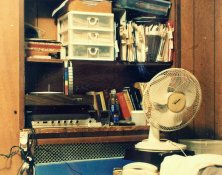
I just took another picture of my bookshelf: this one is a bit better, colorwise.DSCN1170.jpg
The negative was Fuji Super G+ (long discontinued but kept cold). I developed the neg at 90F for 12 minutes. Giving a bit more development gives slightly greater color saturation, at the expense of shadow detail. You cannot have it all with prints, unlike with transparencies. - David Lyga
 
OP
OP
David Lyga

David Lyga

Member
Allowing Ads
Joined
Nov 25, 2007
Messages
3,445
Location
Philadelphia
Format
35mm
david
you don't flip the print to make sure it is fully covered/immersed ?
while i have heard of people getting great results ( like you ) like that
i have also heard of people having problems of uneven development
mottling and all sorts of problems ...
hope i didn't jinx your streak of good luck !

NO, I have come to the conclusion that with a FLAT bottom of the tray, that print will 'glide' better (with agitation) if its emulsion touches the tray bottom. With continuous gentle agitation that full emulsion WILL be properly processed. You cannot cut corners here with agitation. NO RIBS on bottom of tray is BEST. With a flat table, all bases will be covered. - David Lyga
 

mshchem

Subscriber
Allowing Ads
Joined
Nov 26, 2007
Messages
15,989
Location
Iowa City, Iowa USA
Format
Medium Format
No, just obstinate, Murray.
David, I don't know. Some of us just like to complicate things :smile: This line of trays is just getting through the toner. And these are 8x10 trays.
Develop, Stop, Fix, Fix, rinse, hypo clear, toner, hypo clear, rinse, wash. Using a single tray sounds like a great idea. Especially for RC prints, black and white or color. People like to buy equipment so there is that part to overcome. I have some nice Cescolite trays, smooth as silk, all you need is enough liquid to keep the print from sticking to the tray. Perfect laminar flow. No prints sticking together etc. RA-4 will work at any reasonable temp.
I really do enjoy all the fussing around, however, All you really need is Dark, a Thermometer and a Timer, oh and a Tray.
Best Mike
Trays.jpg
 

darkroommike

Subscriber
Allowing Ads
Joined
Mar 22, 2007
Messages
1,738
Location
Iowa
Format
Multi Format
OK! With my ESL it takes longer time to read and get it. But I get it now. 50ml of working solution per one print. To develop. I mix 1L of working solution and dump it at the end. Same.

But how about stop and fixer? Here is absolutely no reason to dump it, instead of re-using. 1L of stop and fixer have more than just twenty prints capacity.
  • Here's the math. Kodak and Ilford both rate fixer at 20 prints per quart/liter if you divide 1000ml by 20 you get 50ml!
  • Huh. That's 50 ml per print just like David is getting.
  • And each print, from first to last is better fixed in fresh fixer. Fixer can "last" (for some definitions of "last") for more than 20 prints per liter but that is the official recommendation. Old fixer makes more of the LESS SOLUBLE argentothiosulfates, fresh fixer drives the reaction towards the more soluble argentothiosulfates. Hypo chek solutions will lie and tell you your fixer is still working, it's better to just count to 20!
  • As far as stop bath is concerned, stop bath is cheap, but if you are using fresh stop bath per print you can use a more dilute stop bath solution (maybe half as strong?) and actually save money on stop bath. You could also just use a couple of water changes between the developer and fixer, since with David's method, there will be no developer carryover accumulation in the stop bath (that's what the acid in the stop is for).
I don't think his method is for everyone but I have used it with great success, scaled up for larger prints, in my darkroom, my old sink couldn't handle three 16x20 trays.
 

trendland

Member
Allowing Ads
Joined
Mar 16, 2012
Messages
3,398
Format
Medium Format
David let me short state :" When I read a post of you here on APUG/PHOTRIO I allways must smile a bit - mostly much more than a bit ! "
But beware of misunderstandings - It is not the case to laught ABOUT you (obvioulsly I read some replys to your posts of members who ALLWAYS are against your methods - may be some of them are indeed just laughting) but as I remember you just don't care about them - RIGHT SO !!!
Well what I am trying to say is : Somtimes the style and the approach to manage problems or to have a new method in use, seams to look a bit strange. BUT on a second look it is most praticable :D....!
So let me say - don't let it be - others irretate your ambitions !
And I am allway smiling because I love your Posts :angel:....
To think different was allways the way to come to new solutions in every period of
human history.

with friendly greetings
 

john_s

Member
Allowing Ads
Joined
Nov 19, 2002
Messages
2,205
Location
Melbourne, A
Format
Medium Format
  • Here's the math. Kodak and Ilford both rate fixer at 20 prints per quart/liter if you divide 1000ml by 20 you get 50ml!
  • Huh. That's 50 ml per print just like David is getting.
  • And each print, from first to last is better fixed in fresh fixer. Fixer can "last" (for some definitions of "last") for more than 20 prints per liter but that is the official recommendation. Old fixer makes more of the LESS SOLUBLE argentothiosulfates, fresh fixer drives the reaction towards the more soluble argentothiosulfates. Hypo chek solutions will lie and tell you your fixer is still working, it's better to just count to 20!
  • As far as stop bath is concerned, stop bath is cheap, but if you are using fresh stop bath per print you can use a more dilute stop bath solution (maybe half as strong?) and actually save money on stop bath. You could also just use a couple of water changes between the developer and fixer, since with David's method, there will be no developer carryover accumulation in the stop bath (that's what the acid in the stop is for).
I don't think his method is for everyone but I have used it with great success, scaled up for larger prints, in my darkroom, my old sink couldn't handle three 16x20 trays.

So at the end of fixing one print in 50mL of fixer the fixer is exhausted, having reached its nominal limit. Is that good?
For black and white, the only processing I do, I prefer the two-bath fixing system.
 

mshchem

Subscriber
Allowing Ads
Joined
Nov 26, 2007
Messages
15,989
Location
Iowa City, Iowa USA
Format
Medium Format
So at the end of fixing one print in 50mL of fixer the fixer is exhausted, having reached its nominal limit. Is that good?
For black and white, the only processing I do, I prefer the two-bath fixing system.
The fixer is far from exhausted. This is the recommended limit set by Ilford. 20 8x10 s per liter for complete fixing. This method would be quite conservative.

Ansel would use two old school F6 hardening fixer baths followed by plain hypo. All sodium thiosulfate baths, he went through a crap load of chemistry. After all this fix, then, Selenium toner that he used and tossed.
 

Colin Corneau

Member
Allowing Ads
Joined
Nov 20, 2007
Messages
2,365
Location
Winnipeg MB Canada
Format
35mm RF
I'll have to try this the next time I print 16x20. :D
 

Ko.Fe.

Member
Allowing Ads
Joined
Apr 29, 2014
Messages
3,209
Location
MiltON.ONtario
Format
Digital
  • Here's the math. Kodak and Ilford both rate fixer at 20 prints per quart/liter if you divide 1000ml by 20 you get 50ml!
  • Huh. That's 50 ml per print just like David is getting.
  • And each print, from first to last is better fixed in fresh fixer. Fixer can "last" (for some definitions of "last") for more than 20 prints per liter but that is the official recommendation. Old fixer makes more of the LESS SOLUBLE argentothiosulfates, fresh fixer drives the reaction towards the more soluble argentothiosulfates. Hypo chek solutions will lie and tell you your fixer is still working, it's better to just count to 20!
  • As far as stop bath is concerned, stop bath is cheap, but if you are using fresh stop bath per print you can use a more dilute stop bath solution (maybe half as strong?) and actually save money on stop bath. You could also just use a couple of water changes between the developer and fixer, since with David's method, there will be no developer carryover accumulation in the stop bath (that's what the acid in the stop is for).
I don't think his method is for everyone but I have used it with great success, scaled up for larger prints, in my darkroom, my old sink couldn't handle three 16x20 trays.

It is not about Stop to be cheap, it is about polluting for no reason. But seems what only Stop is wasted. Or maybe it gets to its capacity by twenty of 16x20. Developer and fixer are at exact capacity.
The only thing I'm not getting is how twenty prints are washed enough and within reasonable amount of time, if only single tray. Minimum wash is what? 30 minutes for FB?
 
Photrio.com contains affiliate links to products. We may receive a commission for purchases made through these links.
To read our full affiliate disclosure statement please click Here.

PHOTRIO PARTNERS EQUALLY FUNDING OUR COMMUNITY:


Ilford ADOX Freestyle Photographic Stearman Press Weldon Color Lab Blue Moon Camera & Machine
Top Bottom