• Welcome to Photrio!
    Registration is fast and free. Join today to unlock search, see fewer ads, and access all forum features.
    Click here to sign up

Aero Ektar 12-inch f/2.5 4x5 Astro Camera

Scan-01.jpg

A
Scan-01.jpg

  • 0
  • 0
  • 9
Came home

H
Came home

  • 6
  • 1
  • 85

Recent Classifieds

Forum statistics

Threads
202,207
Messages
2,837,239
Members
101,196
Latest member
Hans85
Recent bookmarks
0

Matt Hall

Member
Allowing Ads
Joined
Feb 9, 2022
Messages
45
Location
Santa Barbara, CA U.S.A.
Format
Multi Format
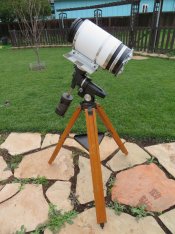
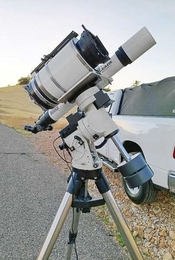
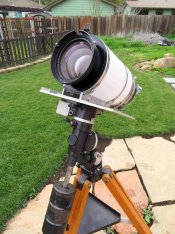
Hi everyone! I am fairly new to Phototrio and wanted to share a project I have been working on for some years now. In 1985 I purchased this Aero Ektar 12-inch f/2.5 lens (dated to 1953 using the serial number) from a military surplus outfit in Pasadena, CA that I'm fairly sure doesn't exist anymore. I was heading down to New Zealand with a group from Brooks Institute to shoot Comet Halley and thought a large format astro camera would be really cool. The head of the Industrial Dept. at Brooks, Vern Miller, turned me onto this lens. Unfortunately, I never got it finished and it got put into storage until about a year ago. When I rediscovered it I decided it was time to finish the project. Although Vern has passed several years ago I know he would have been proud to be apart of this effort.

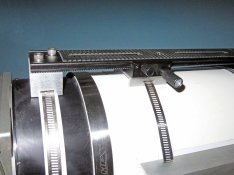
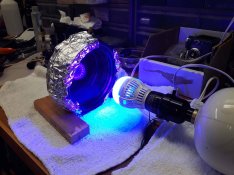
I had to clear the rear lens group as it was quite brown from age due to the Thorium/Lanthanum fused into the glass to get the required dispersion characteristics the government needed for an aerial lens. I used a 5W UV LED bulb purchased on Amazon and left it on about 2 inches from the rear glass grouping for 7 weeks, 24/7. As it was just 5W there was no appreciable heat to damage the lens. It finally completely cleared up. Turns out I was losing 2-3 stops of light due to the discoloration which completely defeated the f/2.5 speed of the lens. With the help of a machinist to cut the threads on the lens mount I slowly built this camera. It has a rack and pinion focus mechanism with a locking screw (needed if you are pointing vertically) and I am working with Rick Oleson to create a 4x5 Bright Screen ground glass for me to aid in framing the image. I found a NOS 6"x 6" Aero 2 yellow filter (minus violet as this is an achromat) which I will use just as the military did when shooting this with IR B&W film. I am using the 4x5 rotating back from my old view camera while at Brooks (it worked great then so why not?). The entire thing was placed onto my GEM this last Saturday to make sure the weight was good and I had enough counterweight. etc. The entire camera weighs 28 pounds (most of that is the glass). I turned it to the Moon and could clearly see the surface craters on the ground glass. I was a bit surprised just how sharp it is (I did use a magnifying loop to aid in focusing). Anyway, I have some Porta 400 sheet film coming from B&H which I will have pushed 2 stops during processing to get a 1600 equivalent ASA rating. Think my first shots will be of Orion as it is in the right place and contains several bright stars to aid in focusing this beast. Just waiting for the Moon to get out of the way now so I can make my test exposures. Any comments or ideas would be welcomed!
 

Attachments

  • Aero Ektar On GEM.jpg
    Aero Ektar On GEM.jpg
    314.5 KB · Views: 502
  • Aero Ektar On GEM2.jpg
    Aero Ektar On GEM2.jpg
    296.1 KB · Views: 395
  • Broken Down.jpg
    Broken Down.jpg
    159.7 KB · Views: 388
  • Rack and Pinion Focus.jpg
    Rack and Pinion Focus.jpg
    181.7 KB · Views: 387
  • UV Clearing.jpg
    UV Clearing.jpg
    246.7 KB · Views: 437

Cholentpot

Member
Joined
Oct 26, 2015
Messages
7,047
Format
35mm
I've only gotten into 4x5 recently. I've only learned that these lenses are somewhat of the grail lenses for 4x5. Time to keep an eye out for one.

Can't wait to see results from your setup.
 

NB23

Member
Allowing Ads
Joined
Jul 26, 2009
Messages
4,307
Format
35mm
Wow nice!

i have something that might interest you. I purchased a Aero Ektar 178mm f2.5 that came with a superb handmade camera/box, made for astrophotography. It turns out it was owned/made by a famous astrophotographer. Takes 2 1/4 x 3 1/4 sheets and it’s calibrated for infinity with the aero ektar 178mm.

The shutter is a little door on a hinge that opens and closes with the help of a cable release.

I have no use for it but don’t have the heart to throw it away. I’m always amazed at how well it’s made.
 
OP
OP
Matt Hall

Matt Hall

Member
Allowing Ads
Joined
Feb 9, 2022
Messages
45
Location
Santa Barbara, CA U.S.A.
Format
Multi Format
Whatever you do, DO NOT throw it away. These lenses are hard to find, especially if in good condition. If you ever want to get rid of it let me know. Perhaps we could work out a deal. Matt
 

NB23

Member
Allowing Ads
Joined
Jul 26, 2009
Messages
4,307
Format
35mm
Whatever you do, DO NOT throw it away. These lenses are hard to find, especially if in good condition. If you ever want to get rid of it let me know. Perhaps we could work out a deal. Matt

the lens unscrews, and I’m keeping it. But the body... I will post pictures, you will understand by looking at it. Took me a bit longer to understand the camera but it made total sense in the end
 

Dan Fromm

Member
Joined
Mar 23, 2005
Messages
6,937
Format
Multi Format
I've only gotten into 4x5 recently. I've only learned that these lenses are somewhat of the grail lenses for 4x5. Time to keep an eye out for one.

Can't wait to see results from your setup.

Potty, I don't know whether you have a weak mind but using one of those monsters requires a strong back. I just took a quick look on eBay, several, in various states of decay, are on offer. None has a diaphagm. Big aerial lenses, for that matter aerial lenses in general, are hard to put in shutter. Monsters like the 12" AE might be usable in front of or behind a large Packard. Otherwise, except for astrophotography, their best use is as doorstops.

If you want a relatively portable relatively fast 300 or so aerial camera lens for use on 4x5 think about the 12"/4 TTH Telephoto lens as fitted to Vinten F. 95, AGI F.134 and AGI F.139 cameras. They're supposed to cover 4x5. I have one, it is the longest lens that's a comfortable fit on a 2x3 Speed Graphic.

But bear in mind that in general a free aerial camera lens is a poisoned gift. I've had a bunch of them. The only ones I can recommend are the 38/4.5 Biogon (I've had 20, still have 2; not for 4x5, they cover 84 mm), the 4"/2.0 TTH Anastigmat (not for 4x5, covers 2x3) and the 12"/4 TTH Telephoto. You absolutely positively don't want a 200/2.0 S.F.O.M., said to have been made by Kinoptik.
 

Cholentpot

Member
Joined
Oct 26, 2015
Messages
7,047
Format
35mm
Potty, I don't know whether you have a weak mind but using one of those monsters requires a strong back. I just took a quick look on eBay, several, in various states of decay, are on offer. None has a diaphagm. Big aerial lenses, for that matter aerial lenses in general, are hard to put in shutter. Monsters like the 12" AE might be usable in front of or behind a large Packard. Otherwise, except for astrophotography, their best use is as doorstops.

If you want a relatively portable relatively fast 300 or so aerial camera lens for use on 4x5 think about the 12"/4 TTH Telephoto lens as fitted to Vinten F. 95, AGI F.134 and AGI F.139 cameras. They're supposed to cover 4x5. I have one, it is the longest lens that's a comfortable fit on a 2x3 Speed Graphic.

But bear in mind that in general a free aerial camera lens is a poisoned gift. I've had a bunch of them. The only ones I can recommend are the 38/4.5 Biogon (I've had 20, still have 2; not for 4x5, they cover 84 mm), the 4"/2.0 TTH Anastigmat (not for 4x5, covers 2x3) and the 12"/4 TTH Telephoto. You absolutely positively don't want a 200/2.0 S.F.O.M., said to have been made by Kinoptik.

Thanks for the info and the update on my mental state.

I've been down the path of using the wrong lenses on the wrong cameras. I put a lot of time and money into getting a anamorphic setup only to find that it was far too fussy for everyday use and far too heavy. Results are brilliant though.
 

reddesert

Member
Allowing Ads
Joined
Jul 22, 2019
Messages
2,613
Location
SAZ
Format
Hybrid
Good to see when someone actually manages to bring such a monster lens project to fruition.

The surplus store in Pasadena might have been C&H Surplus. They had all sorts of strange and impressive things. Looks like they moved a while ago and then closed the retail store, but there is still a website.

For focusing the beast, you may want to try using a pupil mask. This is not difficult in principle since you just have to make masks that fit over the front of the lens. One way to do it is to first mask off the left side of the objective, then the right side, and look for image motion relative to a fiducial mark in the focal plane (like a mark on the ground glass). If you're in focus the image won't shift, if you're forward of focus it shifts one way, and behind focus it shifts the other way. A more elaborate mask that has become common for astrophotographers is the Bahtinov mask: https://en.wikipedia.org/wiki/Bahtinov_mask It works on the same image motion principle but looking at the motion of a diffraction spike.
 

AgX

Member
Allowing Ads
Joined
Apr 5, 2007
Messages
29,968
Location
Germany
Format
Multi Format
Matt, I like your design. Looks like straight of a tinkerers shop, made from stuff lying around anyway, or brought home "as one day I shall need it"...

But what is the function of the open, shallow U-profile at the side of the baseboard?
EDIT:
I just realized a slit for a bandage at this profie. Thus it is to take a 2nd, aiming lens.
 
Last edited:

polaroid_memories

Member
Allowing Ads
Joined
Feb 27, 2016
Messages
63
Location
England
Format
Multi Format
I decided it was time to finish the project.

Stunning work Matt! Cant wait to see the results of Orion!

Sorry to hijack your post, but a question for you - I have an Aero Ektar 178mm and am looking for a comprehensive guide to disassembling it to restore. Do you know of any resources availbel? Did you find anything during your restoration process?
 
OP
OP
Matt Hall

Matt Hall

Member
Allowing Ads
Joined
Feb 9, 2022
Messages
45
Location
Santa Barbara, CA U.S.A.
Format
Multi Format
Matt, I like your design. Looks like straight of a tinkerers shop, made from stuff lying around anyway, or brought home "as one day I shall need it"...

But what is the function of the open, shallow U-profile at the side of the baseboard?
EDIT:
I just realized a slit for a bandage at this profie. Thus it is to take a 2nd, aiming lens.
You are correct! I have a 400mm f/5 guide scope that fits into this slot so I can take long exposure, guided photos. I have 1/4-20 holes on the other side if I want to piggyback a camera to take small format images at the same time. Unfortunately I am pushing the limit of my GEM and need to find another unit that has more weight capacity. I have dragged this setup all over the world chasing comets and other various celestial sights so it has performed very well.
 
OP
OP
Matt Hall

Matt Hall

Member
Allowing Ads
Joined
Feb 9, 2022
Messages
45
Location
Santa Barbara, CA U.S.A.
Format
Multi Format
Stunning work Matt! Cant wait to see the results of Orion!

Sorry to hijack your post, but a question for you - I have an Aero Ektar 178mm and am looking for a comprehensive guide to disassembling it to restore. Do you know of any resources availbel? Did you find anything during your restoration process?
I assume that you have the 7-inch f/2.5 baby brother to my lens? I have never seen any literature regarding these lenses as far as maintenance or restoration goes. I did disassemble the front grouping to do some cleaning internally. Mostly clumps of dust oily residue, no fungus fortunately. You will need and extra large spanner wrench, good luck finding one (I had to build my own) to unscrew the front retaining ring. It was extremely tight as it had not been turned in over 50 years. Are you just trying to clean the glass or is there more involved such as servicing the shutter, etc?
 

Dan Fromm

Member
Joined
Mar 23, 2005
Messages
6,937
Format
Multi Format
Matt, did your monster come with a between the lens shutter? I ask because nearly all of the 6" and 7" AEs I 've seen didn't. Also, did yours come with a diaphragm? Most of the 7 inchers I've seen, very few of the 6 inchers, have had a diaphragm.
 
OP
OP
Matt Hall

Matt Hall

Member
Allowing Ads
Joined
Feb 9, 2022
Messages
45
Location
Santa Barbara, CA U.S.A.
Format
Multi Format
Matt, did your monster come with a between the lens shutter? I ask because nearly all of the 6" and 7" AEs I 've seen didn't. Also, did yours come with a diaphragm? Most of the 7 inchers I've seen, very few of the 6 inchers, have had a diaphragm.
When I purchased this lens in 1985 it was the complete camera. The was a front cone with the lens and a rear plate for film and everything. It had a shutter in between the two lens groups but no diaphragm. I believe that these were used wide open and had no need for an iris. Unfortunately, I sold the camera and shutter years ago as I really had no use for them. Now I wish I had kept the shutter, although it was as big as the lens and a bit heavier. I have also read that the shutter blades were strong enough to take off a finger. I got the entire thing for $200.00 and thought that was expensive. Looks really cheap now!
 

kinglang

Member
Allowing Ads
Joined
May 22, 2018
Messages
24
Location
HK
Format
Medium Format
I have an Ektar 178/2.5 and want to get rid of it😃
 
OP
OP
Matt Hall

Matt Hall

Member
Allowing Ads
Joined
Feb 9, 2022
Messages
45
Location
Santa Barbara, CA U.S.A.
Format
Multi Format
Well, I ran into some problems and finally got this thing up and running. Hopefully somebody out there will still be around to view this.

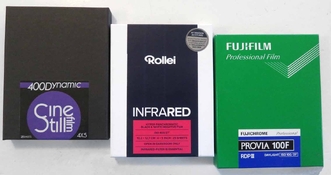
It took me over a year to finally get a focusing screen bright enough for me to focus this beast. I had a fresnel bright screen, which in most cases works just fine, but with the true point sources I am dealing with turned out to be the wrong choice. The problem was that the star points would fall between two of the fresnel ridges and not be able to focus correctly. The final solution was to go back to a true ground glass screen. It took some time to find someone that could grind one fine enough for me and still keep it extremely bright, but I did it. Next, I found that much of the film stock I used to shoot back in the day has been discontinued. After a lot of experimenting with different film/development combinations i settled on the following (remember, the film has to be pushed at least 2 stops in development and not all film can handle this and keep the color correct and the grain structure fairly fine). The first photo attached shows the films I settled on:

1. Color Negative- Cine Still Film: a very fine grained ASA 400 color negative stock (C-41) that can stand up to the 2 stop push very well.
2. Black & White- Rollei Infrared Film: a hyper-panchromatic fine-grained ASA 400 stock that is sensitive from visible light up into the IR (up to around 800nm). I use with an 87C filter.
3. Color Transparency- Fujifilm Provia 100F: A fine-grained ASA 100 stock that holds its color and grain extremely well even when pushed 3 stops (effective ASA 800)

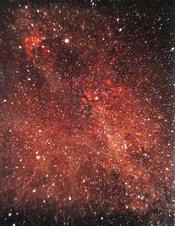
This image was taken on Nov. 9, 2025 on Figueroa Mountain, just north of Santa Barbara, CA. The second photo shows my setup that night. I used a Meade 800mm f/10 refractor as my guide scope to help ensure that the tracking stayed true. The larger barreled tube is my 4x5 camera. I only shot color neg and transparency that night as the IR stock had not yet arrived. Unfortunately it has been very rainy here since then so I have no samples of that to show as of yet. The third photo attached is the Fuji Provia 100F image. It is a shot of the Cygnus constellation showing the North American Nebula/Deneb in the upper left, along with a LOT of hydrogen emission areas that appear quite red (one of the reasons I chose this area of the Milky Way-and due to what was visible that night). I really wanted to image Orion, but it didn't get high enough to clear all the atmospheric haze until around 2am. That will have to wait for another night.

NOTE: there is some slight field curvature present here. But mostly it is chromatic aberration visible, much of which can be corrected with proper filtration. Remember, this lens was designed to be used with a yellow (minus blue) filter. I did not use any filtration on this first image so I could see exactly what I have here. All in all not a bad first attempt as I shot just the one sheet and seemed to nail the exposure/processing combination fairly well.

More to come . . . .
 

Attachments

  • IMG_1464.JPG
    IMG_1464.JPG
    74.7 KB · Views: 104
  • First Light.jpg
    First Light.jpg
    136.4 KB · Views: 99
  • Cygnus Chrome.jpg
    Cygnus Chrome.jpg
    238 KB · Views: 99

abruzzi

Member
Joined
Mar 10, 2018
Messages
3,276
Location
New Mexico, USA
Format
Large Format
Provia seems obvious for slide film because it reciprocity is almost as good as Acros was. I would have thought TMAX100 or maybe TMAX400 would have been best for B&W since at least the 100 has better than most reciprocity. Rollei Infrared is Aviphot 200, right? How is reciprocity on that? I've shot it, but never long exposure--always with a R72 in front of it.
 
OP
OP
Matt Hall

Matt Hall

Member
Allowing Ads
Joined
Feb 9, 2022
Messages
45
Location
Santa Barbara, CA U.S.A.
Format
Multi Format
I agree on the Provia. I used to shoot Provia 1600 chromes and that was spectacular. Too bad it is gone. As for the B&W, I don't know about the Aviphot 200 you mentioned. The box states this is an ASA 400 film, sensitive to the full visual spectrum as well as the IR up to about 800nm. It is extremely fine grained and can handle push processing without building up too much contrast. But, as it has such a large range of sensitivity it will give me more exposure per second with the added IR portion so should cut down exposure times if used unfiltered. As I haven't shot it yet (raining again today, we have got 11 inches over the last 7 days) I can't speak to any reciprocity issues. Still trying to figure out how to adjust the focus when shooting IR only. I know it will be slightly further back than infinity in visual range but have to experiment to get it right.
 

OAPOli

Member
Allowing Ads
Joined
Sep 26, 2022
Messages
864
Location
Toronto
Format
Medium Format
That's awesome project; I'd love to see more.

I wonder if the astigmatism (I think that's what stretching the stars into ovals?) could be alleviated via an aperture stop? Since the lens can be split in half... How long are your exposure times?
 

physixvox

Member
Allowing Ads
Joined
Nov 20, 2025
Messages
3
Location
Germany
Format
ULarge Format
The way these f/2.5 Aero Ektars were used originally is for night recon photography, partly using flash bombs. You often find 12 inch 2.5 Aero Ektars inside Fairchild "Night Photo Shutters". So the limitation to overcome here was to make a Double Gauss to be as fast as possible so you could get enough light at night; the priority was not exceptionally high resolution.
As you can see in the astro photo example, it shows quite a bit of astigmatism/coma.
I for my part think that f/2.5 Aero Ektars are more popular because they give nice bokeh as portrait lenses wide open. 178mm f/2.5 on 4x5 is the full frame equivalent of 50mm f/0.7 (it gives the same performance as the Kubrick Planar, so to speak). Although you can stop them down for Astro of course (some of them have an aperture already).
Good work though making it work like that.
 
OP
OP
Matt Hall

Matt Hall

Member
Allowing Ads
Joined
Feb 9, 2022
Messages
45
Location
Santa Barbara, CA U.S.A.
Format
Multi Format
All information on this lens states that the astigmatism is fairly well corrected. I think it is chromatic aberration (with a bit of field curvature) as the different colors of light are focused progressively further away in a larger circle of confusion. Stopping the lens down would kind of negate having purchased such a fast lens in the first place. Remember, this was used as an aerial spy lens during the war and used 9"x 9" infrared film shot at night with filtration. I don't think it was ever designed to be a panchromatic lens, so I will need to selectively filter each image to get the sharpness desired. I may even go as far as shooting color separation negatives and combining digitally. Hopefully all this will correct the issues. We'll see.

P.S.- I would like to point out that I am pushing this lens to its very limit. Test equipment that look for optical flaws use the same procedure to plot a full resolution of a lens. They use true point sources of light which will immediately show ANY optical imperfection in a lens. Extended objects will look soft, but a point source will show each aberration in all its glory, all the various shapes that each imperfection introduces. So guess what I am imaging, point sources!
 

physixvox

Member
Allowing Ads
Joined
Nov 20, 2025
Messages
3
Location
Germany
Format
ULarge Format
Not exactly correct. The 7 inch f/2.5 was for aerial 4.5 inch roll film format, nominally, and the 12 inch f/2.5 is for 9x9 inch roll film.
I have a couple of these 7 and 12 inches, one of the 7 with the original 4.5x4.5 camera including the roll film cartridge still on it.
See USAF lens data sheets. Pages 5-1, 5-2, 7-5, 7-6.
and

Notable: The resolution given by their testing isn't too terribly high. Both the 7 and 12 inch are specified as 25 lpmm in the center and 10 lpmm at the edge, wide open.
That is not much! Using the lenses on a digital Full Frame sensor, that would yield "only" 2 Megapixels equivalent essentially.
Of course when using 4x5, you're expecting to get about 15 Megapixel equivalent out of this.
For Full Frame lenses, you usually want 50 lpmm or more in a lens.
 
Last edited:
Photrio.com contains affiliate links to products. We may receive a commission for purchases made through these links.
To read our full affiliate disclosure statement please click Here.

PHOTRIO PARTNERS EQUALLY FUNDING OUR COMMUNITY:


Ilford ADOX Freestyle Photographic Stearman Press Weldon Color Lab Blue Moon Camera & Machine
Top Bottom