
• Welcome to Photrio!
    Registration is fast and free. Join today to unlock search, see fewer ads, and access all forum features.
    Click here to sign up

Advice needed for silver halide emulsion recipe

Iriana

H
Iriana

  • 4
  • 1
  • 68
Puddle

Puddle

  • 4
  • 2
  • 105

Forum statistics

Threads
202,734
Messages
2,844,787
Members
101,489
Latest member
Sunnydoran
Recent bookmarks
2

LeoniD

Member
Allowing Ads
Joined
Jan 24, 2020
Messages
187
Location
Kyiv
Format
35mm
I want to start making emulsions, the issue is that I want to achieve a fairly high speed. I understand that it's all trial and error, but I want to at least start from a somewhat faster recipe and to have a fair understanding of what went wrong in a certain batch and how to fix it. Based on Photo Engineer's posts here and some literature I've put together what seems like a logical recipe. Well, at least it seems logical to me as I have 0 knowledge to notice any errors.
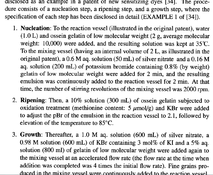
Here it is (it's a PE's SRAD recipe modified to be core-shell based on info in his posts "The placement of Iodide in emulsions", "A very high speed film formula" and picrelated)

A solution
Gelatin 4.615 grams
Potassium Iodide 0.23 grams
Water 130 ml

B solution
Silver nitrate 20 grams
Water 60 ml

C solution
Potassium Bromide 20.307 grams
Water 31 ml

D solution
Potassium Iodide 0.23 grams
Water 5ml

E solution
Potassium Iodide 0.23 grams
Water 5ml
Heat all to 45 deg C

Add 28% ammonium hydroxide to B with stirring until a clear solution results.
Take 2.5ml of solution B, add 2.5ml of water=sol.F

Add F -> A over 2 minutes, 2000rpm/highest setting of stirrer
Let it sit at 45C for 5min with no stirring
Add B, C, E
Flow rate for B=6ml/min
Flow rate for C=3.1ml/min
Flow rate for D=2.5ml/min
Flow rate for E=1.25ml/min

Hold for 30 minutes at 45 deg C. after everything was added

adjust gelatin percent to the desired level (5 - 10%), let stand for 2 hours or until at room temperature.

Shred into noodles and wash. (make sure all salts and ammonia are removed), "I use 4 deg C for my wash"
Add spectral sensitizing dye and hold at 45 deg for 15 mins. You use a dye at about 20 - 100 mg / mole of silver.
Coat with a hardener and surfactant.
Does it have any obvious errors? The gelatin percent level after precipitation affects only coating parameters, not grain, right? There are "recipes" for erythrosine sensibilization in Mikhailov's "Techminimum" and Baker's "Photographic emulsion technique", but it, as well as sulfur sens. depends on surface area of grains, right? How do I approximate how much dye and thiosulphate I should use?
Duffin states that some antifoggants give a slight increase in speed, and benzotriazole seems to be one of them. How do I calculate how much to add?
 

Attachments
  • изображение_2023-10-13_233403333.png
    изображение_2023-10-13_233403333.png
    600 KB · Views: 197
Last edited:
Yeah, how is this emulsion as a film base?
 
Also, here iodide content is just 1%, whereas PE mentioned as high as 8-10%. Can I add more iodide and an equimolar amount of AgNO3 to compensate for it, or do I just "subtract" some bromide?
 
Last edited:
how are you planning to add so many solutions at the same time in a controlled manner? I've been doing a lot of research on recipes similar to what you described and am working on building my own rig for emulsion precipitation.
 
how are you planning to add so many solutions at the same time in a controlled manner? I've been doing a lot of research on recipes similar to what you described and am working on building my own rig for emulsion precipitation.

Arduino+stepper motors rotating a long threaded rod+syringes, basically. I tried this with just 1/3, the stream doesn`t seem to pulsate at least. I plan to build the whole thing after the New Year, but someone pointed out that this recipe, if it works, will have very high contrast due to very uniform size of crystals, so since I want to get a photographic emulsion, not duplicating, idk how to proceed.
 
Arduino+stepper motors rotating a long threaded rod+syringes, basically. I tried this with just 1/3, the stream doesn`t seem to pulsate at least. I plan to build the whole thing after the New Year, but someone pointed out that this recipe, if it works, will have very high contrast due to very uniform size of crystals, so since I want to get a photographic emulsion, not duplicating, idk how to proceed.

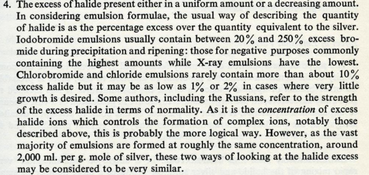
Oh fantastic, Im planning to build pretty much the same system, ive attached the stepper motor, driver and Arduino mega and am getting the motor to turn quickly but cant get it to step slowly. Ya for the precipitation method you are using, you need an excess of bromide if you want a good grain size dispersion and as a result good contrast. your recipe has a 53% bromide excess so should have an OK amount of contrast. you can go up to 250% excess

I've attached some multi jet addition patents I've found that might give a bit of info.

What sensitisers do you have? If you want speed you will need at least a sulphur and gold sensitiser.

Btw if you use erythrosine, it needs to go in before precipitation, its an acid dye and needs to be present during precipitation for it to properly adhere to the halide grains and work properly. You can also add eosin to super sensitize the ortho bit and make it isochromatic.(between ortho and pan)
 

Attachments

  • halide concentrations.png
    halide concentrations.png
    342.4 KB · Views: 159
  • double jet (mentions oswald).pdf
    711.7 KB · Views: 150
  • fast double jet recipes.pdf
    1.4 MB · Views: 138
  • More double jet recipes featuring gold sensitisation (patent).pdf
    862.1 KB · Views: 127
I want to start making emulsions, the issue is that I want to achieve a fairly high speed. I understand that it's all trial and error, but I want to at least start from a somewhat faster recipe and to have a fair understanding of what went wrong in a certain batch and how to fix it. Based on Photo Engineer's posts here and some literature I've put together what seems like a logical recipe. Well, at least it seems logical to me as I have 0 knowledge to notice any errors.
Here it is (it's a PE's SRAD recipe modified to be core-shell based on info in his posts "The placement of Iodide in emulsions", "A very high speed film formula" and picrelated)

A solution
Gelatin 4.615 grams
Potassium Iodide 0.23 grams
Water 130 ml

B solution
Silver nitrate 20 grams
Water 60 ml

C solution
Potassium Bromide 20.307 grams
Water 31 ml

D solution
Potassium Iodide 0.23 grams
Water 5ml

E solution
Potassium Iodide 0.23 grams
Water 5ml
Heat all to 45 deg C

Add 28% ammonium hydroxide to B with stirring until a clear solution results.
Take 2.5ml of solution B, add 2.5ml of water=sol.F

Add F -> A over 2 minutes, 2000rpm/highest setting of stirrer
Let it sit at 45C for 5min with no stirring
Add B, C, E
Flow rate for B=6ml/min
Flow rate for C=3.1ml/min
Flow rate for D=2.5ml/min
Flow rate for E=1.25ml/min

Hold for 30 minutes at 45 deg C. after everything was added

adjust gelatin percent to the desired level (5 - 10%), let stand for 2 hours or until at room temperature.

Shred into noodles and wash. (make sure all salts and ammonia are removed), "I use 4 deg C for my wash"
Add spectral sensitizing dye and hold at 45 deg for 15 mins. You use a dye at about 20 - 100 mg / mole of silver.
Coat with a hardener and surfactant.
Does it have any obvious errors? The gelatin percent level after precipitation affects only coating parameters, not grain, right? There are "recipes" for erythrosine sensibilization in Mikhailov's "Techminimum" and Baker's "Photographic emulsion technique", but it, as well as sulfur sens. depends on surface area of grains, right? How do I approximate how much dye and thiosulphate I should use?
Duffin states that some antifoggants give a slight increase in speed, and benzotriazole seems to be one of them. How do I calculate how much to add?

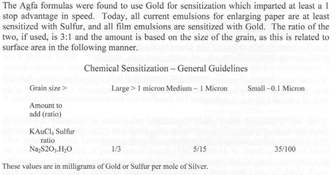
I have a document here that I typed up to work out weights and amounts for a patent I want to replicate, I also have a snippet from photo engineers book that should answer your surface area question.
 

Attachments

  • sensitiser amounts.png
    sensitiser amounts.png
    122.7 KB · Views: 160
  • Emulsion dopant recipe v1.pdf
    250.6 KB · Views: 175
Oh fantastic, Im planning to build pretty much the same system, ive attached the stepper motor, driver and Arduino mega and am getting the motor to turn quickly but cant get it to step slowly. Ya for the precipitation method you are using, you need an excess of bromide if you want a good grain size dispersion and as a result good contrast. your recipe has a 53% bromide excess so should have an OK amount of contrast. you can go up to 250% excess

I've attached some multi jet addition patents I've found that might give a bit of info.

What sensitisers do you have? If you want speed you will need at least a sulphur and gold sensitiser.

Btw if you use erythrosine, it needs to go in before precipitation, its an acid dye and needs to be present during precipitation for it to properly adhere to the halide grains and work properly. You can also add eosin to super sensitize the ortho bit and make it isochromatic.(between ortho and pan)

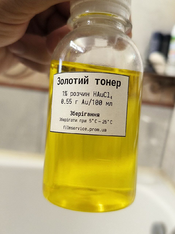
I have picrelated, probably could make aurothiocyanate. Regarding sensitising dyes, for now-erythrosine and maybe chlorophyll, it is mentioned in a 1800s German book. In theory though, I probably can get any dye I need custom-synthesized, there is still an institute in Kyiv that researched sensitisers for soviet photoindustry. Thanks for the heads-up abt erythrosine, I already did find this info, but still appreciate it.
 

Attachments

  • изображение_2023-12-28_180119736.png
    изображение_2023-12-28_180119736.png
    1.4 MB · Views: 142
Try this:

A. Salts solution
Distilled water – 100ml
Potassium bromide – 12g
10% solution of Potassium iode – 5ml
Gelatin – 2.5g

B. Silver solution (room temperature)
Distilled water – 100ml
Silver Nitrate – 10g

C. Gelatin
Gelatin – 12.5g

D. Sulfur sensitizer
sodium thiosulphate pentahydrate sol 1:1000 – 10 ml
10% sol sodium carbonate anhydrous – 4 ml
fresh chicken egg albumen dilute 1:1 with water – 20 ml

E. hardener. (optional)
5% Chrome Alum solution – 1ml

F.
Spectral sensitization (optional)
(Bath) 2 minutes:
Distilled Water..................................200 Ml
Ammonia (25-28%)........................... 3 Ml

Transfer Now For 3 Minutes To:
Distilled Water............................. 200 Ml
Ammonia (25-28%).............................3 Ml
Stock Sol Erythrosine I: 500 ........10 Ml (1g erythrosine, 250ml distilled water, 250ml ethyl alcohol)
(capacity 6 plates of 4x5)


Heat up A to 55*C, Add 20% of B over 5-10 seconds with vigorous agitation
Start adding rest of B at a rate of 1ml in 10 seconds (pause 5 second) over 20 minutes.
Hold 10 minutes in 55*C with frequent agitation.
Take off the heating and add C, agitate about 10 minutes until dissolved.
Cool to room temperature and place in refrigerator (in light proof box) until hard set.
Shred and wash.(30 minutes in ice cold water. 5 changes of water)
Melt emulsion, add D and heat up to 55*C. Ripen for up to 3h (for first time is best to take small 50ml amount and do a test batch. ripen for 90 minutes and then smear small amount on paper every 20 minutes up to 4 hours- develop it normally - look for signs of fog - last sample without the fog will be your ripening time.
Proceed with rest of emulsion for a time you tested. adjust water to correct level (150ml if you took a test batch or 200ml for full amount) - you can also adjust volume with ethyl alcohol if you plan to coat it straight away.
This emulsion is capable of ISO 30
 
Last edited:
looks like a solid formula, might i suggest tho that the erythrosine be added to solution A, it is usually only really effective if used during the precipitation so it becomes part of the halide grains as they form.
 
looks like a solid formula, might i suggest tho that the erythrosine be added to solution A, it is usually only really effective if used during the precipitation so it becomes part of the halide grains as they form.

Yea. Erythrosine can be a part of formula. I read that bath is as effective as adding dye to the emulsion (bromide can suppress effect of erythrosine) specially for non ammonia formulas.
Another thing, for a first batch is better if done without it anyway. test for fog, cover glass plates, test emulsion, check ISO etc. and then if you wish you can sensitize it with erythrosine bath. If all would be fine you can do next batch already sensitized to green and yellow.

Spectral sensitization bath is useful for panchromatic emulsion. (you can do emulsion in normal way under safe light, cover glass plates etc. and do panchromatic part as the last (and only) thing that require darkness. Its so much easier to do for amateur than all the steps in darkness.
btw. I found a panchromatic sensitization bath based on pinacyanon and pinaverdol but google (and other search engines) show limited results (and no source of pinaverdol at all) it maybe an old, old way not available today...
Did anyone heard about it?

Other way I read about (just shortly going trough search engine) is to do pinacyanol bath of plates sensitized with erythrosine - maybe its better then to add erythrosine to the emulsion.
 
Last edited:
Other way I read about (just shortly going trough search engine) is to do pinacyanol bath of plates sensitized with erythrosine - maybe its better then to add erythrosine to the emulsion.
panchromatic sensitisation leaves you in the dark, I've found a dye that acts as a super sensitiser to erythrosine and gives it almost panchromatic sensitivity, up to 620nm, eosin y, I found it sold as a microscope slide stain. Add the erythrosine and the eosin y right at the beginning. They are both acid dyes which means that (by some mechanism im not fully clued in on) the dyes are only properly active when they are present during the precipitation. Dyes like pinacyanol are not acid dyes and work fine when added after the emulsion is made.
 
Hello everyone!
I am brand new to this forum and it is good to know that I am not the only one loosing their mind trying to cook a decent emulsion.

I have seen some of the recipes from other posts here and I have also made up the baryta coating as suggested by Photo Engineer (extremely helpful!).

However, I am not getting constant results no matter how precise I replicate the recipes. My greatest trouble is that the Chloro-Bromide emulsion is always resulting in very warm prints. I am aiming at a more neutral print. Furthermore, I would rather an emulsion that is variable contrast.

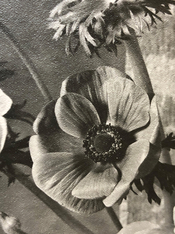
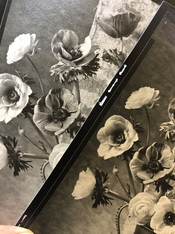
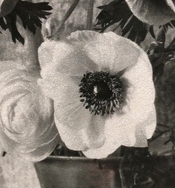
The two photos below show the same negative printed on:

Chloro-Bromide emulsion exactly as described in Denise Ross's book coated using a mayer rod over a baryta coating exactly as described by Photo Engineer also coated with a mayer rod over Fabriano Artistico.

Developed using Ilford MGD 1:9, stopped and fixed using Arista fixer. Wash, wash, wash and stab.

I am about to try a recipe adding Cadmium Chloride that has been omitted from Ross's recipe.

Any insights?

Thanks!!
 

Attachments

  • IMG_1307web.jpg
    IMG_1307web.jpg
    1,006.5 KB · Views: 138
  • IMG_1306web.jpg
    IMG_1306web.jpg
    1.2 MB · Views: 136
Have you tried a normal bromide emulsion? Chloro-Bromide emulsions by default give warmer images if im not mistaken. You might also try doping the emulsion to adjust the characteristics, here is a patent that talks about that.
 

Attachments

  • minolta dopant (patant).pdf
    558.7 KB · Views: 115
Welcome to Photrio @TarekMourad !
I wonder if perhaps your chlorobromide paper fogs; the highlights look a little compressed. Have you tried masking a piece of paper and developing it?

PS: I think your progress so far is already quite phenomenal!
 
Hello Koraks!

Thanks for the kind words!

I have tried overexposing paper to test for the deep blacks and they are there. I have not tried developing an unexposed paper. Will do that now.

Cheers!
 
Your dmax looks excellent!
If the unexposed paper test doesn't give any hints of fog, I'd suggest that the color you're seeing is just the inherently warm color of your emulsion. Grain size seems to be the dominant factor in silver image hue; you might find that altering the variables of the ripening process yields a cooler or warmer tone - it will also affect the speed of the emulsion.

You can of course always try gold toner to get more neutral or even decidedly cool tones. I bet your emulsion tones very beautifully.
 
I am back...

Before talking about the photos below, I have a few remarks to rectify regarding my previous post...

1- I just realize that the batch of emulsion I used had been refrigerated as leftover (already containing all the finals) and was reheated and coated.

2- The baryta coating revealed a problem. The baryta I am aiming for is somewhat like the old Oriental Seagull paper that has a pearly opalescence to it. You cant really see it in the pic below because to see the opalescence you need to handle the paper (or move in front of a framed photo to get the effect). To add to the problem, I used lithopone (70% barium sulfate / 30% zinc sulfide as an alternative to the very hard to find barium sulfate. Even in areas that were not coated with emulsion (see the small patch near #18), the baryta coating turned a deep cream. My chemistry knowledge is very limited but I suspect the zinc sulfide might be the culprit.

Now to the tests below:

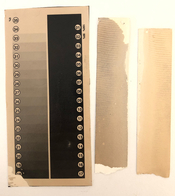
The scale I used is a "homemade" scale printed on offset film using 300 lines. Each number represents almost 3% in density.

The scale sample shows steps ranging from #34 all the way up to #8 (not so visible in the phone pic). Above 8 it is all black and there is no visible difference between 34 and 35.

The sample in the middle was developed unexposed, stopped, fixed and washed.

The third sample was not developed and just fixed and washed. Comparing both, there seems to be some fogging but when you look at the step test, it looks closer to the sample that did not go into developer.

I will prepare a new sample on Monday keeping things more controlled by:

1- Making a fresh baryta coating with barium sulfate
2- Making a fresh opalescent baryta coating with barium sulfate
3- Making a fresh emulsion introducing the Cadmium Chloride

Hope to come back with some fresh news soon.

All the best!

PS: I was still not able to source some gold chloride for toning but hope to do so soon.
 

Attachments

  • IMG_1328web.jpg
    IMG_1328web.jpg
    801.4 KB · Views: 117
  • IMG_1329web.jpg
    IMG_1329web.jpg
    680.7 KB · Views: 130
Photrio.com contains affiliate links to products. We may receive a commission for purchases made through these links.
To read our full affiliate disclosure statement please click Here.

PHOTRIO PARTNERS EQUALLY FUNDING OUR COMMUNITY:


Ilford ADOX Freestyle Photographic Stearman Press Weldon Color Lab Blue Moon Camera & Machine
Top Bottom