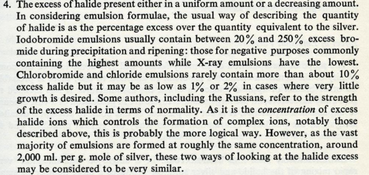
I want to start making emulsions, the issue is that I want to achieve a fairly high speed. I understand that it's all trial and error, but I want to at least start from a somewhat faster recipe and to have a fair understanding of what went wrong in a certain batch and how to fix it. Based on Photo Engineer's posts here and some literature I've put together what seems like a logical recipe. Well, at least it seems logical to me as I have 0 knowledge to notice any errors.
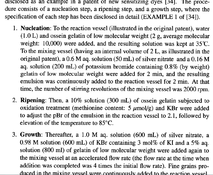
Here it is (it's a PE's SRAD recipe modified to be core-shell based on info in his posts "The placement of Iodide in emulsions", "A very high speed film formula" and picrelated)
A solution
Gelatin 4.615 grams
Potassium Iodide 0.23 grams
Water 130 ml
B solution
Silver nitrate 20 grams
Water 60 ml
C solution
Potassium Bromide 20.307 grams
Water 31 ml
D solution
Potassium Iodide 0.23 grams
Water 5ml
E solution
Potassium Iodide 0.23 grams
Water 5ml
Heat all to 45 deg C
Add 28% ammonium hydroxide to B with stirring until a clear solution results.
Take 2.5ml of solution B, add 2.5ml of water=sol.F
Add F -> A over 2 minutes, 2000rpm/highest setting of stirrer
Let it sit at 45C for 5min with no stirring
Add B, C, E
Flow rate for B=6ml/min
Flow rate for C=3.1ml/min
Flow rate for D=2.5ml/min
Flow rate for E=1.25ml/min
Hold for 30 minutes at 45 deg C. after everything was added
adjust gelatin percent to the desired level (5 - 10%), let stand for 2 hours or until at room temperature.
Shred into noodles and wash. (make sure all salts and ammonia are removed), "I use 4 deg C for my wash"
Add spectral sensitizing dye and hold at 45 deg for 15 mins. You use a dye at about 20 - 100 mg / mole of silver.
Coat with a hardener and surfactant.
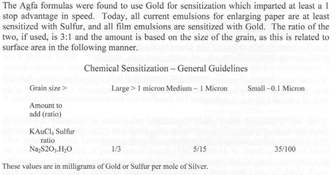
Does it have any obvious errors? The gelatin percent level after precipitation affects only coating parameters, not grain, right? There are "recipes" for erythrosine sensibilization in Mikhailov's "Techminimum" and Baker's "Photographic emulsion technique", but it, as well as sulfur sens. depends on surface area of grains, right? How do I approximate how much dye and thiosulphate I should use?
Duffin states that some antifoggants give a slight increase in speed, and benzotriazole seems to be one of them. How do I calculate how much to add?
Here it is (it's a PE's SRAD recipe modified to be core-shell based on info in his posts "The placement of Iodide in emulsions", "A very high speed film formula" and picrelated)
A solution
Gelatin 4.615 grams
Potassium Iodide 0.23 grams
Water 130 ml
B solution
Silver nitrate 20 grams
Water 60 ml
C solution
Potassium Bromide 20.307 grams
Water 31 ml
D solution
Potassium Iodide 0.23 grams
Water 5ml
E solution
Potassium Iodide 0.23 grams
Water 5ml
Heat all to 45 deg C
Add 28% ammonium hydroxide to B with stirring until a clear solution results.
Take 2.5ml of solution B, add 2.5ml of water=sol.F
Add F -> A over 2 minutes, 2000rpm/highest setting of stirrer
Let it sit at 45C for 5min with no stirring
Add B, C, E
Flow rate for B=6ml/min
Flow rate for C=3.1ml/min
Flow rate for D=2.5ml/min
Flow rate for E=1.25ml/min
Hold for 30 minutes at 45 deg C. after everything was added
adjust gelatin percent to the desired level (5 - 10%), let stand for 2 hours or until at room temperature.
Shred into noodles and wash. (make sure all salts and ammonia are removed), "I use 4 deg C for my wash"
Add spectral sensitizing dye and hold at 45 deg for 15 mins. You use a dye at about 20 - 100 mg / mole of silver.
Coat with a hardener and surfactant.
Does it have any obvious errors? The gelatin percent level after precipitation affects only coating parameters, not grain, right? There are "recipes" for erythrosine sensibilization in Mikhailov's "Techminimum" and Baker's "Photographic emulsion technique", but it, as well as sulfur sens. depends on surface area of grains, right? How do I approximate how much dye and thiosulphate I should use?
Duffin states that some antifoggants give a slight increase in speed, and benzotriazole seems to be one of them. How do I calculate how much to add?
Attachments
Last edited: