
Background: I read the Chiba Process PDF, and I've been trying to make a print from hide glue and watercolor pigment for a little while now, mostly failing with problems like dramatic staining issues, but with enough almost-successes to keep me at it. This was the first time I was able to get a few layers down with no catastrophe.
Materials
Paper: Canson XL Watercolor paper. I used the smoother side.
Pigment: Ancient Winsor & Newton Series 1 026 Ivory Black watercolor paint bought at a thrift store
Hide Glue: From Amazon, "Hide Glue Granules/Crystals, 251 Gram Strength"
Gelatin: 200 bloom beef leaf gelatin from pantry
Sensitizer: FAC from Jacquard cyanotype kit
Paper prep
Paper was soaked for about 10 minutes. Then I squeegeed it on both sides, spread 3ml of 3% gelatin onto the back side of the paper, and squeegeed the paper onto a piece of glass. The paper will stay on this glass throughout all layers, so registration will be simplified.
Now I prepared 9ml of 3% gelatin + 0.15g FAC and spread this over the front of the paper and let it dry for several hours, under a fan after the first hour or so. Then I exposed under my UV lights for 5 minutes, immersed in 0.3% hydrogen peroxide, and rinsed with several baths of warm water. Without this step, I get intermittent to constant horrible paper paper staining. I'm not sure I need so much gelatin, but I did try a single unpigmented glue layer, and that was not enough.
Image layers
For the pigmented glue solution: I made a 3% w/v solution of glue. Then I put 5g paint in a small bottle and added the glue solution to make 60ml total (this is about 8.3% w/v). The sensitizer solution is a 1.5% w/v solution of FAC in distilled water. I mixed 1ml of the glue solution with 1ml of the pigmented glue and brushed it on the image area, which here is about 6.75" by 5". I let it dry for about 20 minutes under a fan before exposure.
After exposure, I immerse the print in 400ml of 0.3% hydrogen peroxide solution, usually for about one minute as I get hot water from the tap. I then pour 1L of hot water directly into the hydrogen peroxide solution. After waiting for about 30 seconds, I pour more warm/hot water over the image to wash away the softened glue. This is typically enough to completely clear the glue from the highlights, and I remove the print from the water after maybe three minutes total, probably less.
So far I have not been precise with the temperatures, the hot water is just hot water from the tap. Since I pour that directly into the room temperature hydrogen peroxide, the development water is more warm than hot, and this does not seem to be warm enough to melt the gelatin holding the paper to the glass. A little bit more warmth and I can separate them.
Clearing FAC stain
I tried to clear some of the yellow stain with a 20 minute, 1% bath in disodium EDTA at room temperature. It didn't do much to clear the yellow, and there was a loss of density. I'm not sure what concentration/time would be appropriate, and I'm not 100% sure my EDTA dissolved fully.
Observations/comments
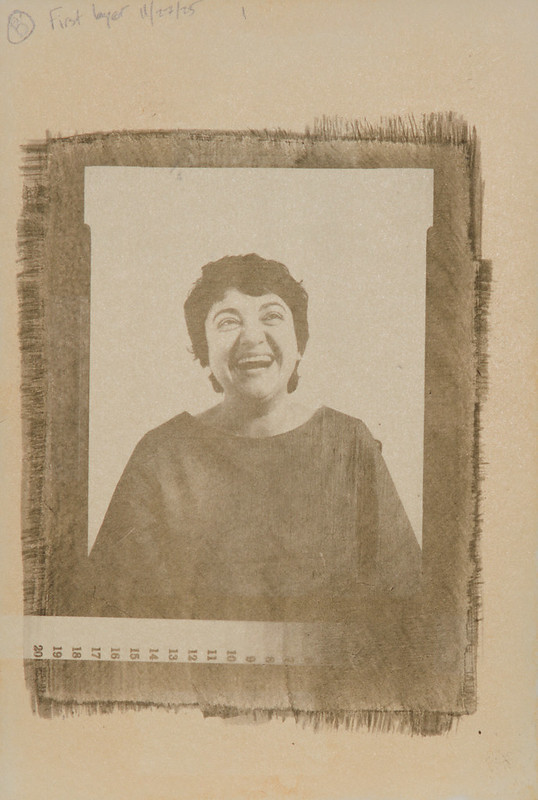
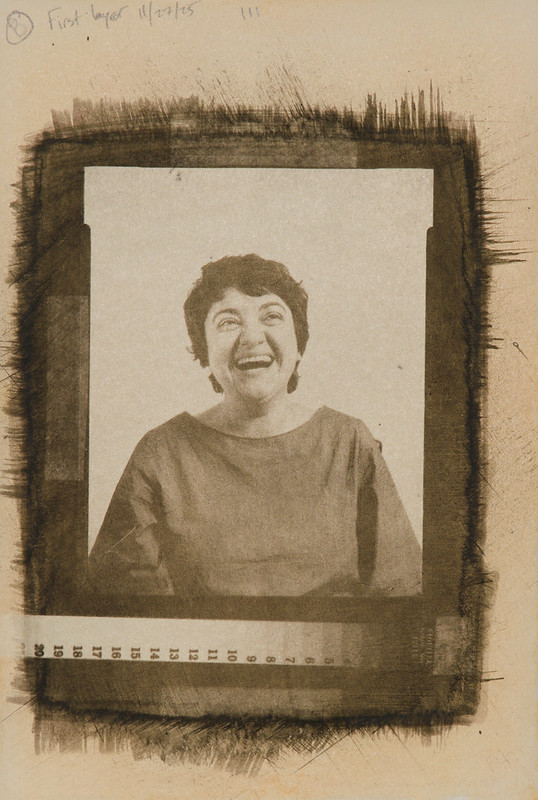
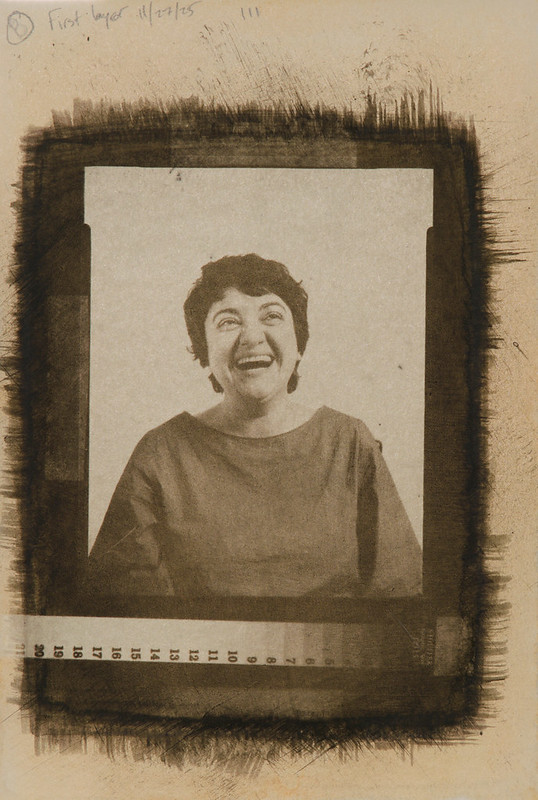
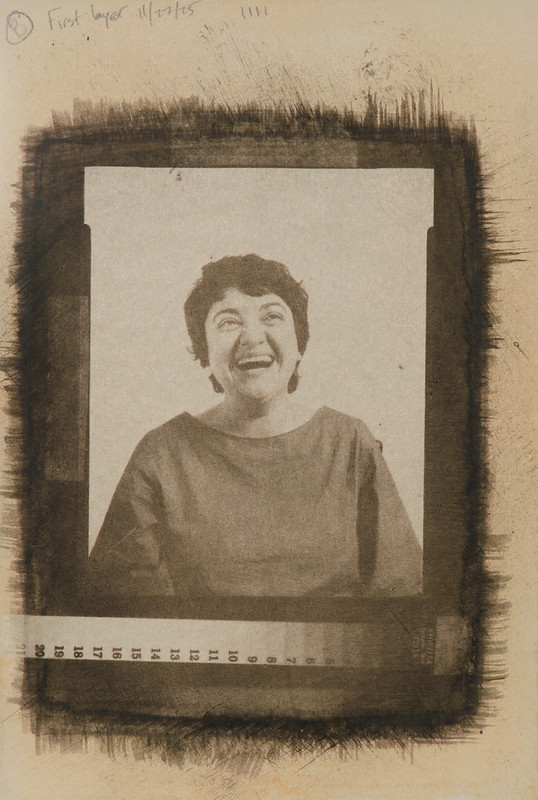
The exposure times for the layers, in order: 16, 44, 8, and 11 minutes. You can see that the high values from layer 2 were lost after layer 3 -- steps 10 and 11 have some density in layer 2, but are completely gone in layer 3. Next time I will probably try a negative with a smaller density range (this one is somewhere in the 1.4-1.6 range depending on whether you want any texture on the background). I will also print my layers from shorter to longer times, which I think will be a bit more predictable since I won't have to worry about the highlights washing away.
Images are here, layers 1-4 and then the attempt at clearing some FAC stain:
Materials
Paper: Canson XL Watercolor paper. I used the smoother side.
Pigment: Ancient Winsor & Newton Series 1 026 Ivory Black watercolor paint bought at a thrift store
Hide Glue: From Amazon, "Hide Glue Granules/Crystals, 251 Gram Strength"
Gelatin: 200 bloom beef leaf gelatin from pantry
Sensitizer: FAC from Jacquard cyanotype kit
Paper prep
Paper was soaked for about 10 minutes. Then I squeegeed it on both sides, spread 3ml of 3% gelatin onto the back side of the paper, and squeegeed the paper onto a piece of glass. The paper will stay on this glass throughout all layers, so registration will be simplified.
Now I prepared 9ml of 3% gelatin + 0.15g FAC and spread this over the front of the paper and let it dry for several hours, under a fan after the first hour or so. Then I exposed under my UV lights for 5 minutes, immersed in 0.3% hydrogen peroxide, and rinsed with several baths of warm water. Without this step, I get intermittent to constant horrible paper paper staining. I'm not sure I need so much gelatin, but I did try a single unpigmented glue layer, and that was not enough.
Image layers
For the pigmented glue solution: I made a 3% w/v solution of glue. Then I put 5g paint in a small bottle and added the glue solution to make 60ml total (this is about 8.3% w/v). The sensitizer solution is a 1.5% w/v solution of FAC in distilled water. I mixed 1ml of the glue solution with 1ml of the pigmented glue and brushed it on the image area, which here is about 6.75" by 5". I let it dry for about 20 minutes under a fan before exposure.
After exposure, I immerse the print in 400ml of 0.3% hydrogen peroxide solution, usually for about one minute as I get hot water from the tap. I then pour 1L of hot water directly into the hydrogen peroxide solution. After waiting for about 30 seconds, I pour more warm/hot water over the image to wash away the softened glue. This is typically enough to completely clear the glue from the highlights, and I remove the print from the water after maybe three minutes total, probably less.
So far I have not been precise with the temperatures, the hot water is just hot water from the tap. Since I pour that directly into the room temperature hydrogen peroxide, the development water is more warm than hot, and this does not seem to be warm enough to melt the gelatin holding the paper to the glass. A little bit more warmth and I can separate them.
Clearing FAC stain
I tried to clear some of the yellow stain with a 20 minute, 1% bath in disodium EDTA at room temperature. It didn't do much to clear the yellow, and there was a loss of density. I'm not sure what concentration/time would be appropriate, and I'm not 100% sure my EDTA dissolved fully.
Observations/comments
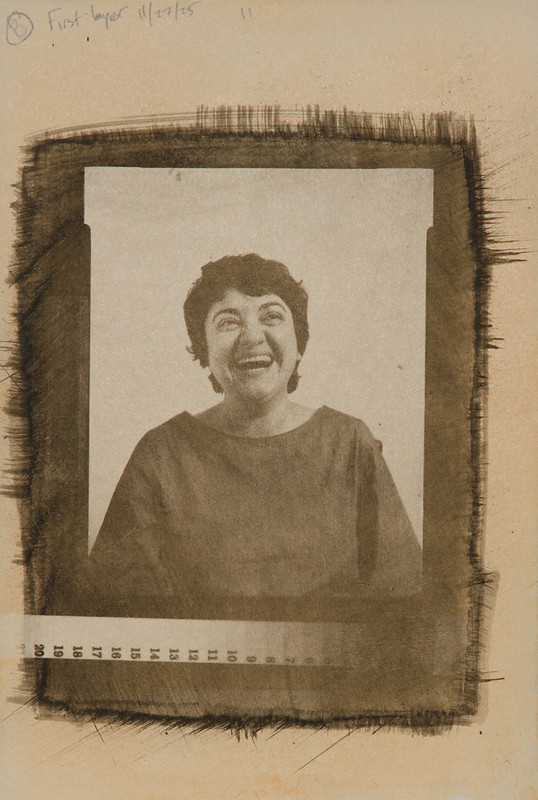
The exposure times for the layers, in order: 16, 44, 8, and 11 minutes. You can see that the high values from layer 2 were lost after layer 3 -- steps 10 and 11 have some density in layer 2, but are completely gone in layer 3. Next time I will probably try a negative with a smaller density range (this one is somewhere in the 1.4-1.6 range depending on whether you want any texture on the background). I will also print my layers from shorter to longer times, which I think will be a bit more predictable since I won't have to worry about the highlights washing away.
Images are here, layers 1-4 and then the attempt at clearing some FAC stain:
Last edited:


