

• Welcome to Photrio!
    Registration is fast and free. Join today to unlock search, see fewer ads, and access all forum features.
    Click here to sign up

ADOX D-76 introduced

Recent Classifieds

Forum statistics

Threads
202,853
Messages
2,846,602
Members
101,570
Latest member
Justgregor
Recent bookmarks
0

ADOX Fotoimpex

Partner
Partner
Allowing Ads
Joined
Nov 20, 2005
Messages
892
Location
Berlin
Format
35mm RF
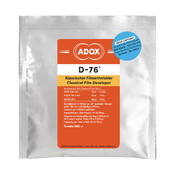
We are proudly announcing ADOX D-76.
It is the newest product from our powder line.

The Kodak “Developer-76” recipe is a photography legend next to Rodinal, gaining almost universal recognition as the go-to developer for photojournalistic work during the WWII and post war era.

D-76 is a universal, easy-to-use developer with a multitude of applications with the most different films and contrast situations, always delivering fine grain and great speed-utilisation.

ADOX took the classical formula and, while keeping all the important original properties and developing times, brought it up to the modern standards. The new ADOX D-76 has significantly lower dissolving temperatures, as well as the Captura® technology for dust-free mixing. Additionally, all the borates were removed and replaced with a non-toxic biodegradable buffer. The ADOX D-76 powder developer is made in Germany, with both research and post-production quality control carried out on site. The product is available in 1l and 5l packs.

The ADOX D-76 developer can be used exactly like the Kodak D-76, with the already-published D-76 times, dilutions and factors.

Available now at FREESTYLE and FOTOIMPEX.
 

Attachments

  • ADOX-D76-1l.jpg
    ADOX-D76-1l.jpg
    1.6 MB · Views: 187
This is good to see - what is the expected stability of the powder in its packaging?

We cannot say this at this point. The product has not been on the market long enough. Theoretically it should not be inferior to what has been sold in the last two years by our competitors. There are many things you can do wrong in manufacturing photochemistry. We are confident we do everything right but with every new product you need verification of this assumption, so answering you a number would be reading the glass bowl.
Our oldest storage tests date back 6 months now.
 
FWIW, powder chemicals, even mixtures like developer packets, generally have a very good record for shelf life while the packets are sealed. I've mixed Dektol and Xtol that were more than ten years past the expiration printed on the bags, with no problems.
 
FWIW, powder chemicals, even mixtures like developer packets, generally have a very good record for shelf life while the packets are sealed. I've mixed Dektol and Xtol that were more than ten years past the expiration printed on the bags, with no problems.
Thank you for your efforts!
 
FWIW, powder chemicals, even mixtures like developer packets, generally have a very good record for shelf life while the packets are sealed. I've mixed Dektol and Xtol that were more than ten years past the expiration printed on the bags, with no problems.
Good info, thanks - I know I've heard of some issues specifically with developers, with people saying they're more sensitive than some other chemicals and break down on a shorter timescale.

I especially like the Adox packaging in 1l increments, that's a lot better for me than having to mix up a whole gallon at a time.
 
@ADOX Fotoimpex Thank you for bringing this product to the market. Quick question: since this is a D76 equivalent developer, which datasheet do you recommend for determining the starting times: Ilford's or Kodak's? It is well known that D76 and ID-11 have different times for some films like HP5+.

I realize that I am asking a question about someone else's products, but just in case you've looked into it.
Thank you.
 
which datasheet do you recommend for determining the starting times: Ilford's or Kodak's?

This was answered in the first post in this thread:

ADOX D-76 developer can be used exactly like the Kodak D-76, with the already-published D-76 times, dilutions and factors.

I'd add to this that any published development time is a starting point; individual workers will need to adjust for their own preferences in final negative condition. Variations in water, thermometers, agitation scheme, exposure metering methods, and printing/scanning techniques can make more difference in the final "perfect" time/temperature combination than the difference between D-76 and ID-11.
 
Huge advantage is the Captura technology. The speed of dissolution is amazing. No dust in your space.
No doubt that this is a new product, new option, actually new and improved.
Don't buy to store 😊

Easy mixing, No dust!
 
This was answered in the first post in this thread

Maybe I wasn't clear... my question was basically about an explanation for ID-11 vs Kodak D76 datasheets, from the point of a real chemical manufacturer. Sorry, it's probably off-topic.
 
my question was basically about an explanation for ID-11 vs Kodak D76 datasheets, from the point of a real chemical manufacturer. Sorry, it's probably off-topic.

It's not off topic. The current Kodak D76 data sheet has incorrect times for pretty much every film. This was very firmly established in another thread. The times listed on the data sheets for the individual films are correct.
 
Maybe I wasn't clear... my question was basically about an explanation for ID-11 vs Kodak D76 datasheets, from the point of a real chemical manufacturer. Sorry, it's probably off-topic.

What we can chip in to this is that we do not target publications from Kodak. We took a few bags of the latest version of D-76 from Sino Promise and made ours match the curves that this developer produced on the spot. So we can say that it works exactly like the last Sino Promise (Kodak license- branded) D-76. This does NOT mean that we verified all Kodak published times or publications. Neither did we compare it to ID-11.
 
We took a few bags of the latest version of D-76 from Sino Promise and made ours match the curves that this developer produced on the spot.

Then that means it should work just like it's supposed to according to the Kodak film sheets (not the Sino D76 sheet).


If you have problems comprehending geologic timescales, just think about how many epochs it took to dissolve all that borax before the lake dried up and they hitch'd the team of mules.

Buffers aside, I prefer a more soluble alkaline for DIY mixing, so kudos to Adox 👊
 
Borax is a convenient alkali for mixing from scratch, if you live somewhere you can buy it easily (I can get a kilo or so any time the local supermarket is open -- and there has been plenty of confirmation that the 20 Mule Team product is pure enough for most photographic uses). In EU, that's apparently not the case.

The (unspecified) buffering system that Adox has developed also has the advantage of holding pH better than original D-76 (Kodak's commercial product has managed this for some decades as well). If you mix your own D-76 according to the original published formula, you'll find the activity increases for a week or so after mixing (due to pH rising).
 
Why did the strong man lift 100 lb. bags of Borax? He heard it would make him buffer!
And he got them free from Germany, because there Borax is classified as a GIFT!
 
FWIW, powder chemicals, even mixtures like developer packets, generally have a very good record for shelf life while the packets are sealed. I've mixed Dektol and Xtol that were more than ten years past the expiration printed on the bags, with no problems.

"While the packets are sealed". This was the achilles heel of some Kodak chemistry a while back.
 
Photrio.com contains affiliate links to products. We may receive a commission for purchases made through these links.
To read our full affiliate disclosure statement please click Here.

PHOTRIO PARTNERS EQUALLY FUNDING OUR COMMUNITY:


Ilford ADOX Freestyle Photographic Stearman Press Weldon Color Lab Blue Moon Camera & Machine
Top Bottom
