
• Welcome to Photrio!
    Registration is fast and free. Join today to unlock search, see fewer ads, and access all forum features.
    Click here to sign up

Add contrast to Ilford Gallery paper #2

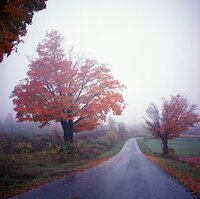
Rainy Day Trees

A
Rainy Day Trees

  • 5
  • 1
  • 79
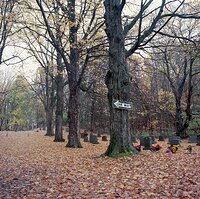
One Way

A
One Way

  • 3
  • 1
  • 76

Recent Classifieds

Forum statistics

Threads
203,154
Messages
2,850,683
Members
101,703
Latest member
arrowactive
Recent bookmarks
0
You can call it what you want but there are effectively 3 emulsions in current Ilford VC papers, each with a different sensitivity to green light, hence variable contrast.

The coating/blending process is another matter.

EDIT - Just realized my previous post was potentially misleading in the use of the word "layers" (I don't know if Ilford's current papers are coated with one "blended" layer of 3 emulsions, or if the three emulsions are coated in three layers). Apologies for the confusion.

They are coated as one emulsion layer with a gelatin Super-coat, that came from the horse mouth at Ilford :D

Ian
 
Guys, the difference I was getting on Galerie 3 by varying the green/blue component was anything but subtle. Please have a look at the scan enclosed in post #11 of the thread linked below, it is the same neg on the same uncut sheet processed at once. The only difference was the illuminant colour. Of course, this could have been all a mistake, old batch etc etc, hence I am keen to know if this is still the case with the current lots.

(there was a url link here which no longer exists)

So the image on right is lighter. Why do you suppose that is?

How sharp is the cut off of the green filter? Do you know? Does the green filter actually transmit some wavelengths in the blue region of the spectrum? Do you know? How sharp is the cutoff of the blue sensitive emulsion layer? Does the wavelength band that the emulsion is sensitive to extend out into the green and/or UV regions of the spectrum.

When you have ascertained the answers to these questions then it may be possible to give a correct answer as to what and why your images repsond in the way they do to your filtration changes.
 
The scans Rafal posted show a marked difference in contrast.

Yes but interpreting WHY they show a difference is easy to get wrong if you don't know the answers to the questions I asked.

Forst of all the one on the right is going to be lighter because a lot of blue is going to be blocked by green. But also the one on the right has no deep blacks so basically the print is under exposed because a lot of blue has been taken out. So how do you get a deep black but 1/2 grade softer to bring the highlights back in?
 
Rob, the filtration (green and blue) in my experiment was produced by the well-known Ilford 500H system. You can find out the cut-off frequencies online from the service manual. Assuming we knew them, how would this change the explanation of the fact there is a clear, marked difference in contrast between the two exposures, from the current hypothesis that this paper responded to varying green/blue light mixture by offering different contrast, somewhat as VC papers do?

As for your other question:

So how do you get a deep black but 1/2 grade softer to bring the highlights back in?

I am not sure I understood your question, sorry. Are you asking me about the left or the right test strip, or is it a more general question about balancing contrast to a desired shadow and highlight?
 
Firstly I think you have just killed contrast and blacks by using green and secondly the OP wants to increase contrast of G2. But assuming OP has some G3 paper I don't think you will be able to get a decent looking print by using adding some green filter. It will just make the print look muddy/veiled. But I may be wrong.
 
Ah, I think I understand you, but please correct me if I am wrong, RobC. You seem to suggest that the green filter had the effect of reducing contrast of Galerie 3, in comparison to the effect I have produced with the blue filter, or the white light.

What remains to check, then, is if the blue filter had the effect of increasing contrast compared to that obtained with the white light, which I expect it would, by about half a grade. Since the OP is looking for about a half a grade variation to what he is getting with Galerie 2, I would still strongly recommend trying out my experiment. Until someone does, and proves it to be no longer the case, it would remain a fairly simple method of varying graded papers' contrast, possibly easier than using multiple developers.

To your comment about being unable to obtain a decent looking print by using a green filter, I'd say that you may be quite right, but only assuming that the grade so obtained would have been the wrong grade. If that is the grade the printer is looking for, a wonderful print is as likely to come out as by using a different method of reducing contrast of their paper.
 
Photrio.com contains affiliate links to products. We may receive a commission for purchases made through these links.
To read our full affiliate disclosure statement please click Here.

PHOTRIO PARTNERS EQUALLY FUNDING OUR COMMUNITY:


Ilford ADOX Freestyle Photographic Stearman Press Weldon Color Lab Blue Moon Camera & Machine
Top Bottom
