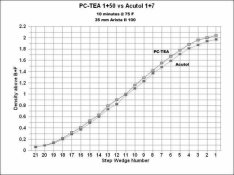
I looked up several things. I had saved my letter to Scarpitti describing the comparison photos, etc, that I sent him. I compared Acutol 1+14 with PC-TEA 1+50 for grain, gradation and sharpness. If I had developed FP4+ (Arista 100) for 10 minutes in Acutol 1+7, it would not have been printable on grade 2.5 as I stated in my letter. The characteristic curves I posted must have been mislabeled. At the time, I was still recovering from meningo-encephalitis. That takes a long time. It caused loss of memory connections, which can also be caused by aging, which is frustrating because there are things I know are in my memory, but I can't remember their names. Not that I'm getting old. I'm only 81. Here is the letter.
Mike,
I got my FP4+ and Acutol and have done a comparison of Acutol with my single solution
PC-TEA as I proposed a while ago. I shot 36 exposures of the same scene at the same exposure
with the camera on a tripod. The exposure was determined by incident reading with a Luna Pro
meter. I developed 2 short pieces, one in Acutol as per your tables that I found on the net by
Googling, and one in my PC-TEA developer composed of phenidone, ascorbic acid and
triethanolamine.
Acutol 1:14 at 7 minutes, 70 o F has a little less contrast than my developer at 7 minutes, 70 o
F. All the necessary detail is there in both, and the difference was made up in printing the Acutol
negative with a #2.5 Ilford MG filter on AGFA RC VC paper. The #3 filter was a little too
contrasty for my taste. I made these prints on my Beseler 23C condenser enlarger with APO
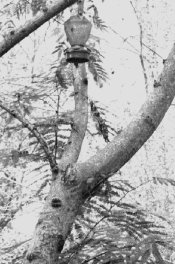
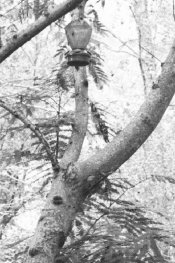
Rodagon 50 mm lens at 5.6. If you are going to see any difference in grain, it will be at the base
of the tree trunks in the Iris leaves. You will need at least a 5 X loupe.
You are right that Acutol is a very good developer. I think I am right also that my PC-TEA is
a very good developer. The major point I was trying to make with my mixtures cannot be shown
in a single test, as it involves the storage life of the stock, but the fact that sulfite is not needed to
make a fine grain high sharpness developer is shown. Nevertheless, if sulfite is required, it can be
added to the working solution through the B part, along with any other chemical that is not
soluble in glycol or TEA. In point of fact, a part A comprised of phenidone and hydroquinone
must have an amount of sulfite in the B solution in order for the superadditivity between
phenidone and hydroquinone to be activated. This amount need only be a gram or so per liter of
working solution. Without it, the hydroquinone-phenidone combination is a staining developer
akin to pyrogallol or catechol.
I am sending by UPS a package containing the unused part of the test roll and a small
amount of the PC-TEA developer along with some graphs for FP4+ in PC-TEA at 70 o F
prepared by Sandy King. These graphs are for 1 + 50 dilution. On the graph of H&D curves each
line has numbers that tell developing time, effective film speed, contrast index, and SBR in F-
stops that a paper with exposure scale of 1.55 could accommodate. This is a very wide range
paper because he is mostly interestd in so-called alternative processes such as platinum and
Kallitype. That would be about a No. 1 paper in graded silver. The curve for 10 minutes would
be about right for #2 paper and a SBR of about 5 stops, which is about the range of the scene I
used. It was an overcast day.
You will notice that the effective film speed does not drop below 100 even at the lowest
contrast indices