

• Welcome to Photrio!
    Registration is fast and free. Join today to unlock search, see fewer ads, and access all forum features.
    Click here to sign up

Acutance - is there something real behind the hype?

Forum statistics

Threads
203,279
Messages
2,852,228
Members
101,756
Latest member
rsj1360
Recent bookmarks
0
Thanks Sandy. Have you a link to the two-bath Pyrocat technique? Obviously with roll film you are using either a "manual" tank, or your Jobo at very low-or even intermitten agitation, correct? Yes, I will bring out the Leica with my associated lenses and tripod! Might I ask what you recommend as "high resolution film"? I'd like to try to compare negatives with my 4x5 with the 35mm as discussed above. By the way, from the standpoint of sharpness, I would guess that there is no way that the prints could approach 8x10 contact prints......or could they?

So much fun to follow....:}...isn't it great to have mentors here on APUG?
 
Thanks Sandy. Have you a link to the two-bath Pyrocat technique? Obviously with roll film you are using either a "manual" tank, or your Jobo at very low-or even intermitten agitation, correct? Yes, I will bring out the Leica with my associated lenses and tripod! Might I ask what you recommend as "high resolution film"? I'd like to try to compare negatives with my 4x5 with the 35mm as discussed above. By the way, from the standpoint of sharpness, I would guess that there is no way that the prints could approach 8x10 contact prints......or could they?

So much fun to follow....:}...isn't it great to have mentors here on APUG?

There are some general directions for using Pyrocat as a two-bath developer at the end of my article on pyrocat formulas and mixing in the article section of APUG. (there was a url link here which no longer exists)

This is based on development in tanks with the film on stainless steel reels, which I find to be a very convenient method of developing MF B&W film.

For MF I don't find the need for anything better than Acros, Tmax-100 or Delta 100, and of these Acros is my favorite because of its very low reciprocity failure. Some of the ASA 25 and 50 films are potentially capable of finer grain but unless you are makig huge prints there won't be much advantage over one of the main line ASA 100 films.

As for 35mm versus 8X10, you could never match the detail of an 8X10 contact print with 35mm.You might be able to match apparent sharpness.

Sandy King
 
There was an argument 25+ years ago that 35mm Technical Pan was capable of matching 5x4 in terms of quality, and many well known US photographers were using the film and getting good results, but it totally lacked acutance and micro-contrast compared to conventional 5x4 films & even 120.

The argument also fell down because Technical Pan was available in 5x4 :D

Ian
 
To what extent does developing to enhance micro-contrast limit enlargement size? My guess is that effect would look best at one size and quickly fall apart with larger sizes. That was my experience with developing 35mm TMX with minimal agitation in FX-1. (That was done a long time ago.)
 
Regarding the contact print-as I had suspected of course.

Thanks Sandy!
 
To what extent does developing to enhance micro-contrast limit enlargement size? My guess is that effect would look best at one size and quickly fall apart with larger sizes. That was my experience with developing 35mm TMX with minimal agitation in FX-1. (That was done a long time ago.)

Done with care with 120 & particularly 5x4 it should make little difference, but as you point out final print size is an important factor, which is why I've kept being a bit pedantic.

As developer. choice of film & format and method of agitation all make a big difference it's a case balancing the acutance to suit your needs.

Steve Sherman has it right in that it's how it affects the final print that's important, but it's equally important to be able to get similar effects in prints from 35mm & 120 which are being greatly enlarged (ratherb than contact printed) and that requires slightly different technique.

Ian
 
Last edited by a moderator:
Wirelessly posted (Palm680/RC2 Mozilla/4.0 (compatible; MSIE 6.0; Windows 98; PalmSource/Palm-D053; Blazer/4.5) 16;320x320)

Retro acutance, by which I mean acutance as it was in the 50's and 60's with Adox thin emulsions,gives grainy results with engraving-like sharpness.
Adox/Efke film in FX-1 or similar agitated only every 3 min gives this result.Unlike the Acros example it is mainly due to edge effects.
 
Ian,

I really can't dispute your claim for the only developers I have ever used are PyroCat HD and PMK.

Going all the way back to what got me involved in this thread in the first place, the acutance component of the process is secondary to me.

The process allows one to control micro contrast to such a degree that the entire literal scene is significantly altered, a byproduct of that phenomenon is higher acutance through adjancey effects. Herein lies the creative possibilities of Reduced Agitation Dev.

For whatever reason very few choose to discuss those attributes of the process. Very likely the word "acutance" is what got me involved in the thread in the first place, hoping to launch a discussion in the direction of the possibilities beyond increased apparent sharpness.

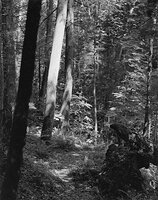
If Peter is interested in sending me his address I will forward him a print shown here which was developed using the RA method and let a third party evaluate and report his perceptions.

Cheers

Steve

That's a great picture by any measure! Congratulations.
 
This really has me thinking with respect to especially the pinhole work that I do. When I first started using my 6x6 pinhole camera (ZeroImage), it was all Plus-X film and Rodinal 1+200. This gave me highly printable negatives for the most part, and with enough agitation I managed to stay away from bromide drag problems.
With my current processing I can extend development, and this works fine for all my standard work, but I feel like my pinhole images are lacking something that I can't put my finger on. There is less bite to them.

I may have to revisit highly dilute developers for the pinhole work. I have some Pyrocat-HD at the house I can mix up and give it a go.

Every time I see that picture of yours, Steve, I get inspired... :smile:

- Thomas

Ian,

I really can't dispute your claim for the only developers I have ever used are PyroCat HD and PMK.

Going all the way back to what got me involved in this thread in the first place, the acutance component of the process is secondary to me.

The process allows one to control micro contrast to such a degree that the entire literal scene is significantly altered, a byproduct of that phenomenon is higher acutance through adjancey effects. Herein lies the creative possibilities of Reduced Agitation Dev.

For whatever reason very few choose to discuss those attributes of the process. Very likely the word "acutance" is what got me involved in the thread in the first place, hoping to launch a discussion in the direction of the possibilities beyond increased apparent sharpness.

If Peter is interested in sending me his address I will forward him a print shown here which was developed using the RA method and let a third party evaluate and report his perceptions.

Cheers
 
Would a divided FX-1 work? And if so, would there be any advantage over, say, a 1-bath reduced agitation scheme?
 
FX-1 part A working solution contains only 0.5g/L metol,Thornton's 2 bath has 6.5g/L metol.Also there must be enough sodium sulfite to remove the oxidation product of the metol,in 1 bath solution this is about 5g/L, in 2 bath it would have to be found by experiment.See also the formula suggested by Bill Troop,it may work without the ppd:
www.apug.org/forums/forum37/59223-microdol-x-replacement-19.html
Also google 'troop kodak sd-5'
 
Last edited by a moderator:
There was an argument 25+ years ago that 35mm Technical Pan was capable of matching 5x4 in terms of quality, and many well known US photographers were using the film and getting good results, but it totally lacked acutance and micro-contrast compared to conventional 5x4 films & even 120.

The argument also fell down because Technical Pan was available in 5x4 :D

Ian

To paraphrase an old race car analogy from the USA:

There ain't no substitute for square inches...
 
Back to the old discussion :smile:

Did this lead any tests? Any results?


What I can tell so far is that yes - the border effect is there.
I have seen it quite well (I should say too well) with Fuji Neopan 400 developed in Pyrocat-HD 1:1:100 using partial stand (minimal agitation?) method, ie. constant agitation for initial 60 seconds, then 10 seconds at every 3rd minute.

I wrote too well, as that method gives so visible border effect that it's way too strong when using 135mm film and enlarging prints to 5x7" size.

It really gives the similar feel like a watching over USM'd digital print.


So far my own conclusion is that chasing of the border effect / extreme acutance with minimal or stand agitation isn't the very good choise until the film negative size is big enough, perhaps bigger than MF..
 
Jukka, you're the first to concur with what I've said many times about acutance developers, it really is a case of matching technique to format and it raelly does look like an over sharpend Digital image if over done. That's why I never used Paterson Acutol-S after testing it with FP4 in the 70's :D

I tried all the formulae back then and personally think high acutance developers & techniques probably are best left to format like 5x4 or larger.

Ian
 
Photrio.com contains affiliate links to products. We may receive a commission for purchases made through these links.
To read our full affiliate disclosure statement please click Here.

PHOTRIO PARTNERS EQUALLY FUNDING OUR COMMUNITY:


Ilford ADOX Freestyle Photographic Stearman Press Weldon Color Lab Blue Moon Camera & Machine
Top Bottom
