
• Welcome to Photrio!
    Registration is fast and free. Join today to unlock search, see fewer ads, and access all forum features.
    Click here to sign up

A mystery for a film-sherlock...

Forum statistics

Threads
203,279
Messages
2,852,254
Members
101,756
Latest member
rsj1360
Recent bookmarks
0

tkmusgrave

Member
Allowing Ads
Joined
Feb 9, 2009
Messages
11
Format
35mm
Hey all, back here at the photolab. Here are the facts; work your magic!

- A student came in with a contact sheet like this and none of us can figure out what happened. There's a light strip down the entire length of the film.

-If you look closely, there are ever-so-slight lines going across it from perf to perf...or at least the beginnings of the lines.

-The person she developed with (in a double-tank) had something similar to this, though not as light of a strip (his reel was on the bottom).

:confused: But I figure the lighter strip is so irregular that it can't be an in-camera issue, and it doesn't seem to be a developing issue because it goes all the way down the entire film-strip. :confused:
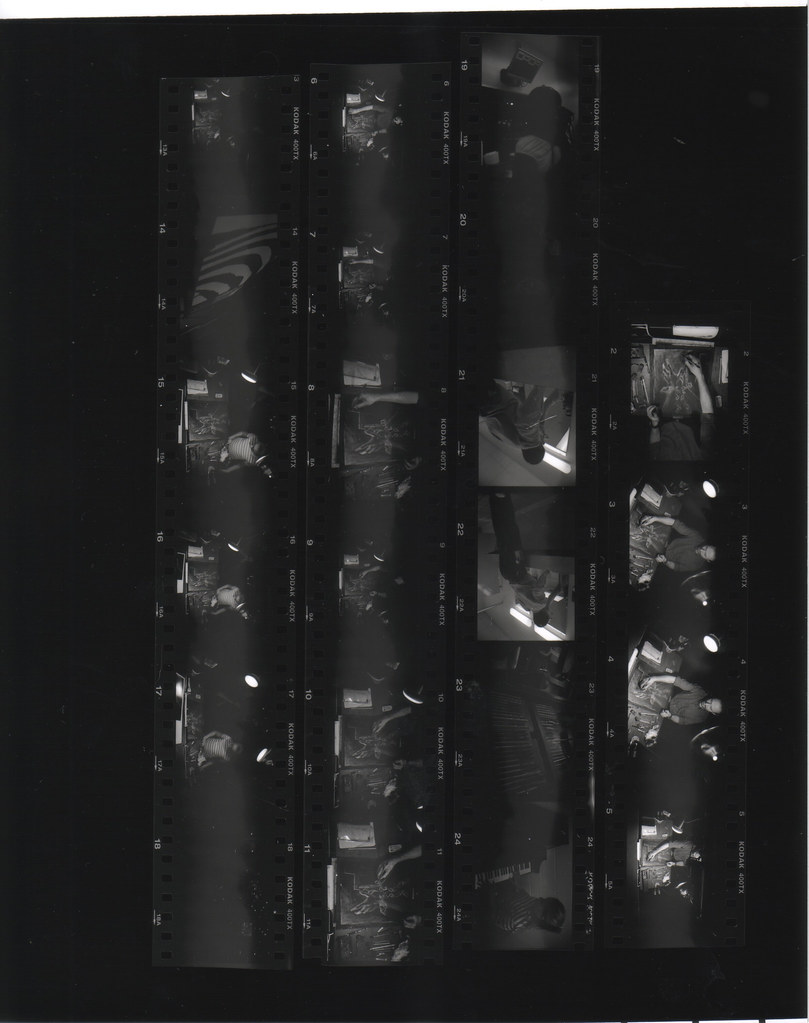
4309565743_389edb385c_b.jpg


If you can't see as well or if the picture won't work, go here and see if you can look closer....

I'm all ears...
 
I would say incomplete fixing combined with inadequate agitation during fixing. You should look at the negs to see if they have a slight milky appearance. Additional fixing should solve the problem.
 
My guess is improper aggitation for the type of tank causing uneven dev and/or fixing.

vaughn
 
Lets be more clear on this please. There is a dark streak down the middle of the film which causes the lighter streak down the middle of the proof sheet strips we see, right?

If so, then the center either got more development or less fixation for whatever reason.

PE
 
Does either
1. fixing w/o agitation
or
2. incomplete fixation

result in less fixation in the central areas?

I can't say yes with 100% confidence, so
I am thinking film stick as being involved here as a cause of any inefficient processing that occurred.
 
Does either
1. fixing w/o agitation
or
2. incomplete fixation

result in less fixation in the central areas?

I can't say yes with 100% confidence, so
I am thinking film stick as being involved here as a cause of any inefficient processing that occurred.

Yes. Absolutely yes. Watch it sometime. It's safe to open the tank after a minute or so in the fixer. If you keep agitation down to a minimum, you will see that the edges fix faster than the center. No, the film didn't stick to itself. That would look a lot worse.
 
You said this was a student? In that case, they most likely did what all my students do (despite my warnings) and fill the tank, then set it down and walk away instead of agitating.

Don't I know it! I help students decide on exposure times based on their test strips -- and when the print at the decided time turns out lighter or darker than the same exposure on the test strip, the first thing I ask is what their development time was.

If they give me sort of a blank look, I remind them about the concept of consistancy.

Vaughn
 
Thanks everyone for your input...I'll definitely be printing this out to show them. And @Vaughn, that last post is a serious eye-opener...a lot of the times I'll help them pick out the right exposure from their test-strips, and sometimes it's something little, like not remembering that they're exposing for a dark spot in their print. But sometimes, it completely boggles me why it's a completely different exposure from their test-strip. How does that link-up with developing?

Again, many thanks everyone!
 
You said this was a student? In that case, they most likely did what all my students do (despite my warnings) and fill the tank, then set it down and walk away instead of agitating.

I'm sure that I don't have as much experience as you, but wouldn't that cause an all-over problem. Maybe not since as was pointed out the center takes longer to fix. Also, it would be an easy catch if the student simply didn't agitate.

I'm guessing the lower reel got more exposure to fresh chemicals. I'm not entirely sure why that would be, though.
 
You said this was a student? In that case, they most likely did what all my students do (despite my warnings) and fill the tank, then set it down and walk away instead of agitating.
*************
If they don't walk away, then it is called "stand" development. Nyuck, Nyuck.:tongue:
 
Thanks everyone for your input...I'll definitely be printing this out to show them. And @Vaughn, that last post is a serious eye-opener...a lot of the times I'll help them pick out the right exposure from their test-strips, and sometimes it's something little, like not remembering that they're exposing for a dark spot in their print. But sometimes, it completely boggles me why it's a completely different exposure from their test-strip. How does that link-up with developing?

In my beginning photo class, some 33 years ago, I was told to look for the black I wanted on the test strip. I finally realized, many years later that this advise is back asswards. It seems much better to me to expose for the highlights in a B&W print, as Greg suggests, and control the blacks through one's contrast controls -- just like exposing and developing film, but in reverse. Though I suspect that the use variable contrast paper does throw in a wrench into this line of thought.

Actually there are two questions I ask of the student who brings me a test print that differs from the time suggested on their test strip. The first one is to make sure they developed the test strip and the test print for the same amount of time. Since the students do not develop to completion, a set amount of time in the developer is very important.

The other question I have to ask is if they used the same tray of developer for the test strip and print. We we are busy, we run two sets of chemicals in the sink, and as the two trays of developer are often used at different rates and are replaced at different times, one is often stronger than the other -- giving different results.

Vaughn
 
Photrio.com contains affiliate links to products. We may receive a commission for purchases made through these links.
To read our full affiliate disclosure statement please click Here.

PHOTRIO PARTNERS EQUALLY FUNDING OUR COMMUNITY:


Ilford ADOX Freestyle Photographic Stearman Press Weldon Color Lab Blue Moon Camera & Machine
Top Bottom
