

• Welcome to Photrio!
    Registration is fast and free. Join today to unlock search, see fewer ads, and access all forum features.
    Click here to sign up

A CURIOUS EFFECT

Tractor & Tulips

A
Tractor & Tulips

  • 1
  • 1
  • 34
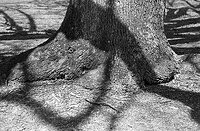
Tree with Big Shadows

Tree with Big Shadows

  • 3
  • 0
  • 82

Forum statistics

Threads
203,458
Messages
2,855,076
Members
101,853
Latest member
DJFOX
Recent bookmarks
0

tonyowen34

Member
Allowing Ads
Joined
Jan 22, 2017
Messages
50
Location
Anglesey, UK, 53.3N 4.4W
Format
Multi Format
Continuing the investigation of my 2 ½ x 3 ½ enlarger (or perhaps it should be 2 ¾ x 3 ¾ allowing 1/8 inch for each border) I have used an industrial 60w tungsten pearl bulb with the wattage and other information printed on the end of the bulb. [Domestic tungsten bulbs are not longer available in the UK]

I am surprised to note that the inscriptions/markings on the end of the bulb are not projected onto the baseboard of the enlarger.

The magnification, arbitrarily by the position of the enlarger head on its pole, is around 4x. The bulb is positioned (externally) to provide adequate and even illumination of the negative. The enlarger is fitted with two condensers arranged convex to convex. The lens has been used in the fully open (f4.5) setting.

However, whether through a negative or empty negative carrier no indication of the lettering of the bulb is apparent.

Does anyone have any explanation as to what I am experiencing?

Regards

Tony
 
With opal bulbs the light is pretty well scattered by the time it reaches the negative carrier. The enlarger should be set up so that it is the filament that could be imaged if the bulb were of clear glass. Then too the marking on the bulb is small compared to the area of the bulb.

However as a precaution true enlarging bulbs have their marking on the stem near the base.
 
Last edited:
whether through a negative or empty negative carrier no indication of the lettering of the bulb is apparent.
Why should there be?

The image plane which the lens focuses on the print is at the film emulsion.
The depth of focus in the emulsion is very shallow, small fractions of a mm.

The text on the bulb is far away from that image plane.

- Leigh
 
Last edited:
One does not want the print on the bulb nor the filament to show up on the print.
 
Why should there be?

The image plane which the lens focuses on the print is at the film emulsion.
The depth of focus in the emulsion is very shallow, small fractions of a mm.

The text on the bulb is far away from that image plane.

- Leigh
+1
 
It depends.
If you are using a condenser enlarger, the condensers may actually be focusing the light source. So a source that is uneven, due to visible text on the bulb, may illuminate the negative unevenly, and the pattern of that unevenness will be the pattern of the text.
 
It's invisible on an individual print... But... If there is any un-evenness... you'll only notice it after you post a dozen prints on APUG Galleries.... and then look at your content.
 
Thank you all for your responses. The non-enlarger lamp was used solely for test purposes [I have one enlarger lamp but many industrial tungsten lamps)
On other enlargers I've owned - the projected printing of any non-enlarger lamp fitted was always been obvious - hence the reason for the posting.
With the testing of this enlarger all negatives - and I tried several - ware sharply in focus on the baseboard
The implied conclusion is that under certain circumstances I do not need to use a dedicated enlarger bulb?????
regards
Tony
 
Continuing the investigation of my 2 ½ x 3 ½ enlarger (or perhaps it should be 2 ¾ x 3 ¾ allowing 1/8 inch for each border) I have used an industrial 60w tungsten pearl bulb with the wattage and other information printed on the end of the bulb. [Domestic tungsten bulbs are not longer available in the UK]

I am surprised to note that the inscriptions/markings on the end of the bulb are not projected onto the baseboard of the enlarger.

The magnification, arbitrarily by the position of the enlarger head on its pole, is around 4x. The bulb is positioned (externally) to provide adequate and even illumination of the negative. The enlarger is fitted with two condensers arranged convex to convex. The lens has been used in the fully open (f4.5) setting.

However, whether through a negative or empty negative carrier no indication of the lettering of the bulb is apparent.

Does anyone have any explanation as to what I am experiencing?

Regards

Tony

Yes. The magic of optical design.

The enlarger consists of two optical systems coupled together: the condenser/illumination system, and the imager/magnifier.
On the condensor side, the image of the bulb (filament position) is focused onto the enlarger lens. The film plane (where the negative is placed) acts as the aperture stop for this system. In an optical system, the light is uniformly mixed at the stop, and thus the negative is uniformly illuminated by the source (bulb filament).

The enlarging lens, of course, focuses the negative onto the easel. Thus you get uniform illumination *and* a sharply focused negative imaged onto the easel. (That is according to the paraxial model...non-uniformities are introduced if the ray angles from the enlarging lens to easel are too steep...cosine^4 law).

As you may infer, the image of the filament (and the lettering on the bulb) image is nowhere near the focus of the enlarging lens via use of the condenser.

A diffuser head provides uniform illumination to the negative by acting as a near-perfect Lambertian source. Different way to get at a solution for uniform illumination.

The formal term is Kohler Illumination, although Kohler illumination most often refers to use for microscopy.
 
Last edited:
Photrio.com contains affiliate links to products. We may receive a commission for purchases made through these links.
To read our full affiliate disclosure statement please click Here.

PHOTRIO PARTNERS EQUALLY FUNDING OUR COMMUNITY:


Ilford ADOX Freestyle Photographic Stearman Press Weldon Color Lab Blue Moon Camera & Machine
Top Bottom
