

• Welcome to Photrio!
    Registration is fast and free. Join today to unlock search, see fewer ads, and access all forum features.
    Click here to sign up

6X24CM - 85MM Focal L. - 0.390MM Dia. Pinhole - What its sharpest, closest subject distance ?

Parliament Square.

A
Parliament Square.

  • 0
  • 0
  • 13
Courtyard

A
Courtyard

  • 1
  • 4
  • 31

Recent Classifieds

Forum statistics

Threads
203,325
Messages
2,853,039
Members
101,787
Latest member
bikepark64
Recent bookmarks
1

Mustafa Umut Sarac

Member
Allowing Ads
Joined
Oct 29, 2006
Messages
4,959
Location
İstanbul
Format
35mm
I am building an 6X24CM Panoramic pinhole camera. Curved plane radius is 85mm and pinhole diameter is around 0.39mm laser drilled. What is the closest but sharpest camera to subject distance for archaeology museum ?
 
If you want sharp, a pinhole is not a great choice.

I made it with curved plane for most available sharpness , Real lens is for summer time, when the life is easy
 
You should stay at least a half meter away from the subject for best results.
 
Resolution would be related to pinhole size and focal length.
 
I am building an 6X24CM Panoramic pinhole camera. Curved plane radius is 85mm and pinhole diameter is around 0.39mm laser drilled. What is the closest but sharpest camera to subject distance for archaeology museum ?

A pinhole is a diffraction-limited lens and theoretically has an almost infinite DOF, but it is never truly sharp.
 
I asked the resolution to gpt and it says 1 lpmm for my camera , it says image size 60kb. Is it too bad ?
 
Only you can decide.

Is there any photo may be 6X24 with that resolution you know ? Physics might indicate the average resolution of 6X24 Pinhole cameras are at that level ? It seems to me from the images , if we properly expose and develop , not bad.
 
There are plenty of examples of pinhole photos online. Have a look at them and decide for yourself.

For comparison, a 24" full-HD desktop computer monitor is about 1.8lpm, and an entry-level Samsung smartphone is around 8lpm. The main difference is that on these systems, pixels are sharply delineated so the images look crisp and sharp. A 1lpm photo will be visibly fuzzy. Also keep in mind that this is at life size; if you were to enlarge your 6x24cm image, resolution will of course scale down. Say you view it at 12x48cm it'll only be 0.5lpm, etc.

However, I wouldn't worry about resolution. You know a pinhole will give a fuzzy photo. That's the whole point. If you worry about this, then it's just not for you.
 
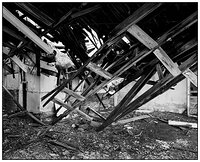
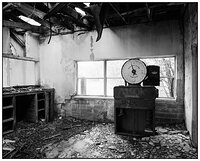
Here's some examples of that size. I'd say you can make an image of about 1024 pixels before softness starts to overtake any gain in detail.


Last edited:
Here's some examples of that size. I'd say you can make an image of about 1024 pixels before softness starts to overtake any gain in detail.

Hi loccdor , what do you mean with 1024 pixels ? Your Flickr images are excellent. I liked them a lot. Do you mean total image size - 6x24- was 1024 pixels ?
 
1024x256. Going beyond that to me didn't produce more detail.
 
1024x256. Going beyond that to me didn't produce more detail.

1024x256 : 256000 pixels ,Hmmm 1 line per milimeter pinhole resolution makes , 240 x 60: 15000 pixels it makes 1/15 of your resolution suggestion. But scanning interpolation improves the image or not ?
 
1 line per milimeter
"lpmm" or "lpm" refers to line pairs per millimeter. So if you want to turn that into pixels, it ends up being 2 pixels, since it takes two adjacent pixels to make a pair of lines.

240 x 60: 15000 pixels it makes 1/15 of your resolution suggestion.
You're getting lost in the woods thinking about the resolution of a digital medium in reference to a film-based image. This doesn't make a whole lot of sense.

The pinhole will be limited in resolution in the sense that it won't record much detail. However, the piece of 6x24cm film is still a large negative and you can scan that on any resolution you want. If you scan it at a high resolution, you will get many, many pixels. The digital image will be very fuzzy, but it will still be a larger digital image in terms of pixel dimensions.

Anyway, the whole discussion is IMO not very sensible; the example images @loccdor linked to earlier give an impression of what you can expect. They look fairly sharp to me as long as the size is kept limited to about 15cm (so a little smaller than life-size). At life-size and larger, they start to look fuzzy. Again, that shouldn't be a problem if your purpose is to leverage the unique look of a pinhole image. If you're using a pinhole because you can't afford a lens or don't know how to make a camera using a lens, you're setting yourself up for disappointment as a pinhole will never give you the same image that a lens will. That's why lenses exist.
 
Line pairs, not lines, so 1 lp/mm would be 480x120. I think you might get more like 1.3 lp/mm with your setup. That would be 624 * 156. But it's not a hard fall-off at this resolution so it's still worth going up to 1024x256. If you like to see grain, go up more, but you won't see more detail.
 
‘Pixel’ is not a unit of resolution. It is a container.
 
You can get as close as you want. .21mm hand-drilled hole, 30mm from 6x6cm frame. About 50mm away.

IMG_1614.jpeg
 
I made it with curved plane for most available sharpness , Real lens is for summer time, when the life is easy
The curved film plane should result in sharper corners, but I don't think it will affect sharpness in the center of the frame.

I asked the resolution to gpt and it says 1 lpmm for my camera , it says image size 60kb. Is it too bad ?
Like many Chat GPT answers, that makes no sense to me. I assume "kb" indicates the units are kilobytes, right? What do kilobytes have to do with a film camera? Nothing, until you digitize the image. And trying to define the sharpness of a piece of film with a scanner is problematic, to say the least.

BTW, kilobytes are the correct units when talking about FILE size, not "image size". The correct units for image size of a digital image are pixels. Because the file size for a given image can vary considerably, depending on file format and compression algorythms, file size is not a good indicator of image resolution.
 
Photrio.com contains affiliate links to products. We may receive a commission for purchases made through these links.
To read our full affiliate disclosure statement please click Here.

PHOTRIO PARTNERS EQUALLY FUNDING OUR COMMUNITY:



Ilford ADOX Freestyle Photographic Stearman Press Weldon Color Lab Blue Moon Camera & Machine
Top Bottom