• Welcome to Photrio!
    Registration is fast and free. Join today to unlock search, see fewer ads, and access all forum features.
    Click here to sign up

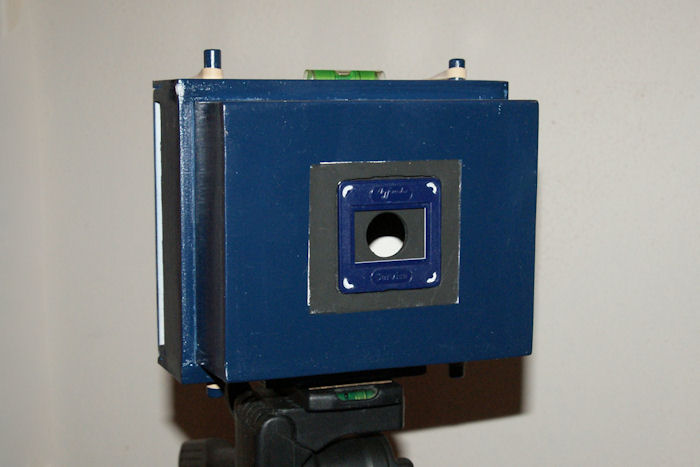
5x4 pinhole camera

Recent Classifieds

Forum statistics

Threads
203,474
Messages
2,855,357
Members
101,862
Latest member
Justagram
Recent bookmarks
0
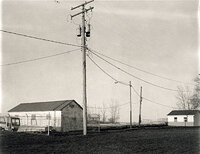
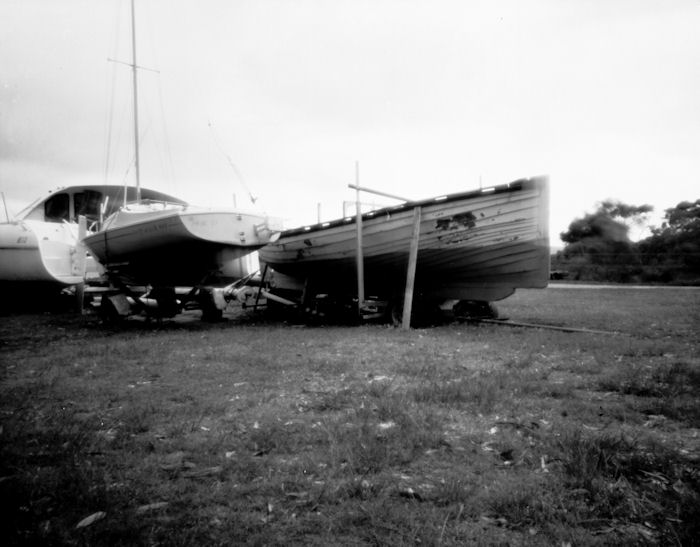
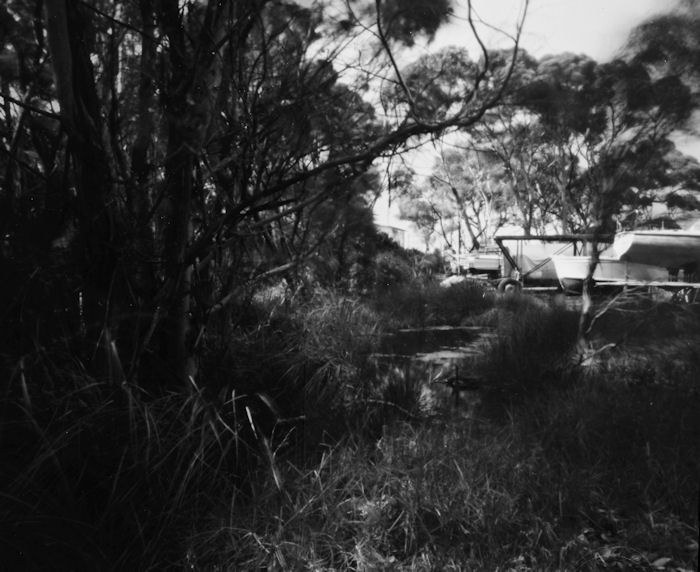
The weather wasn't that good for photography.but the camera needed testing.

Foma 100

Diafine 4+4


36 seconds exposure. tad over exposed


image hosting sites

18 seconds exposure
 
Thanks Horacekennneth
 
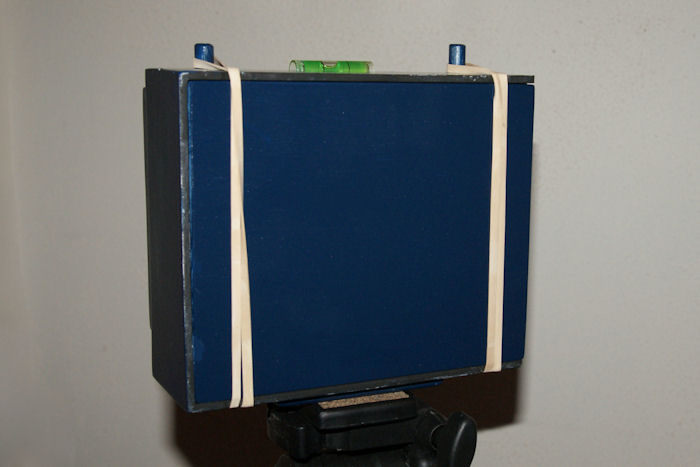
DW is that your camera with the rubber bands ?

Colin
 
Great web site Dave:smile: The quality of you craftsmanship is 110%
 
How did you decide on the right "focal" length? I'm thinking of making a 5x7 pinhole camera over Christmas...
 
Alexander. I'm not sure if it's the right focal length, but I wanted something that was on the wide side. If the diagonal of a 5x4 negative is about 150mm, that would give a normal angle of view . so 90- 100 mm should be wide angle. My aim was for a 90mm focal length.. but the woodworking skills aren't that good as it ended up at 88mm Colin
 
PS
Aexander.Best of luck with your Christmas project. I hope it all goes well and you post some pictures Colin
 
ColRay,

AWESOME! Thanks for sharing. Have fun and keep posting the results.
 
How did you decide on the right "focal" length? I'm thinking of making a 5x7 pinhole camera over Christmas...

Arguably there is no "right" focal length, but loosely speaking, a focal length equal to the film diagonal is a "normal" angle of view. At extremely wide angles of view, the pinhole -- even if 'perfect" -- becomes a narrow ellipse viewed from toward the edges and you get significant light fall-off. The numbers for my 4x5 referenced above worked out to about 104º angle of view; there's some fall-off but it's tolerable. With a program like Pinhole Designer you can play around with the parameters and see what looks interesting.

In general you set a couple of parameters and calculate the remaining number. For example, pick a film format and pick a pinhole-to-film distance based on angle of view, then calculate the optimum pinhole. Or if you inherited a pinhole plate, you might use that size and a film format to pick an optimum pinhole-to-film distance, etc.
 
Thanks for the responses. That's more or less what I thought, but it's nice to have confirmation. I thought ColRay's camera looked shorter than I would have expected, so that makes sense. Both cameras on this thread look similar to what I envision, though more elaborate. DWThomas, I'm curious about your tripod mount. That's the part I can't quite figure out (in my mind, I haven't started building yet). Is that a special part (the one with the four flanges)?
 
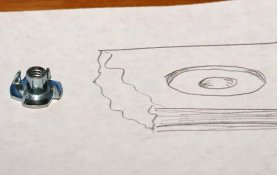
The tripod mount is a rectangle of plywood drilled and counter-bored to take a 1/4-20 "T-nut." That's a top hat shaped piece with a 1/4-20 thread inside, and some prongs sticking up from the 'brim' that get driven into the wood to prevent rotation. It's a common hardware store item used to provide sturdy metal threads in a wooden part. The plywood rectangle is then attached to the camera box with flathead screws from the inside. My failing on that was the screws were slightly long and the tips ended up being sanded down and showing. In the bit of CAD drawing showing in that picture you can see a crude cross-section of the T-nut in the plywood plate.

I actually used brass screws and stainless steel T-nuts which easily accounted for the bulk of my cost (well, and a can of flat black spray paint!), as most of the wood was leftover scrap.

A sample:

_G0398_Tnut_and_Sketch.jpg

The bore in the sketch would be against the camera body and the T-nut would be inverted and inserted in that hole before the block is attached to the camera, capturing the T-nut. I used two, one on the 5 inch side and one on the 4 inch so I can do horizontal or vertical formats.
 
Last edited by a moderator:
Ah, that explains it. Thanks, I'll have to look for one of those T-nuts. That's a good idea having one on each side, it hadn't occurred to me.
 
Ah, that explains it. Thanks, I'll have to look for one of those T-nuts. That's a good idea having one on each side, it hadn't occurred to me.

Don't forget the block the light from the holes in the t-nut...
 
I use the hammer on 'T' nuts that are made for screw on coffee table legs, they only cost a few dollars for a pack of four. I also use them with a plate the nut fits on the inside of the plate so no hole is needed on the camera body.
 
Last edited by a moderator:
Photrio.com contains affiliate links to products. We may receive a commission for purchases made through these links.
To read our full affiliate disclosure statement please click Here.

PHOTRIO PARTNERS EQUALLY FUNDING OUR COMMUNITY:



Ilford ADOX Freestyle Photographic Stearman Press Weldon Color Lab Blue Moon Camera & Machine
Top Bottom