

• Welcome to Photrio!
    Registration is fast and free. Join today to unlock search, see fewer ads, and access all forum features.
    Click here to sign up

3d Aerial Photograph in 1950s Germany

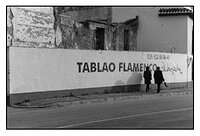
Tablao Flamenco

A
Tablao Flamenco

  • 1
  • 0
  • 38
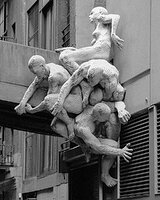
Untitled

A
Untitled

  • 1
  • 2
  • 91

Forum statistics

Threads
204,332
Messages
2,867,224
Members
102,225
Latest member
Narsanam
Recent bookmarks
0
Joined
Oct 29, 2006
Messages
4,972
Location
İstanbul
Format
35mm
I was buying lots of interesting photo magazines 20 years ago from antique book shops. There was a german magazine and experts were looking to the giant printed bw roll to check the aerial results.

I asked myself , how would it be possible to look one print and see in 3d ?

There was a desktop stereo magnifiers - I dont know their names- and wondered how would it been possible to look aerial pictures in 3d with printing on paper with 60 years old aerial technology ?
 
It is the same as stereo photography. The separation between the two pictures can be hundreds or thousands of meters, depending on how fast the plane flies. More separation between the two pictures, when viewed in stereo, makes the terrain look like a model train layout.

figure_1v2.jpg
 
I spoke with a man(British) who evaluated 3D aerial reconnaissance during WWII. He said after a couple weeks on the job he could free view them which he felt was faster and better. They used the magnifiers for detailed examination. He was looking at Burmese jungle for anti aircraft emplacements etc...
 
As the above video is restricted, here another that shows the intended overlapping of the exposures, to gain sight of the same place from different angles. That again yields stereoscopic view and precise relative heights mesurements.


The intended flight lines were established in advance and the operator/navigator had to keep the airplane on track over a line of established ground points, thus the visor.

If you look at two adjacent contact prints placed next to eacher (with parts of them maybe rolled out of view) with a mirror stereoscope you can achieve a stereoscopic view of the landscape quite easily. Even under such primitive setup you are able to make height measurements.

This stereoscopic photography was applied in standard map making, but also for something odd as weekly or so control of progress in open pit mining.

Today such rather plain photography is added by other means of range/height detection.
Also with satellite navigation there is no longer a need to control the flight line by sight, except for clouds.
 
Last edited:
...
If you look at two adjacent prints placed next to each other (with parts of them maybe rolled out of view) with a mirror stereoscope you can achieve a stereoscopic view of the landscape quite easily.
...

As a kid using a 127-format Brownie, I would make stereo photos of my neighborhood by placing the camera on the top of an outside stair railing, making the one photo, then sliding the camera over two inches for the second photo. I would put the prints side-by-side and stare at them crosseyed to produce the 3d image.

I've even done this recently at work with my phone's camera, then emailing myself the images for cropping and viewing on a monitor.
 
I,m working on a series of plates in 3D using models. I am about half way through. It is of an astronomical subject with some 1890's theme thrown in. The materials are collodion tins and negatives, and paper negatives for the closer scenes so a smaller stop can be used and not so long of an exposure and better depth of field.
 
Photrio.com contains affiliate links to products. We may receive a commission for purchases made through these links.
To read our full affiliate disclosure statement please click Here.

PHOTRIO PARTNERS EQUALLY FUNDING OUR COMMUNITY:


Ilford ADOX Freestyle Photographic Stearman Press Weldon Color Lab Blue Moon Camera & Machine
Top Bottom
