• Welcome to Photrio!
    Registration is fast and free. Join today to unlock search, see fewer ads, and access all forum features.
    Click here to sign up

2700K LED bulb step tablet test for paper contrast

IMG_1779.JPG

H
IMG_1779.JPG

  • 0
  • 0
  • 6
Frio River

A
Frio River

  • 1
  • 0
  • 26

Recent Classifieds

Forum statistics

Threads
203,578
Messages
2,856,640
Members
101,908
Latest member
lokiloki
Recent bookmarks
1

yya

Member
Allowing Ads
Joined
Mar 8, 2023
Messages
214
Location
Australia
Format
4x5 Format
Due to the poor quality of the current halogen bulbs and the difficulty of purchasing Philips bulbs, I’m facing a bulb shortage issue with my De Vere 504 condenser. As a result, I have to look for new solutions. I’ve explored discussions about LED bulbs on various forums, but none of them have conducted contrast tests using a step tablet.
Today, I conducted a test based on the method mentioned in the book Way Beyond Monochrome. You can find the detailed procedure by Googling "measure paper contrast," where a PDF document is available for reference.
For my test, I exposed two test strips:
  • Test Strip 1 was exposed using a 0 filter.
  • Test Strip 2 was exposed using a 5 filter.
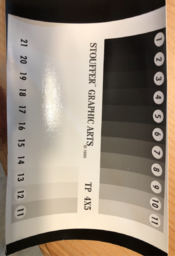
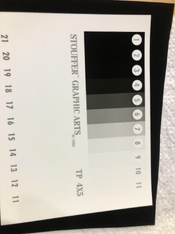
I used a 21-step step tablet for the test.
  • With the 00 filter, the results showed that step 12 had a density of 0.13 and step 2 had a density of 1.96. Based on the calculation, this bulb produced a contrast of R150 (VERY SOFT) under the 0 filter.
  • With the 5 filter, the results showed that step 8 had a density of 0.1 and step 3 had a density of 2.0. The calculated contrast was R70 (VERY HARD) under the 5 filter, though it did not reach the extra hard range.
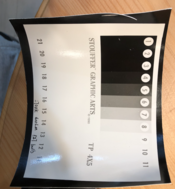
 

Attachments

  • Screen Shot 2025-01-04 at 10.53.56 pm.png
    Screen Shot 2025-01-04 at 10.53.56 pm.png
    1.2 MB · Views: 100
  • Screen Shot 2025-01-04 at 10.54.19 pm.png
    Screen Shot 2025-01-04 at 10.54.19 pm.png
    1.4 MB · Views: 98
That looks OK to me. What paper did you use?

BTW, there's no reason why you wouldn't be able to reach the entire range of the paper, from the softest to the hardest grade, with a white LED. There's nothing magic about LED light that somehow prevents this.
 
That looks OK to me. What paper did you use?

BTW, there's no reason why you wouldn't be able to reach the entire range of the paper, from the softest to the hardest grade, with a white LED. There's nothing magic about LED light that somehow prevents this.

foma fb paper
 
I see, so that would be Fomabrom Variant. I'd start by comparing the curve you got for the highest and lowest grades to the curve shown in the datasheet. You may find your results match those curves, while the ISO-R grades mentioned in the datasheet don't. It wouldn't be the first time a discrepancy shows up here. If you still note that your grade 5 curve is less steep than the one shown in the datasheet, try with a blue filter instead of your multigrade #5. It's possible the multigrade filter doesn't quite hit the hardest grade in your case.

All this is assuming you properly develop the paper to completion and the paper is reasonably fresh.
 
I see, so that would be Fomabrom Variant. I'd start by comparing the curve you got for the highest and lowest grades to the curve shown in the datasheet. You may find your results match those curves, while the ISO-R grades mentioned in the datasheet don't. It wouldn't be the first time a discrepancy shows up here. If you still note that your grade 5 curve is less steep than the one shown in the datasheet, try with a blue filter instead of your multigrade #5. It's possible the multigrade filter doesn't quite hit the hardest grade in your case.

All this is assuming you properly develop the paper to completion and the paper is reasonably fresh.

Can I ask which blue fiter you recommend?
 
Following along with this; a drop-in LED bulb that works well for split printing with #00/#5 filters is something I'd like to find.
 
Kodak #47 or similar.

Have you done the same test with a regular tungsten bulb btw? How did that work out?

Not yet
Due to different bulb, I need print new test strip to get print time, I don’t have enough time(sunset 8pm), but I will try recently
 
I just want to find a bulb with a rapid on/off, and which doesn't have a ton of afterglow. That's proven a bit elusive.

Using low-wattage bulbs(400lm) and extending the exposure time will reduce the impact of this issue on the paper.
 
All of the LED bulbs we use in our home answer to those requirements. I'm sure something along those lines is available where you live.

Really? Ours don't seem to do that at all; most of them have a perceptible rise/fall in illumination, regardless of type or brand. Out of five or six types, only one brand/wattage/color seems to snap on/off quickly, and I can even see a bit of ramping up/down with that one. 🤔

Using low-wattage bulbs(400lm) and extending the exposure time will reduce the impact of this issue on the paper.

Some of the ones that we have in our kitchen are around 350, but they have the same behavior as all the rest. I definitely don't want to extend my printing times, though; my best results come from much shorter exposures...and I have to do those for my test strips, anyway.

Hmmm...the search continues. Looking forward to your results on the painting. 👍
 
I am interested in LED bulbs for my Omega Condenser enlarger to replace the current PH213 - 250 watt bulbs . I would like more light if possible.
 
Would it help if you put a restive load across the lines to attenuate any stray voltage after the timer switch is opened?
 
Would it help if you put a restive load across the lines to attenuate any stray voltage after the timer switch is opened?

Nope. You could consider a proper snubber circuit, but I don't see what problem it would solve. Also, 'stray voltage' doesn't really exist. It's not like some power lingers in the line after switching off, that finds its way into the bulb. Well, there is, in the form of the parasitic capacitance in the wiring, but we're talking maybe double digit picofarads. That's orders of magnitude less than required to even get the bulb to light up.

The only thing a resistor across the lines would accomplish is some heating up and thus wasting a little extra power.
 
I use an off the shelf GE LED for my Meopta, and on occasion for my D3, there is a bit of afterglow. I can only see it if I take the lamp housing off and look a the blub and turn it on and off. When installed I cannot any afterglow on the baseboard or paper easel. I use a metronome when making test strips, and I cover the paper with cardboard after exposure. This is likely excessive as the afterglow is so faint that I don't think it will make a difference. In terms of contrast, I print VC, 2 to 3 grade filters, grade 3 paper seems to work fine. I have an old Kodak projective step wedge, square with pie shaped wedges used to determine exposure, I have used it as a step wedge, I guess I should see how the LED bulb works with grade 1 to 5 filters.
 
The latest results from the 47 filter test show that a 2700K LED bulb can easily achieve an R40 (0.3) contrast.
 

Attachments

  • new test.jpeg
    new test.jpeg
    101 KB · Views: 63
So the main difference with your earlier test is the use of a #47 filter instead of a grade 5 multigrade filter?

YES
I bought the filter from BH test the contract
 
I use Philips 213 bulbs for my work with the condenser enlarger Omega.... question has anyone tested LED for density difference ie slower or faster times?
 
I notice the most afterglow with "smart" bulbs that are turned off remotely. When you cut the power to them, they go dark much faster. The ultra-cheap LED bulbs I use in enlargers -- I have no idea if they have any afterglow. You won't get any discernible light from an afterglow through a lens at F5.6. A projection is very dim compared to the bare bulb.
 
Photrio.com contains affiliate links to products. We may receive a commission for purchases made through these links.
To read our full affiliate disclosure statement please click Here.

PHOTRIO PARTNERS EQUALLY FUNDING OUR COMMUNITY:


Ilford ADOX Freestyle Photographic Stearman Press Weldon Color Lab Blue Moon Camera & Machine
Top Bottom