• Welcome to Photrio!
    Registration is fast and free. Join today to unlock search, see fewer ads, and access all forum features.
    Click here to sign up

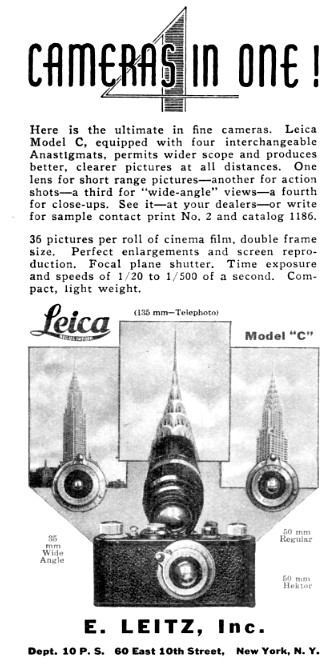
1931 vintage Leica ad ...

Recent Classifieds

Forum statistics

Threads
203,394
Messages
2,853,978
Members
101,817
Latest member
goodman1999
Recent bookmarks
0

dmr

Member
Allowing Ads
Joined
Sep 9, 2005
Messages
868
Format
35mm
This came from a vintage technology thread on "another network" and is attributed to Popular Science magazine.

Enjoy.
smile.png


18865-leica1931-h.jpg
 
I find the ad misleading. I mean, if someone got already the Hektor, I do not see why he should have added an Elmar,, thus that 4th-camera alternative practically was not existent. The same if one upgraded from the Elmar to the Hektor.
 
Very cool. I have a 1933 model F, mine has a built-in rangefinder, any lens other than the 5 cm requires a external viewfinder. Mine is well used.
 
Keeping in mind that this ad appeared during the earliest days of Leica, I don't see anything that indicates that this is sold as a kit, but rather to show the advantages of interchangeable lenses. My 1936 iiia cameras are going strong with clear viewfinders.
 
Keeping in mind that this ad appeared during the earliest days of Leica, I don't see anything that indicates that this is sold as a kit, but rather to show the advantages of interchangeable lenses. My 1936 iiia cameras are going strong with clear viewfinders.

The earliest Leicas needed the lenses adjusted to the body. They made a matched set. However, you didn't need to buy all the lenses. The camera in the ad may or may not have needed matched lenses, since it's so early.
 
Keeping in mind that this ad appeared during the earliest days of Leica, I don't see anything that indicates that this is sold as a kit, but rather to show the advantages of interchangeable lenses. My 1936 iiia cameras are going strong with clear viewfinders.

Yes, but I did not speak of being sold as kit, but that the ad says it being a kit or being turned into a kit. A kit of 4, which makes no senses to me, but is more impressive than a kit of 3.

Of course people here today might argue about the different bokehs the two standard lenses yield. But I doubt people back then bothered. For sure not in Germany, maybe in affluent America. It rather was a issue of which of the two being able to afford.
 
Yes, but I did not speak of being sold as kit, but that the ad says it being a kit or being turned into a kit. A kit of 4, which makes no senses to me, but is more impressive than a kit of 3.

Of course people here today might argue about the different bokehs the two standard lenses yield. But I doubt people back then bothered. For sure not in Germany, maybe in affluent America. It rather was a issue of which of the two being able to afford.

The concern would have been detail and sharpness and ability to enlarge the negatives to a decent size. No one would have cared in the least for out-of-focus rendering for a 50mm lens. So, I agree with you. Maybe the Hektor was mislabelled - maybe it was supposed to be the 28mm? The front element looks too big, though.
 
“Double frame size” (8 sprocket holes) reminded me that by convention 4 sprocket holes are single- frame (but usually referred to as half-frame)
 
The term "Double-Frame" format seems rare to me, from as it hints at 35mm cine film, to which still photographers wre not accustomed, but maybe the tem rather comes frome the industy.

Anyway, when did half-frame format (thus "Single-Frame") came up in still photography?
The oldest that right now comes up my mind is the Ducati Sogno from 1950.
 
Last edited:
The term "Double-Frame" format seems rare to me, from as it hints at 35mm cine film, to which still photographers wre not accustomed, but maybe the tem rather comes frome the industy.

Anyway, when did half-frame format (thus "Single-Frame") came up in still photography?
The oldest that right now comes up my mind is the Ducati Sogno from 1950.


The motion picture cameras were half the 35mm Leica frame.

1654790634551.png
 
Of course I know. And in the industry one thus may have called a 24x36 still format "Double", but seen from the perspective of a still photographer this would have looked strange as he was not aware of the respective "Single" format, but rather saw already the 24x36 format as miniature format. "Double" thus would have been a good marketing ploy of the industry. ("glass half empty" vs. "glass half full").
 
Yes, but I did not speak of being sold as kit, but that the ad says it being a kit or being turned into a kit. A kit of 4, which makes no senses to me, but is more impressive than a kit of 3.

Of course people here today might argue about the different bokehs the two standard lenses yield. But I doubt people back then bothered. For sure not in Germany, maybe in affluent America. It rather was a issue of which of the two being able to afford.

I think the Hektor (50/2.5, right?) was viewed as a special super-speed lens at the time. It's clear from the ad copy that they meant four lenses each for an application. I assume the Hektor is the one that corresponds to "action shots" and the 135mm is for "close-ups" - close-up in the "Mr. De Mille, I'm ready for my close-up" sense, not macro.

At the time a system of 4 lenses would have been much more than most people, including professionals, might own. It's like those 70s-80s SLR ad photos that showed 30 different lenses in the system. No one was expected to actually acquire all 30 lenses.
 
Wouldn't it have used a Summar? That was the first year of production, it was considered a very high speed lens for the time. It's still a great lens, one of the best I've ever used. A clean Summar is a good thing for sure.
 
I'm thinking Summar as well, and agree it is a fine lens.
 
Photrio.com contains affiliate links to products. We may receive a commission for purchases made through these links.
To read our full affiliate disclosure statement please click Here.

PHOTRIO PARTNERS EQUALLY FUNDING OUR COMMUNITY:



Ilford ADOX Freestyle Photographic Stearman Press Weldon Color Lab Blue Moon Camera & Machine
Top Bottom