
• Welcome to Photrio!
    Registration is fast and free. Join today to unlock search, see fewer ads, and access all forum features.
    Click here to sign up

19" Artar lens circa 1957

Tractor & Tulips

A
Tractor & Tulips

  • 0
  • 0
  • 10
Tree with Big Shadows

Tree with Big Shadows

  • 2
  • 0
  • 69

Forum statistics

Threads
203,456
Messages
2,855,025
Members
101,852
Latest member
keith1420
Recent bookmarks
0

vceinc01

Member
Allowing Ads
Joined
Mar 31, 2011
Messages
15
Format
35mm
Is it possible that Artar Lenses with serial numbers in the range of 773000 - 774000 (circa 1957) could have had quartz integrated into them, giving them the ability to focus in the UV spectrum? My understanding is that a lens manufactured with quartz is the only way that an image in the low (350nm - 250nm) ultraviolet range can focus.
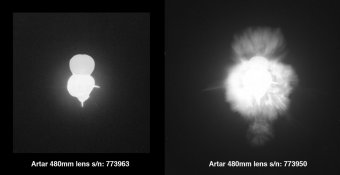
 
Is it possible that Artar Lenses with serial numbers in the range of 773000 - 774000 (circa 1957) could have had quartz integrated into them, giving them the ability to focus in the UV spectrum? My understanding is that a lens manufactured with quartz is the only way that an image in the low (350nm - 250nm) ultraviolet range can focus.


UV lenses can be made of calcium fluoride, fused silica (basically, glassy quartz), lithium fluoride, sapphire, and a few other materials. None of these materials are easy to work with. Fused silica might be the easiest. I believe Vycor also has good UV transmission, and it might be easier to work with than fused silica.
 
lens_comparison.jpg

These two pictures were of the same high energy event in 1957. One image appears to show sharp ionization around the event whereas the first image does not. The ionization is there, but is very dark and very soft. I believe this ionization of the air is fluorescing in the range of 250nm - 350nm in UV. But this range is just below a photographic image using ordinary glass for the lens. Any glass in the optics is going to cut down on the Ultra Violet. There something has to be special in the lens, no? There are no filters, both lens seem to have similar serial numbers. Both same focal length lenses (480mm), same f/stop (f/11). The one that shows the ionization clearly has a slightly greater exposure time but that doesn't account for why the ionization is very soft in the other picture.
 
Last edited by a moderator:
Photrio.com contains affiliate links to products. We may receive a commission for purchases made through these links.
To read our full affiliate disclosure statement please click Here.

PHOTRIO PARTNERS EQUALLY FUNDING OUR COMMUNITY:


Ilford ADOX Freestyle Photographic Stearman Press Weldon Color Lab Blue Moon Camera & Machine
Top Bottom