• Welcome to Photrio!
    Registration is fast and free. Join today to unlock search, see fewer ads, and access all forum features.
    Click here to sign up

18% Neutral Gray Paint?

Tompkins Square Park

A
Tompkins Square Park

  • 4
  • 0
  • 62
Siesta Time

A
Siesta Time

  • 1
  • 0
  • 44

Recent Classifieds

Forum statistics

Threads
202,859
Messages
2,846,675
Members
101,573
Latest member
IanSeehorn
Recent bookmarks
0
My beard is still not 18% gray. It has too much brown in it to use it as a standard for reflectance.
 
I don't mean that the meter is calibrated to 12% reflectance.

I mean that 12% reflectance is a better test target than 18% when you want to take meter readings off a test target. I verified this with a light meter that has both spot and incident modes and a test target with several target patches 1/6 stop apart surrounding 18% gray. The 12.7% target patch reading in spot mode closely matches the reading in incident mode.

My test doesn't prove that 12.7% is the theoretical correct percent, it just gives me a patch that's pretty close to the right percent to cause the meter to agree from one mode to the other. There's a 14.3% patch that's "too light" for the two modes to agree.

I'm using this as a sanity check on any math that I'm playing with, because any result far off of 12% needs to be explained.

Did you use the flat receptor on your incident meter? If you use the dome than it's 12.7 is correct.
 
Interesting - I would have thought it's just the other way round : 100 squares with 18 of them black ... :wondering:


nope. 18% gray reflects back 18% of the light that hits it. A target with 18 black squares would reflect 82%.
 
Roger and Francis(last name ?) who wrote for Shutterbug said reflectance is actually 12% rather than 18%
This is just a glimmer of a very faint shadow of a memory from years ago.
Any way from the same period don't the instructions on the Kodak card say to turn the card at an angle
to the meter for the reading, not face it straight on?
 
Did you use the flat receptor on your incident meter? If you use the dome than it's 12.7 is correct.

Lately I've been using a 100 Foot Lambert reference light source for comparison. The last experiment I did the photoflood light I was using to match to the reference light had to be so close to the meter that I don't think the dome or flat receptor made any difference...

If I were to shoot a gray card that wasn't 12.7%, I would take an incident reading to set the exposure... and then angle the gray card until its reading agreed with the incident reading. It would be an unnatural angle, but the amount of light reaching the lens would be correct for the metered point exposure.
 
Where are you getting 12.5% from? 18% gray is almost smack in the middle of the human lightness range.
 
Last edited:
That's because a checkerboard is not 18% reflectance; its 50%. For 18% reflectance, you'd need 100 squares, with only 18 of them white!
or print a 56%K patch. That works out close to 18% reflectance in my tests.
 
or print a 56%K patch. That works out close to 18% reflectance in my tests.
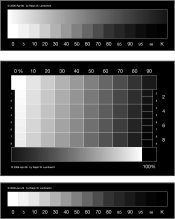
You can try it for your printer and paper by printing the attached template.
 

Attachments

  • DigitalStepTabletGray.jpg
    DigitalStepTabletGray.jpg
    133.7 KB · Views: 132
Where are you getting 12.5% from? 18% gray is almost smack in the middle of the human lightness range.
When discussing what is the proper shade of gray for a gray card, I consider the question at hand to be...

Assuming both meters are calibrated correctly, using a spotmeter and an incident meter... what percentage of reflectance would you wish a flat card to be, such that if you position it in same light as subject the spotmeter reading would be the same as the incident meter reading?

I would confirm the test results by taking photographs on a roll of film that also includes sensitometer exposure and graph the characteristic curve of the film and the gray card's density. I expect the graphed (x-axis of the gray card's densitometer reading) exposure of the card to fall at 10 times the speed point (where curve crosses 0.1 above base+fog).

In one test I did the gray card reading fell within 1/6 stop of "10 times the speed point". I shot in automatic having taken an OM-4 spot reading of an 18% card. I concluded that the OM-4 calibration is "10 times the speed point within experimental error".

Any exposure of any gray card where the spotmeter was used from camera position and the camera settings were made per spotmeter reading... should hit that "10 times the speed point".

The question is does the incident meter read the same, and most of the time it doesn't.

Next would be to change the gray card reflectance so that the incident and spotmeter readings would be the same, and I expect the gray card that you find that meets this requirement would be approximately 12.5%.
 
Assuming both meters are calibrated correctly, using a spotmeter and an incident meter... what percentage of reflectance would you wish a flat card to be, such that if you position it in same light as subject the spotmeter reading would be the same as the incident meter reading?

18%, which is almost in the middle of the tonal scale.
 
18%, which is almost in the middle of the tonal scale.

That would be logical but people are finding that it's not logical.

I think 18% is close enough when shooting flat copywork in main light and metering with the flat disk.

But a gray card is a flat subject in a 3-D scene's main light.

And a 3-D scene includes shadow regions that require consideration.

That's where the difference seems to come from.

Most people use the dome on their incident meter and find the incident meter reads differently by about a stop. The spotmeter reading would underexpose. The incident meter reading would correctly expose.

And if the gray card were 12.5% and you held it in the main light, spotmeter would give the same exposure reading as an incident meter with dome up... depending on the brand.
 
The spotmeter reading would underexpose. The incident meter reading would correctly expose.

Or the incident meter is overexposing :D There must be a way to work it out correctly based on math.
 
Ted Baker,

Sometimes this discrepancy makes it so bad that you can only trust the gray card that photographers often include in test exposures of their scenes... to get color balance, and you have to adjust exposure of the print manually.

You're working on color negatives a lot, just a heads up I usually write about black and white negatives.

C-41 is great because the development aims are fixed so densitometer readings should be more predictable.

Suppose you have a random color negative where a gray card was included and you are creating software to base the exposure of the print from that gray card.

I would put radio buttons into the software: Meter used to evaluate exposure: ( ) Incident with dome; ( ) Incident with flat receptor; ( ) Spotmeter reading of gray card.
Maybe give users a chance to enter their own particular brand of meter. Or maybe they can enter their specific C and K values.

You could probably nail the print exposure with these buttons instead of using sliders.
 
For many years I metered white mat board with a Weston Master II for incident light readings and applied a now forgotten correction factor. Sometimes a simple technique is more versatile, more reliable, and a lot cheaper.
 
Or the incident meter is overexposing :D There must be a way to work it out correctly based on math.

Here's some of the math...

http://beefalobill.com/benskin/

I think I know this question and answer: How many meter candle seconds is the meter trying to put on the film? 10 times the speed point.

Since that answer comes after all the math is done... I can take it and run with it.
 
The short answer is that the incident meter's usually right and a spotmeter reading of an 18% gray card taken as-is results in a slight underexposure.

A darker gray card would be useful.
 
Last edited:
Odd that paper says 11.8% for a flat receptor while Conrad's paper says 18% for a flat receptor

I read it more carefully, the conversion method is very similar, except conrad's paper is much more thorough. The one I posted is a bit contrived in that the author has taken the mean of the two variables K an C to get 11.8. You can get close to 18% if you pick allowable values for K and C that you like, you can also get less 10% to... He also assumes that reflective surface is perfectly diffuse.

I never really thought it through properly but there doesn't really seem to be any real reason why a reflective reading has to based on 18% Gray, or a tone that is perceptually in the middle of the tonal scale. In fact I can think at least one reason why it shouldn't.
 
It would only make sense to base a reflective reading on 18% reflectance if all those explorations of "average reflectance" of average scenes yielded an average of 18%.
The 12% amount is a real world average, not a paint chip average.
It is those pesky "best print" experiments that you should blame.
 
I never really thought it through properly but there doesn't really seem to be any real reason why a reflective reading has to based on 18% Gray, or a tone that is perceptually in the middle of the tonal scale. In fact I can think at least one reason why it shouldn't.
I hear you, any gray will do.
 
The question then becomes moving to the proper white and black paints to choose. There are dozens of white and black paints to choose from...
 
Photrio.com contains affiliate links to products. We may receive a commission for purchases made through these links.
To read our full affiliate disclosure statement please click Here.

PHOTRIO PARTNERS EQUALLY FUNDING OUR COMMUNITY:



Ilford ADOX Freestyle Photographic Stearman Press Weldon Color Lab Blue Moon Camera & Machine
Top Bottom