
135mm f/4.7 Graflex Optar Shutter Service

Higher ups

D
Higher ups

  • 1
  • 0
  • 5
Approx. point-75

D
Approx. point-75

  • 2
  • 0
  • 22
Coal Harbour

H
Coal Harbour

  • 3
  • 1
  • 45
Aglow

D
Aglow

  • 0
  • 0
  • 49
Gilding the Lily Pads

H
Gilding the Lily Pads

  • 5
  • 2
  • 65

Recent Classifieds

Forum statistics

Threads
200,574
Messages
2,810,311
Members
100,304
Latest member
Kurt01
Recent bookmarks
0

Howie1922

Member
Joined
Sep 2, 2025
Messages
26
Location
Minnesota
Format
Medium Format
Hey everyone!

I have a customer that wants to overhaul their 135mm f/4.7 Graflex Optar lens. Here are the shutter speeds tested on the Reveni labs camera tester:

Marked speed T Eff. (1/)
1 0.96
2 1.71
5 4.2
10 8.17 - slow
25 21.61
50 44.28
100 126.21 - fast
200 181.8
400 250.03 - slow
The customer is mostly concerned about getting the fast speeds in spec because he is shooting handheld on a speed graphic.

To get 1/400th in spec, would that just require a thorough cleaning and changing out the main spring? Or are there other springs involved that would need to be changed? Does the high speed spring wear out over time?

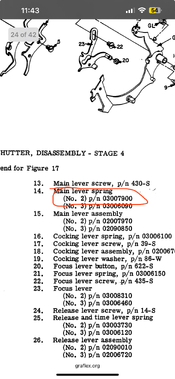
The main spring is part number 03007900 in the graphex shutter manual. Does anyone have some stock of these I could potentially purchase?

Any advice is appreciated!
 

Attachments

  • IMG_3544.jpeg
    IMG_3544.jpeg
    932.4 KB · Views: 19

reddesert

Member
Joined
Jul 22, 2019
Messages
2,549
Location
SAZ
Format
Hybrid
The tolerance on leaf shutters in prime condition is typically said to be 1/3 stop, which is a factor of 1.26x in speed. IMO, that shutter is within spec.

The fastest speed on a leaf shutter is typically a bit slow, and leaf shutter aperture efficiency will usually make the effective speed a little faster than shown on a single-sensor tester (I don't know what, if anything, the Reveni Labs tester does to compensate for shutter efficiency, which is the fact that at fast speeds the leaf shutter is open for less time at the edges of the aperture than at the center).

I am not a tech, but I don't think you should replace a part on that shutter.
 

Dan Daniel

Subscriber
Joined
Jul 4, 2009
Messages
2,967
Location
upstate New York
Format
Medium Format
Can't see what the spring looks like from your drawing section. There are a variety of simple extension coil springs out there. I've even trimmed a loop or two off to get more tension at times, but not for main shutter springs, a bit dicey for a spring under constant retensioning.

That's a good speed for 1/400. Has the shutter been stripped down and cleaned, with proper lubrication in assembly? Is the speed step removing the escapement fully from the path? I don't know the shutter. Might be possible to file back the 1/100 step on the speed ring to bring it slower.
 

BrianShaw

Member
Joined
Nov 30, 2005
Messages
16,845
Location
La-la-land
Format
Multi Format
First, it's not a "Optar shutter" but rather a shutter holding an Optar lens. Nobody likes being called the wrong name, even shutters. "_

You might want to have conversation with "your customer" about the factual realities of leaf shutters, especially old ones, and the reality of handheld work with a Speed Graphic. As mentioned above, it is typical for the highest speed to be "slow". This one is only slightly below the factory spec. Probably not enough to worry about. Folks have used that equipment fo rdecades handheld without fussing over having exactly the marked speed measured. Getting to the exact speed would likely entail so much fussing that the pay wouldn't be high enough, anyway.

As a repairman, you should know that measurements prior to a proper cleaning and lubrication may or may not be good readings. It would be necessary to measure again after proper servicing to determine how far out of range the 1/400 really is. But a good guess in this case would be that the speeds you measured are the capability of the shutter. Springs aren't as often the problem as are other factors. The stories of "weakened springs" is questionable as rarely, if ever, is spring tension actually measured to vaildate those claims. In the past, mainsprings wre frquently replaced prophactically because they wree available and that was one way of putting additional assurance into the guarantee.

An without intending to be rude... it would be best to actually read the service manual fully before proceeding.

A couple of things to consider from some service notes comtemporary with the shutter:

Screenshot 2025-10-31 092858.png


Screenshot 2025-10-31 093022.png
 

Rumbo181

Subscriber
Joined
May 25, 2023
Messages
64
Location
Madrid - Spain
Format
Multi Format
As far as I know, the maximum shutter speed in central shutters is always achieved without engaging the delay mechanism, which is used to control the slower speeds. Therefore, the top speed depends only on the friction within the shutter mechanism itself and on the strength of the main spring — even the Synchro-Compur in the Retina Ia relies on a separate, stronger main spring to reach 1/500. Cleaning may certainly help, but your speeds look quite acceptable to me — I’d say it’s more a matter of finding a replacement for the main spring.

And yes, even without being tensioned, a decades-old main spring will inevitably lose a significant amount of its strength. I find it rather unlikely for any leaf shutter to truly reach its maximum marked speed, especially 1/400 s and above. So, when someone claims that an old leaf shutter has been restored to factory specifications, I believe that might be achievable for the speeds governed by the delay mechanism — but for the top speed, particularly 1/500 s, I remain skeptical.

Anyway, I hope you find a satisfactory solution for your customer. If you manage to reach 1/400 without replacing the main spring, I’d be glad to hear about it — at least I’d know that in some cases it can actually be possible.
 
Last edited:

reddesert

Member
Joined
Jul 22, 2019
Messages
2,549
Location
SAZ
Format
Hybrid
I'm curious what mechanism (like, what metallurgical process), would cause a shutter mainspring to lose a significant amount of strength over time, just sitting there untensioned.

Steel springs of this sort operate below their elastic limit, so that they can return to their relaxed shape. The spring is bent beyond the elastic limit to shape it in the first place, but then in use it should not exceed the elastic limit. It is possible (but I cannot estimate it for a random existing spring), that most shutter springs are steel designed to operate below or near the fatigue limit, so that tensioning (bending) them in normal operation doesn't contribute to fatigue. If it's below the fatigue limit of the steel, then a use cycle doesn't contribute to ultimate failure, and if it's just at the limit, then the number of cycles to failure is very very long.
 

Rumbo181

Subscriber
Joined
May 25, 2023
Messages
64
Location
Madrid - Spain
Format
Multi Format
I'm curious what mechanism (like, what metallurgical process), would cause a shutter mainspring to lose a significant amount of strength over time, just sitting there untensioned.

Steel springs of this sort operate below their elastic limit, so that they can return to their relaxed shape. The spring is bent beyond the elastic limit to shape it in the first place, but then in use it should not exceed the elastic limit. It is possible (but I cannot estimate it for a random existing spring), that most shutter springs are steel designed to operate below or near the fatigue limit, so that tensioning (bending) them in normal operation doesn't contribute to fatigue. If it's below the fatigue limit of the steel, then a use cycle doesn't contribute to ultimate failure, and if it's just at the limit, then the number of cycles to failure is very very long.
  1. There is no such thing as a completely untensioned main spring in an uncocked shutter. Keeping the spring in its post always involves a small amount of tension.
  2. We are dealing with mechanisms that are 50 to 70 years old —and that’s without considering that the shutter might have been left cocked on a shelf for decades. So the problem is not caused by normal operation, but by ageing.
  3. The phenomenon involved is not related to hysteresis —it has nothing to do with the elastic limit— but rather with material fatigue. See https://en.wikipedia.org/wiki/Creep_(deformation)
  4. Experience: in one of his videos, Chris Sherlock mentions that it’s really rare to find a main spring that hasn’t deformed, referring to Retina Compur shutters. In my own experience, I’ve only found one once —and I suspect it was a locally made replacement, hence newer and different from the original factory one.
When these cameras were designed and built, reliability issues after half a century were surely never considered. Nowadays we are increasingly facing restoration problems rather than simple servicing.

I didn’t know that camera repairers replaced springs so often, but it seems to me a very sensible practice.
 

Dan Daniel

Subscriber
Joined
Jul 4, 2009
Messages
2,967
Location
upstate New York
Format
Medium Format
Can anyone say what the spring in this shutter looks like? Is it a simple coil extension spring? A specific coil like in later Synchro-Compurs?

I've found a specific size of spring to replace the main spring in Kodak shutters. But it took some time, waiting for batches to come in from China. McMaster Carr has a variety of small springs, and for one-off like this the cost makes sense. I've also done this in other shutters. It seems that there is a range of acceptable spring tension/force (not an engineer so language is wrong I am sure) that will get accurate speeds. So although my Kodak springs are a bit 'stronger' than the original springs, timing works well and the springs hold up fine over time (so far, five years or more).

I've made replacement small springs from music wire, but there are simple bent wire. There are instructions out there for shaping and heating wire for more formal springs like a main spring.

Anyway, OP, what does the spring look like?
 

BrianShaw

Member
Joined
Nov 30, 2005
Messages
16,845
Location
La-la-land
Format
Multi Format
In this situation, the data indicates that the main spring is fine. The 400-speed helper spring really is unloaded of tension when not in use. Springs aren’t the issue here (although I suppose fabrication of a stronger helper spring might be theoretically possible); it’s other aspects of the shutter condition to consider in terms of minimizing friction and action time to the maximum extent possible. But most of all, what should be considered is the potential that it is simply unrealistic to reach a true 400 speed…
 
OP
OP

Howie1922

Member
Joined
Sep 2, 2025
Messages
26
Location
Minnesota
Format
Medium Format
The tolerance on leaf shutters in prime condition is typically said to be 1/3 stop, which is a factor of 1.26x in speed. IMO, that shutter is within spec.

The fastest speed on a leaf shutter is typically a bit slow, and leaf shutter aperture efficiency will usually make the effective speed a little faster than shown on a single-sensor tester (I don't know what, if anything, the Reveni Labs tester does to compensate for shutter efficiency, which is the fact that at fast speeds the leaf shutter is open for less time at the edges of the aperture than at the center).

I am not a tech, but I don't think you should replace a part on that shutter.

Sorry I’ve been MIA on this post, work has been busy. Thanks for the insight! I believe the Reveni tester deals with shutter efficiency, but I’d need to double check. It’s a very capable tester, and I’m glad I invested in it.
 
OP
OP

Howie1922

Member
Joined
Sep 2, 2025
Messages
26
Location
Minnesota
Format
Medium Format
Can't see what the spring looks like from your drawing section. There are a variety of simple extension coil springs out there. I've even trimmed a loop or two off to get more tension at times, but not for main shutter springs, a bit dicey for a spring under constant retensioning.

That's a good speed for 1/400. Has the shutter been stripped down and cleaned, with proper lubrication in assembly? Is the speed step removing the escapement fully from the path? I don't know the shutter. Might be possible to file back the 1/100 step on the speed ring to bring it slower.

The shutter has not been cleaned yet, was just in the beginning discussions of what a CLA would look like.

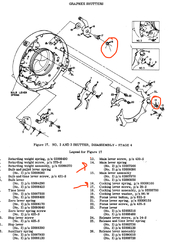
See attached for a picture from the repair manual. It says #14 is the main spring and #16 is the cocking spring, which I feel is a bit unusual. In a German or Japanese shutter, usually I see #16 as the main spring, it’s involved with cocking and driving the whole assembly. Since it’s an American shutter I wonder if they had to work around some patents and did it this way instead.

Without being able to open the shutter up and see how the mechanism works in front of me, this shutter is kind of a mystery still.

Here is the repair manual for anyone who wants some light reading, I forgot to post it on my original post: https://graflex.org/manuals/Graflex-Shutters-(Sizes-1,-2,-and-3).pdf

This is a size 2 shutter.
 

Attachments

  • IMG_3699.jpeg
    IMG_3699.jpeg
    749.5 KB · Views: 12
OP
OP

Howie1922

Member
Joined
Sep 2, 2025
Messages
26
Location
Minnesota
Format
Medium Format
First, it's not a "Optar shutter" but rather a shutter holding an Optar lens. Nobody likes being called the wrong name, even shutters. "_

You might want to have conversation with "your customer" about the factual realities of leaf shutters, especially old ones, and the reality of handheld work with a Speed Graphic. As mentioned above, it is typical for the highest speed to be "slow". This one is only slightly below the factory spec. Probably not enough to worry about. Folks have used that equipment fo rdecades handheld without fussing over having exactly the marked speed measured. Getting to the exact speed would likely entail so much fussing that the pay wouldn't be high enough, anyway.

As a repairman, you should know that measurements prior to a proper cleaning and lubrication may or may not be good readings. It would be necessary to measure again after proper servicing to determine how far out of range the 1/400 really is. But a good guess in this case would be that the speeds you measured are the capability of the shutter. Springs aren't as often the problem as are other factors. The stories of "weakened springs" is questionable as rarely, if ever, is spring tension actually measured to vaildate those claims. In the past, mainsprings wre frquently replaced prophactically because they wree available and that was one way of putting additional assurance into the guarantee.

An without intending to be rude... it would be best to actually read the service manual fully before proceeding.

A couple of things to consider from some service notes comtemporary with the shutter:

View attachment 410329

View attachment 410330

Thanks for the insight. I’d definitely do a full clean prior to physical manipulation of the shutter. I wish I could find information on what the actual measured tension of the spring needs to be. That would make remaking springs easier. Right now if I remade one it would kinda be just a Hope and a prayer that it has the correct tension.
 
OP
OP

Howie1922

Member
Joined
Sep 2, 2025
Messages
26
Location
Minnesota
Format
Medium Format
  1. There is no such thing as a completely untensioned main spring in an uncocked shutter. Keeping the spring in its post always involves a small amount of tension.
  2. We are dealing with mechanisms that are 50 to 70 years old —and that’s without considering that the shutter might have been left cocked on a shelf for decades. So the problem is not caused by normal operation, but by ageing.
  3. The phenomenon involved is not related to hysteresis —it has nothing to do with the elastic limit— but rather with material fatigue. See https://en.wikipedia.org/wiki/Creep_(deformation)
  4. Experience: in one of his videos, Chris Sherlock mentions that it’s really rare to find a main spring that hasn’t deformed, referring to Retina Compur shutters. In my own experience, I’ve only found one once —and I suspect it was a locally made replacement, hence newer and different from the original factory one.
When these cameras were designed and built, reliability issues after half a century were surely never considered. Nowadays we are increasingly facing restoration problems rather than simple servicing.

I didn’t know that camera repairers replaced springs so often, but it seems to me a very sensible practice.

Thanks for writing this out. These were the reasons I was thinking the spring looses tension over time as well I opened up a Prontor-SVS shutter yesterday and had a heck of a time removing the main spring since it was under tension in the uncocked state.

It’s like the spring looses a fraction of its springiness, and causes the speed to become ever so slightly out of spec.
 
OP
OP

Howie1922

Member
Joined
Sep 2, 2025
Messages
26
Location
Minnesota
Format
Medium Format
Can anyone say what the spring in this shutter looks like? Is it a simple coil extension spring? A specific coil like in later Synchro-Compurs?

I've found a specific size of spring to replace the main spring in Kodak shutters. But it took some time, waiting for batches to come in from China. McMaster Carr has a variety of small springs, and for one-off like this the cost makes sense. I've also done this in other shutters. It seems that there is a range of acceptable spring tension/force (not an engineer so language is wrong I am sure) that will get accurate speeds. So although my Kodak springs are a bit 'stronger' than the original springs, timing works well and the springs hold up fine over time (so far, five years or more).

I've made replacement small springs from music wire, but there are simple bent wire. There are instructions out there for shaping and heating wire for more formal springs like a main spring.

Anyway, OP, what does the spring look like?

See my other reply for a picture of the manual. Thanks for the McMaster Carr tip. I’ll check there next time I need something.
 

Dan Daniel

Subscriber
Joined
Jul 4, 2009
Messages
2,967
Location
upstate New York
Format
Medium Format
OK, so it's a round spring coil thingie. Like a Synchro-Compur main spring. Or the 1/400 shutter speed booster spring on a Kodak Supermatic.

I'm not sure who made the Graflex shutters. Often parts are used in a variety of places, so you might find that the main spring can be replaced with a spring from another shutter or another use.

But all in all, hard to get these old ones going to spec. I replaced the main spring on a Kodak Supmatic #3 and did a full cleaning, and still only got high speeds running about 1 stop slow. I'd focus on a good cleaning and such rather than the main spring replacement.
 
Photrio.com contains affiliate links to products. We may receive a commission for purchases made through these links.
To read our full affiliate disclosure statement please click Here.

PHOTRIO PARTNERS EQUALLY FUNDING OUR COMMUNITY:


Ilford ADOX Freestyle Photographic Stearman Press Weldon Color Lab Blue Moon Camera & Machine
Top Bottom