
• Welcome to Photrio!
    Registration is fast and free. Join today to unlock search, see fewer ads, and access all forum features.
    Click here to sign up

What Films Would You Like To See Kodak Re-Introduce Again? And why?

Recent Classifieds

Forum statistics

Threads
204,282
Messages
2,866,593
Members
102,207
Latest member
gustavocf
Recent bookmarks
0
In my reply to this thread I only mentioned Kodak HIE infrared black and white film which I liked for it's pictorial results.
I forgot to mention a colour film.
That would be Kodachrome 25. I only used it in 35mm format.
Was it ever available in 120 film rolls?
 
Most large camera shops in the US had daily pick-up and delivery. If you got your film in before the pick-up, you usually got it back the next day. This was Columbus, Ohio. The lab was in Findlay. Ohio. Chicago had one, New Jersey had one, etc.

  • Rochester, New York: The global headquarters for Kodak research and a primary high-volume processing hub.
  • Atlanta, Georgia: Handled significant volume for the Southeastern US.
  • Dallas, Texas: Served the South-Central region.
  • Chicago, Illinois: A major midwestern processing center.
  • Hollywood, California: Handled both still film and professional motion picture film processing.
  • San Francisco, California: Served the West Coast.
  • Fair Lawn, New Jersey: Provided processing services for the Northeast.
  • Honolulu, Hawaii: Serviced the Pacific region.

I worked nights in Dynacolor's Kodachrome processing lab in Alexandria, VA in the summer of 1967. Films were processed overnight. I don't think they ran a day-shift for processing, just the overnight run, to give next-day Kodachrome/Dynacolor service to local stores.
 
Ektar 25 was still quite idiosyncratic. The present Ektar comes much closer as a replacement to the chrome look,
provided one understands the importance of K value color balance filter corrections to avoid crossover issues.

As far as NG now relying heavily on digital capture, it's apparently an attempt to standardize the majority of their workflow just like they relied on Kodachrome at one time. Then there were the old days, when standard equipment included toting around red sweaters for models in the scenes.

These are a few Ektar 25 shot on 120 Mamiya RB-67. Of course, the film was scanned to present it here. Resolution was terrific on the original. But very slow film.
 
Kodak Canada started closing the labs in 1983.
Home Video killed Kodachrome.

One-hour lab kiosks came out in the 1980's as well. I'd think that had a profound effect too on the higher use of color print film.

I recall my dilemma of whether I want to buy chromes to project or shoot negative color to print for an album. At first, the kiosks furnished a single 3-1/2x5" print with the processing cost. Then they increased it to 4x6". Then the labs provided two prints of each exposure, allowing you to make an album plus have second copies to put in a frame or give to a relative. With Kodachrome, you had to project plus you had to send the film to the Kodalux labs by mail and wait a week or more to get the slides back. It was hard for Kodachrome to complete. Then, Fuji developed Velvia for the magazines and the race was over.
 
None of which would have been of much use to Craig in Canada.
The Kodak Canada Kodachrome (and Ektachrome) lab in North Vancouver BC served Western Canada. And Customer Service was provided by those whose work was managed by my Dad. :smile: And his staff coordinated all that excellent pick-up and delivery service across that half of the country.
Dad retired in 1983 as they were in the process of shutting the plant down. It was finally fully closed by 1984 .
I'm not sure if both Brampton and Toronto had Kodachrome lines. In any case, Kodachrome processing in Canada didn't last much longer than 1984.
And by the way, I don't think anyone anywhere in the Kodak world ever referred to the lab in Northern California as being in San Francisco. It was always Palo Alto. It took me many years to realize that Palo Alto wasn't a single word :smile:.

Palo Alto was where all my 35mm film and Super-8mm was developed when I was stationed in Vietnam in 1969-70. They would process it and then send it back to Vietnam.
 
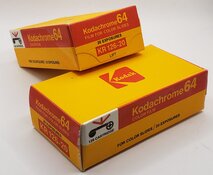
126 Kodachrome, too! 😉
 

Attachments

  • 20260516_154807.jpg
    20260516_154807.jpg
    1 MB · Views: 21
828 as well!
Much of my young life is documented in 828 Kodachrome and Regular 8 Kodachrome :smile:
 
None of which would have been of much use to Craig in Canada.
The Kodak Canada Kodachrome (and Ektachrome) lab in North Vancouver BC served Western Canada. And Customer Service was provided by those whose work was managed by my Dad. :smile: And his staff coordinated all that excellent pick-up and delivery service across that half of the country.
Dad retired in 1983 as they were in the process of shutting the plant down. It was finally fully closed by 1984 .
I'm not sure if both Brampton and Toronto had Kodachrome lines. In any case, Kodachrome processing in Canada didn't last much longer than 1984.
And by the way, I don't think anyone anywhere in the Kodak world ever referred to the lab in Northern California as being in San Francisco. It was always Palo Alto. It took me many years to realize that Palo Alto wasn't a single word :smile:.

Very cool story! I met a number of people over the years who had worked at the North Vancouver lab.
I worked for Kodak Canada as a technician servicing minilab equipment. This was well after the labs in Canada were closed.
I got a tour of the area in the Toronto location where the K-14 line was. The machines were still there but were awaiting removal and the eventual destruction of that building IIRC.
I'm not sure where the lab was located in North Vancouver. I'll do a search to answer that.
Thanks for sharing that.
 
I'm not sure where the lab was located in North Vancouver.

Across the parking lot from the North Shore Winter Club, on the south side of E. Keith Road.
Very near the intersection with Mountain Highway.
Google tells me that the building is still there - 1225 E. Keith Road.
For a long time it was being used as a rental site for equipment for the motion picture industry.
 
As someone who worked on the K-200 & K-100 & K-400 program back in 1986, where only one K-200 was commercialized

Was this project intended to introduce t-grains into Kodachrome/ fix known issues with colour?

I quite liked KL-200 overall.

they couldn't surpass the K-25 for sharpness. The fact that K-25 would not coat well when it was attempted to move into Building 38 was its demise

My understanding is that the demise of KM-25 revolved around the thickness of the layers and/ or machine speed in coating (and that 1999 demand for it was really low by today's standards (never mind then), compared to what people imagine it was)? From interpolation out of Shanebrook, can we infer that it was the shutdown of Room 13 that caused the demise of KM-25?

The main thing I didn't care for with K-14 Kodachrome was the visual effect of the cyan dye fault that Ron M had described in detail on here. I think that the other thing people don't realise is that by the advent of a particular triumvirate of green-box products (RVP/RDP/RAP), drum scanning was very long established (and digital retouching/ compositing, with attendant controversies, was well and truly on its way to killing off dye transfer and solvent compositing) in the publishing/ commercial world, so the assumptions some try to make about their perceptions of what Kodachrome could be are really based off what it did (and what was done to it) in CMYK repro.

The manufacturing of the dyes was a difficult and potentially harmful thing (caustic). US suppliers dropped out of the manufacturing of the components

If I understand the process correctly, the use of what rapidly became an orphaned chemical (CD-6) at a scale that probably fell inconveniently between costly kilo lab and cheaper mass manufacture (and involved the serious nasty that is PPD), can only have hastened the demise in a market segment that had had falling demand long before digital really killed it off.
 
As someone who worked on the K-200 & K-100 & K-400 program back in 1986, where only one K-200 was commercialized, I'll throw my hat into this ring as to why Kodachrome was still around to the near end. But first, Alan, all silver halide is sensitive to blue light, even when dye sensitized to a different spectral color. So, a yellow filter layer must be within a three-color film in order to keep blue light from adding unwanted exposure to the green and red records.

As K-64 user, the color response of Kodachrome was strikingly different than that of any Ektachrome. As a reversal, the film's design is to make the smallest & mid sized grains capture the least information in the negative stage but when reversed, the image as a positive becomes sharper because it is those small and mid-sized grains which the dye couples with to produce tiny dye clouds. As good as E-6 and the green box film became, they couldn't surpass the K-25 for sharpness. The fact that K-25 would not coat well when it was attempted to move into Building 38 was its demise...the costs to rebuild were not justifiable for the volume demand.

As for the process, the Kodak mini-lab K-14 process equipment, which a number of major labs had moved to, were not built robust enough for a 30 year lifetime and a number of the tanks formed leaks way too soon, leading labs to have less reliability while tanks were repaired and increasing their costs. Dwaynes was one of the few labs which had not changed over to a mini-lab so it made sense that they would be the last lab in the business (other than Kodak's older large tank machine).

From what I heard (I'm no Chem E.) The manufacturing of the dyes was a difficult and potentially harmful thing (caustic). US suppliers dropped out of the manufacturing of the components and production was moved overseas and whenever materials are moved overseas the inventory pipeline increases. Eventually, costs to manufacture, changes to the acceptable Health & Safety chemical hit-list, and lower sales volumes put the nails into the beloved K-64.

I'd love to see it come back but I know that studies were done ten years ago and the E100 was the winner of what reversal to bring back.

Can you tell more about this?
 
I would like to know more about the Kodachrome my Dad shot prior to the introduction of Kodachrome II (ASA 25). In the late 40's into the 50's it was daylight speed ASA 10. That stuff was amazing. The wonderful WWII Kodachrome large format stuff, that's my dream. Kinda like the still camera equivalent of IMAX.

In today's world it would probably cost 100 million dollars and violate CA Prop 65 etc.
 
Kodachrome was the best color film ever made. Everything else lacks its magical abilities.
 
I just notice this is in the B&W section. If that I would say Plus-x, not a reintroduction in that sense but TMZ 3200 / Ektapan 3200 in 120.

Ektacolor 1600 - 3200, some high speed C41 film as well. The actual product might have been called Gold 1600 and Ektapress 1600, but something drawn from the current family of film. I recall bringing that up to some other similar thread and having a small discussion with another member.
 
The only magical ability was its ability to fade from light exposure.

The thing I find remarkable is the inability of some dug-in defenders of Kodachrome to find Ron's posts on the colour deficiencies of K-14 dyes. After all, if one of the people who was literally one of the patent holders for the process was pretty critical of aspects of K-14's colour, I think the rest of us can be as well.

The other more difficult question is if there are intersections between certain medical conditions that affect colour perception and people's perception of Kodachrome.
 
The thing I find remarkable is the inability of some dug-in defenders of Kodachrome to find Ron's posts on the colour deficiencies of K-14 dyes. After all, if one of the people who was literally one of the patent holders for the process was pretty critical of aspects of K-14's colour, I think the rest of us can be as well.

The other more difficult question is if there are intersections between certain medical conditions that affect colour perception and people's perception of Kodachrome.

Whatever deficiencies Kodachrome had clearly didn’t stop people from loving how it rendered images. Precise color accuracy is important for technical and product photography but the vast majority of people embraced what Kodachrome gave them. These days digital capture, display, and printing can give us remarkable flexibility around color. It is painfully easy to take essentially perfect pictures these days with digital cameras and a bit of post work.

People are coming back to film not for accuracy’s sake but for a look or feel. Some of us like having images as physical things and slides are about a pure form of analog photography as you can get. It’s only natural that people wish they could try Kodachrome along with Gold and Portra. They all look different and can suit different moods, subjects, or intentions. I used to carry around film holders or magazines with 2 different color films and a B&W as well. You may say there’s no accounting for taste but I say let people enjoy imperfect things!
 
Whatever deficiencies Kodachrome had clearly didn’t stop people from loving how it rendered images. Precise color accuracy is important for technical and product photography but the vast majority of people embraced what Kodachrome gave them. These days digital capture, display, and printing can give us remarkable flexibility around color. It is painfully easy to take essentially perfect pictures these days with digital cameras and a bit of post work.

People are coming back to film not for accuracy’s sake but for a look or feel. Some of us like having images as physical things and slides are about a pure form of analog photography as you can get. It’s only natural that people wish they could try Kodachrome along with Gold and Portra. They all look different and can suit different moods, subjects, or intentions. I used to carry around film holders or magazines with 2 different color films and a B&W as well. You may say there’s no accounting for taste but I say let people enjoy imperfect things!

For it's time, it was the gold standard for colour photography. But a lot of Kodachrome worship is like so much "it used to be better" myths. The truth is that properly implemented digital today delivers leagues better colour rendering (and I am 99% a film shooter).

Kodachrome certainly had a gorgeous look, and I see no colour film today - chrome or negative - that comes close. So, yeah, I'd love for Kodachrome to be available again, but it's not happening. So, for those rather rare circumstances where I want colour, I've resigned myself to bit twiddling.
 
The truth is that properly implemented digital today delivers leagues better colour rendering (and I am 99% a film shooter).

If you want the sterile truth, nothing will beat Ektachrome.

Kodachrome certainly had a gorgeous look, and I see no colour film today - chrome or negative - that comes close.

The last casualty of a world long gone away.
 
Kodachrome certainly had a gorgeous look, and I see no colour film today - chrome or negative - that comes close.

It depends on which version. K25 and K64 had different colour palettes, K64 had a tendency to render skies as cyan, rather than blue. K25 did red well, but green foliage was an odd shade of green. It is a distinctive look for sure. Relatively unsaturated compared to the E6 materials.

As PE said, Kodachrome could make a garbage dump look good, but it wasn't accurate colour and suffered from crossover.
 
Photrio.com contains affiliate links to products. We may receive a commission for purchases made through these links.
To read our full affiliate disclosure statement please click Here.

PHOTRIO PARTNERS EQUALLY FUNDING OUR COMMUNITY:


Ilford ADOX Freestyle Photographic Stearman Press Weldon Color Lab Blue Moon Camera & Machine
Top Bottom