OK, I feel your pain. I have recently gone down the rabbit hole of shooting "panoramic" shots with old 616 cameras. There are two common approaches: (1) shooting outdated 616 film, which is 70mm wide, like 116 film; (2) using 120-to-616 adapters, in order to shoot 120 film. Both options have their own set of challenges.
When it comes to the first option, I immediately encountered the trial of trying to get the 616 film onto any kind of a reel that would work smoothly for processing. Most of the outdated film I obtained was thin (due to a thinner base); moreover, due to age, the film was subject to extreme curling. I have been processing film on metal reels for over 5 decades, but suddenly I felt like I was back in high school, struggling to learn how to feed those first rolls of film onto reels in total darkness -- and plastic reels, no less.
I looked for a stainless 116/616 reel. Nikor/Honeywell sold such reels back in the 1970s, but the only one I saw listed on eBay had sold a month earlier, so they are obviously in short supply.
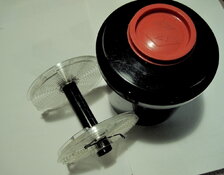
I initially resorted to an old adjustable plastic reel, but that was a sore fight. First, I was unaccustomed to shoving film into a reel from the outside inwards. Further, the flimsy nature of the 616 film, and friction from the reel, made it difficult to keep the film moving, even after the initial struggle to get it started properly.
Next, I learned the art of constructing a 70mm reel from two Paterson 35mm reels. Ah! but the curl of the flimsy film again worked against me, first making it difficult to keep it in place to advance past the bearings, in order to start ratcheting of the reels; but then, after fighting to get the initial alignment, the film had the tendency to pop out of the grooves, even when it was started properly.
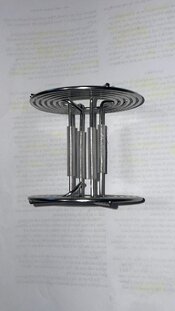
Totally exasperated, I was recently rescued by an ingenious solution offered by a fellow photographer who has more problem-solving skills that I do. His solution was to take a 120 reel, cut it in half, and extend the posts with hard plastic sleeves. (See attached image.) I can happily report that my initial tests with this prototype have been successful. I have been able to get the film loaded on the reel in about the same time as an ordinary 120 roll of film -- working in my preferred direction from the center to the outside edge of the reel.
There is one caveat with this prototype. The 616 film was designed to shoot images at are 6.5 x 11 cm ("panoramic"). That makes the length of the film on the roll a bit longer than a standard 120 roll. Some 616 film extends beyond the outside edge of the reel -- not by much, but enough to consider an enhanced prototype. We have obtained some old 220 reels (that fit in a standard tank); and he is going to construct a prototype from a 220 reel. That may ensure greater flexibility with the length of the film, as well as compatibility with the 70mm width of 616/116 film.
If everything works well, this also raises the potential of hand-spooling fresh 70mm film onto recycled backing paper. There are limited options for 70mm film; and since many 70mm film stocks seem to be designed for surveillance, it often comes on a thinner base -- all the more reason to use a metal reel that can be loaded more easily for processing than any of the plastic reels.
A related project for 616 cameras is for option no. 2: using other film formats with a 616 camera. We have detected common problems trying to use stock 120 film, even with adapters, because the spools are fatter than 616 spools. Users often begin by clipping the rim of the 120 reels, so that the film can fit in the film compartment of a 616 camera. But even if this obstacle is overcome, we have experienced various film transport problems. Our working goal is to produce a 620 to 616 adapter. Like 616 spools, the 620 spools are thinner. With prototype adapters, 620 film moves more cleanly through a 616 camera. Yes, you lose part of the frame width; but this allows us to use modern film stocks, rather than being limited to outdated 616 film. There are still 620 film stocks on the market, or 120 film can be respooled onto 620 spools.
Anybody else in this rabbit hole?