
• Welcome to Photrio!
    Registration is fast and free. Join today to unlock search, see fewer ads, and access all forum features.
    Click here to sign up

Pinhole precision

Recent Classifieds

Forum statistics

Threads
204,279
Messages
2,866,557
Members
102,207
Latest member
gustavocf
Recent bookmarks
0
The hard part of pinhole is the usually ultra wide focal lengths, and the fact that you've got mostly got to visualize it in your head with few, if any, visual aides. For me that's where the biggest challenges are, and where the most fun is too.

While you always have to guess about where the edges of the image will be by pointing the camera, one way to visualize the image is to bring along an SLR that has a lens(es) with the same focal length(s) as your pinhole(s). For me that's a 24-70mm lens, but there are also small "director's viewfinders" as well.

Calculating reciprocity? That's another matter.
 
While you always have to guess about where the edges of the image will be by pointing the camera, one way to visualize the image is to bring along an SLR that has a lens(es) with the same focal length(s) as your pinhole(s). For me that's a 24-70mm lens, but there are also small "director's viewfinders" as well.

Calculating reciprocity? That's another matter.

For my Zero45 the equivalents to 35mm are 21mm, 14mm and 7mm. For the Zero69 it's between about 18mm and 14mm , depending on the frame size. The widest slr lens I have is 28mm, so for me it's looking along the lines and imaging stuff.
I like that's it's so very different, and uses a bunch of different mental muscles to compose. The challenge is the fun, I'm not looking to make it easier.
 
Last edited:
The Noon 6x9 pinhole camera that I used and enjoyed for years had framing guides on the top.
The circled bumps you see here.
1778954050227.png


If you are building your own, it is relatively easy to put something similar on it.
 
If you are building your own, it is relatively easy to put something similar on it.
It's the one deficiency of the Zero camera 8 have. They do give you a plastic viewfinder sheet, though I lost the 4x5 one. You're ok if you know roughly where the film is.
That said, these guides only let you line up edges. You still have to imagine all that forced perspective. I find it a fulfilling mental exercise.
If in doubt, get in close.
 
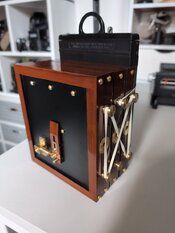
For my Zero45 the equivalents to 35mm are 21mm, 14mm and 7mm.

You have a pinhole for 4x5 that's equivalent to a 7mm lens on 35mm? So your pinhole is about an inch away from the 4x5" film? Your light fall off on the film edges is going to be astronomical.
 
You have a pinhole for 4x5 that's equivalent to a 7mm lens on 35mm? So your pinhole is about an inch away from the 4x5" film? Your light fall off on the film edges is going to be astronomical.

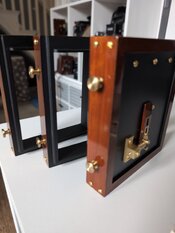
Yep. With a single panel it's 25mm, two panels 50mm, 3 panels is 75mm. The 25mm single panel vignettes heavily. About a 134mm angle of view. It's a bit bonkers.
 

Attachments

  • 20250801_160256.jpg
    20250801_160256.jpg
    163.6 KB · Views: 18
  • 20250801_160103.jpg
    20250801_160103.jpg
    148 KB · Views: 16
…and it will be difficult to apply a center filter to compensate for light falloff, right?

Yes. The fall off is very extreme, so your exposure to bring the edges up would be considerable (not to mention the mechanical difficulty of positioning the filter, or finding one(.
But also, it's an aesthetic you can embrace. For an extreme example you can check out this video by Martin Henson where he makes an 11x14 camera with a focal length just over an inch. (He also includes some examples of vignetted images from the Zero45 at 25mm, if you want to see what that looks like, I've not gotten any at 25mm I thought worth saving just yet)

 
Last edited:
You could use a CND filter, but where would you put it? If it were directly in front of the pinhole, it would have no meaningful effect -- other than to increase your exposure. If you moved it farther out (somehow), that would help, but you still have the longer exposure time. The BIGGEST problem is that you would have to get a very strong CND filter, such as HELIOPAN's 3X models (most CND filters are 1.5X or 2X). The 3X models are nearly impossible to find and VERY expensive.
 
For me, pinhole cameras are about having fun. The fun of building and shooting a camera made by you.
Sometimes we all get caught up in the "technical stuff" instead of just letting the kid in each of us come out and play.
Homemade pinhole cameras are just like a toy truck in a sand box. Just have fun with it.
 
FYI, for some people -- I think there is a word for them -- "technical stuff" IS fun.
 
Second that. Reality so subtle sells good quality pinhole at reasonable price. I especially like their combination pack of different pinhole sizes, so you can experiment.

For OP: you just need to use the pinhole calculator to find out the optical pinhole size for your desired focal length, and then either order or make your own.

The optimum pinhole size also varies with wavelength. optimum Focal length = pinhole ^2 * wavelength factor

wavelength factors
description​
nm​
factor​
daylight​
560​
750​
green​
550​
763​
Blue​
450​
934​
red​
650​
647​
ir​
750​
561​
uv​
370​
1134
Most use the daylight class to match the wavelength our eye's are most sensitive too, and be near the center of the human visual range (400-700nm),
If using Ortho film, or an alternative process there might be a slight improvement calculating for a wavelength nearer 450nm or even UV. As these wavelengths work out to give an optimum focal length around 1.5x that for daylight.

Film is generally not sensitive to IR, but pinholes might prove useful for UV photography, without buying expensive ultrachromatic lenses. :smile:
 
Photrio.com contains affiliate links to products. We may receive a commission for purchases made through these links.
To read our full affiliate disclosure statement please click Here.

PHOTRIO PARTNERS EQUALLY FUNDING OUR COMMUNITY:


Ilford ADOX Freestyle Photographic Stearman Press Weldon Color Lab Blue Moon Camera & Machine
Top Bottom