
• Welcome to Photrio!
    Registration is fast and free. Join today to unlock search, see fewer ads, and access all forum features.
    Click here to sign up

Single coated lens

Recent Classifieds

Forum statistics

Threads
204,282
Messages
2,866,583
Members
102,207
Latest member
gustavocf
Recent bookmarks
0

Frank2122

Member
Joined
May 13, 2026
Messages
7
Location
UK
Format
35mm
Hello
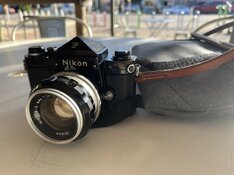
I understand that, for 35mm (Nikon F2) B&W, single-coated lenses are generally preferable in that they give less contrasty results that multi-coated. I am therefore mulling over whether to get a 50 mm f1.4 s auto (pre-Ai) lens. However-

If I fit a lens hood, will that put the contrast back up to more or less where it would have been with a more modern multi-coated lens?

Could I just as easily adjust contrast during printing?

More generally- does anyone have any thoughts on this lens? My interest is in landscape / close-up (not macro) abstracts of lines & patterns found in nature.

Thanks!
 
single-coated lenses are generally preferable in that they give less contrasty results that multi-coated
How is that an advantage?
More modern coatings are better. If you need less contrast, print at a lower grade, adjust in digital processing and/or photograph under softer light. I don't see how technically inferior technology would be a preferred solution.
 
Thanks. Please see attached for an overview.
 

Attachments

  • IMG_6100.png
    IMG_6100.png
    560.3 KB · Views: 66
Indeed. I was just using that to summarise the general points. The Leica forum, linked in the output, is informative on this point.
 
I suppose so; the link of course doesn't embed in the picture you posted.

Mind you, I don't contest that a particular lens can be attractive due to the unique way it renders the image. But the technical underpinnings are broader than just coatings and arguably, the coating isn't really the determining factor in most cases.

Also, I don't contest that coating will affect contrast by moderating flare, but the effect depends on the lighting conditions and I still stick to the argument I made earlier that technically inferior performance is not necessarily the best solution. I mean, look at it this way: if you want lower contrast, there are plenty of ways to get there while using a lens that gives good contrast under a wide range of conditions. But getting good contrast from a fuzzy lens is a lot trickier.
 
That's a valid point of course, even setting aside the tongue-in-cheek side to the remark!

I think the arguments for using film are varied and while some include arguments about supposed technical superiority, I'm personally not of that inclination and believe these arguments are essentially 'irrational'. By this I don't mean that they're stupid or insensible, but simply a manifestation of our human nature, which just doesn't always optimize for what seems to be objectively 'best' (romance isn't quite dead, yet!)

The same logic (or lack thereof?) could of course be applied to lenses, in which case the preferred solution may not be technically superior. However, in that case, there seems to be a discrepancy between that (ultimately 'irrational') preference and the underlying argumentation, which relies on a seemingly rational argument about contrast. I think there can be plenty of reasons why someone would prefer to use a technically inferior lens - perhaps they like how it feels in their hand, how the object itself looks when mounted on the camera, an association with photographers from the past who used similar lenses, or simply a desire to embrace a series of technical shortcomings that serve as 'happy accidents' in the final image. But inherent to such lines of reasoning, at least in my view, is an aspect of deliberately avoiding optimization. So to make this choice while at the same time relying on an argument of optimization in a technical sense seems odd to me.
 
As far as I know better coatings enabled manufacturers to use more lens elements because of higher light transmission and thus improve the correction of the lenses. So multicoating is not merely about contrast.
 
As far as I know better coatings enabled manufacturers to use more lens elements because of higher light transmission and thus improve the correction of the lenses. So multicoating is not merely about contrast.
It is, and it isn't. Higher light transmission is the other side of the same coin as flare. Light is either transmitted, or scattered. The latter is flare and reduces contrast. If you reduce the amount of flare per lens surface, then yes, it's possible to obtain a similar flare profile with a higher number of surfaces (=more elements). There's more to the story, of course, such as flare-related artifacts and tolerance of a lens for having bright light sources within its field of view. These still relate directly to flare.
 
The effect you are talking about is called soft focus, and no - putting the lens hood on will not compensate the imperfections in the optics which cause it, you might just avoid flares. Also soft focus doesn't need to come from such a fast lens as f1.4 (but it comes with some soviet lenses for instance, like helios or jupiter)

I think portraits from 30s and 40s are gorgeous and personally I have been looking for a good deal on such lens for a while. My understanding is, that post-war lenses introduced coatings into their marketing, enhancing micro and macro contrast, reducing flares and doing color correction in general. Thats where "CC" on most m42 lenses come from. The uncoated lenses are pretty expensive due to their age.

You should be able to achieve very similar effect by removing the coatings on the coated lenses, also I heard putting a black stockings cloth over the lens achieves similar effect, or try some black mist / soft filter. I have been experimenting a little with vaseline and baby oil on a spare filter - its interesting, but kind of unpredictable
 

Attachments

  • chloumek 05-26 (42).jpg
    chloumek 05-26 (42).jpg
    422.3 KB · Views: 47
Less or no coatings are absolutely called for to achieve many photographic aims. There have been many times I used a too perfectly coated lens with slide film for example - in harsh lighting conditions, it forces you to either sacrifice the shadows or the highlights. In that same situation with an uncoated or less-coated lens, I'd get shadows that still retained some detail when exposing as not to burn the highlights. If higher contrast was always desirable, you wouldn't be able to buy filters on the new market that reduce it.

Probably 80% of the interest today's digital shooters have in adapting vintage lenses is from the contrast drop alone. The metric by which that's called inferior depends entirely on how you are trying to use it.
 
I understand that, for 35mm (Nikon F2) B&W, single-coated lenses are generally preferable in that they give less contrasty results that multi-coated. I am therefore mulling over whether to get a 50 mm f1.4 s auto (pre-Ai) lens. However-

If I fit a lens hood, will that put the contrast back up to more or less where it would have been with a more modern multi-coated lens?

Could I just as easily adjust contrast during printing?

More generally- does anyone have any thoughts on this lens? My interest is in landscape / close-up (not macro) abstracts of lines & patterns found in nature.
I wouldn't say that early, single-coated lenses are "preferable", but they do as you state have reduced contrast over more modern multi-coated lenses. Of course less contrast may be a preferable rendering in some situations, but if I had the choice of a lens with the exact same optics in single- and multi-coated versions, I would personally go with the multi-coated lens every time.

That being said, there are some older optical designs which have unique attributes, i.e. where the optical flaws are actually pleasing. You mention the Nikkor 50/1.4 S, so if you're going that way, I would go for that lens' predecessor, the 58/1.4 S, which due to its early design does give a very interesting rendering, specifically for things like close-up/abstract. And of course it has the reduced contrast you mention.

If you want the effect of reduced-contrast with a modern lens, you can consider one of Nikon's superb Soft filters, which are particularly suited to portraiture. The Soft 1 is very subtle, and the Soft 2 is more dramatic. Alas, these filters are out of production (replaced by the "New Soft" filters) due to environmental regulations.

As for the hood question: A hood will not improve contrast per se, but rather avoid flare from out-of-frame light sources, and with a single-coated lens that is very important as the flare will have a correspondingly greater effect (unpleasant light-streaks and even further reduced contrast due to veiling flare) so when shooting single-coated lenses I always make sure to use the proper hood.
 
Last edited:
I find (believe) that most of these effects have more to do with different lens formulas than coating type.

For SF with filters, it's a good idea to try a few different types before settling in on judgement of "best" or "preferred". They different types perform differently...
 
This is often the subject of heated arguments whether vintage or modern lenses are best for b/w. It’s up to you and the viewer. All my LF lenses are modern multi coated Schneiders and Rodenstocks because I prioritize image circle coverage. Lens characteristics have more to do with the look than the coating. BTW having a decent lens hood doesn’t increase contrast just that it can block stray light that will compromise your image including contrast.
 
Short answers:

- I have used a 50mm f1.4 Nikkor-S auto with color and like it a lot. You may, too.

- They are so cheap and widely available you can try it out for little money.

- Technically, it is a very good lens that is usable at f1.4 (head / shoulders portraits being my reference) and quite sharp from f2.8 onwards. A few times I have experienced minor flare in very bright light, but I was using a UV filter and no hood, so there’s that too consider.

- Colors are maybe softer than more modern lenses, but I find it pleasing. I call it the 1970s National Geographic Look.

- For longer distances and larger apertures, a better corrected and coated lens may be preferable. Here I’m referencing demolition derbies after dusk when the stadium lights are on, I’m usually limited to about f3.5 or so. My 55mm f1.2 (last version, multi-coated) and Takumar 50mm f1.4 Super Multi Coated are winners, especially the latter.

- For black and white it’s awesome. I have used the 50 S-Auto extensively with HP5 at 800 over many years on trips to the Pacific Northwest. I keep using it for consistency among the images. They seem to have a certain mood that suits the topography.

IMG_6662.jpeg

50mm f1.4 Nikkor-S Auto at 1.4, Ultramax 400, very pink beach sunset light. Minor edits to generic lab scan. (That’s as fancy as I get with color)
 
The 50mm 1.4 of any era is a fine lens.
I am more interested in the overall character of lenses than specifically in their sharpness.
If i were doing technical product photography or architectural work, perhaps i'd use the most modern lenses. I sold off my LF Schneider Super-Angulon XL and Rodenstock Apo-Sironar S, in
favour of Dagors and Commercial Ektars...

IMG_8802 2.JPG
 
If you have a modern multi-coated lens in your bag, you may wish to add an older, single coated version with a distinct character as a useful accessory.
Neither of the two are inherently better than the other.
Each will do many things better than the other, when those things are what you are wanting to do.
 
Here's an image with a modern single coated lens.... VC Nokton 35mm 1.4
IMO beautiful character
48784910603_ab71dfbf71_z.jpg
 
I sold off my LF Schneider Super-Angulon XL and Rodenstock Apo-Sironar S, in
favour of Dagors and Commercial Ektars...

We’re thinking the same. While I have never owned the high LF end stuff, I use Commercial/Wide Field Ektars and can’t think of a reason to get anything else. They provide the look I want. The same can be said of my old Nikkors.
 
I absolutely love my single-coated 50/2 (later Ai'd) Nikkor H, esp for color photog. It has a less harsh rendering than later lenses, plus a better build quality with smoother focus. I haven't tried the 50/1.4 S version yet, and personally see no need for one anyway. But if I came across a clean one already Ai'd at a good price, I might spring for it. But for those more wide-open "bokeh" scenarios, I'd be more likely reach for my other favorite lens, the classic 85/1.4 Ais, which is MC as well as close range corrected. I also like the way the old chrome rim H matches my titanium coated FM2n, and balances so well on it. I always keep a metal lens shade on it; so flare is a non-issue.
 
My lens came back from DAG with a helicoil relube so I wanted to test it around my neighborhood. Leitz 35mm Summilux @1.4

This is a horrible lens if you want technical perfection but nearly any modern lens can give you that.
IMG_0326.jpeg
 
In many cases single- vs multi-coating will make no difference at all. It depends on the lens and the coating. On a lens with few elements -- like most fixed focal lengths -- under normal conditions no one will notice any difference. Besides, there is no definition of "multi-coating". Minolta was the first in Japan to use it, but they didn't call it "MC". It was simply two layers of magnesium fluoride -- in different thicknesses -- applied to one side of one piece of glass in a lens. Even today, a "multi-coated" lens might only have multi-coating to one side of one element in the lens.
 
This is a subject I have been interested in for some time. My first SLR lens was a 57/1.4 Konica Hexanon. It was the silver and black model with the EE lock pin which was being sold new in 1971 with the Autorefles T2 and A2 models. I gave it a lot of use and replaced the lens and the T2 in 1975 with a T3 and the newer
50/1.4 Konica Hexanon. Both lenses were very good. What did I miss? For about a year, in 1972, Konica made a series of lenses which were all black but still didn't have a rubber covering on the focusing ring. This series also had improved coating. The 1972 model has more contrast than the 1971 model and is very similar in performance to the 50/1.4. This is true even though the 50 is a seven element design and tge 57 has six elements.

Minolta went from the 55/1.7 and 58/1.4 standard MC Rokkors to the 50/1.7 and 50/1.4 MC Rokkor-X models in 1973. The X designation was only used in the U.S. market. The new lenses were sharper, more contrasty and better coated. The 1.7 would keep the same optical formula as long as it was made. The 1.4 has a few later variations. Since the 55 and 58 lenses were never made with the improved coating, we don't know how much better they might have been with it. From my own experience, the 50/1.4 Nikkor-S models (before the SC) are not as good as the 1971 57 Hexanon or the 1972 model. The SC was a big improvement and my favorite of the 50/1.4 manual focus Nikkors is the first K version. I have examples of the later AI and AIS models too. At or near wide open, the second K, AI and AIS models seem slightly sharper than the first K lens but stopped down past f/5.6, the first K model seems sharper.

My f/1.4 Topcor is a 5.8CM model. It's sharp but lower in contrast than other f/1.4 standard lenses i have. Canon's first 50/1.4 FL is from 1964 and has six elements. In 1968 the model II came out. It has seven elements but what looks like tge same coating as the first model. The FL line was replaced by the FD line on 1971 - some FD lenses may have already gone into production in late 1970. The 1971-1972 FD lenses did not have very advanced coating. This changed in 1973 with the FD SSC coating - some lenses had SC coating, which was thought to be adequate for those designs. A good example is the 28/2.8 FD SC, which is excellent. An example of very bad coating is the first black front version of the 200/4 FD. The slightest stray light just ruins the image. The later SSC version (same optical formula) is excellent.

No discussion of coating would be complete without a mention of the AOC (Asahi Optical Co.) products. All of their manual focus lenses from the M42 Super-Multi-Coated-Takumar line on have very good coating. The earlier Super Takumar lenses are also very good but not as useful in difficult light situations. Overall, I prefer the results from newer and more contrasty lenses but as a user/collector I enjoy using older ones too. I think that the improved contrast of the later lenses can be compensated for in black & white use between developing and printing. The color differences between older and newer lenses can be subtle. I think they matter more for slide film than for printing film. What lenses have I used most recently? A 50/2 MD, a 60/2.8 S-Planar and a 28-80 3.5-5.6 Canon EF. The MD is from the early 1980s. The S-Planar is marked Made In West Germany so is probably from before 1990. The Canon EF lens is sitting on an EOS Rebel G and is probably from the early 1990s. These all have good sharpness and decent contrast. The S-Planar is probably the most contrasty of three. It was one of the best lenses of its type when it came out and still performs well. I recently got my third Nikkn F. It came with a 50/1.4 Nikkor-S. Based on serial numbers, both are from 1971. My other two Fs are from 1962 and 1973. The 50 which came with my third F is in excellent condition. I will try it out on a recently overhauled Nikkormat FTN. The lower contrast can be part of making the desired image. It just has to be used in a conscious way.
 
Single coated is a misnomer. Zeiss patented dual layer coatings around 1940/1, and then multi coating became common by the mid1960s, but the layers were coated singly.

However, no-one really noticed until Pentax introduced their Super Multi Coated lenses in 1971 in conjunction with Carl Zeiss, it hadn't been a marketing feature before.

Early coatings varied, Kodak's Lumenising was quite different to early Carl Zeiss Jena coatings which gave a cold look with colour films, requiring a warm-up filter. The Tessar lenses on my Ikonta 533/16 B and Rolleicflex Automat both 1953 have improved coatings where you can detect two different colours.

I have (or had) quite a few Kodak 203mm f7.7 Ektars, the British made versions, the coatings on the earliest in the Kodak Epsilon shutter is the early Lumenising, those in the Prontor SVS have improved coating slightly better than the CZJ coatings. The last of these lenses in Compur #0 shutters have excellent coatings, as do the late US versions in a Graphic (Compur) #1

The next big change in coatings is in the early 1960s where coatings were optimised for colour fidelity. Examples are the Color Scopar, CZJ Pancolar (the Flekton with the new coatings). the Pentax Super Takumars, etc.

I spent many years shooting with a Spotmatic and 2 S1a cameras, Super Takumar & SMC Takumar lenses, I never noticed a difference. SMC and similar multi-coatings had a far greater effect with Zooms and more complex lens designs with numerous internal air glass surfaces.

Ian
 
Photrio.com contains affiliate links to products. We may receive a commission for purchases made through these links.
To read our full affiliate disclosure statement please click Here.

PHOTRIO PARTNERS EQUALLY FUNDING OUR COMMUNITY:


Ilford ADOX Freestyle Photographic Stearman Press Weldon Color Lab Blue Moon Camera & Machine
Top Bottom