
• Welcome to Photrio!
    Registration is fast and free. Join today to unlock search, see fewer ads, and access all forum features.
    Click here to sign up

Pinhole precision

Recent Classifieds

Forum statistics

Threads
204,296
Messages
2,866,842
Members
102,216
Latest member
Orthophlegmatic
Recent bookmarks
0

StefantheHun

Member
Joined
Apr 22, 2026
Messages
48
Location
Essen, Germany
Format
Multi Format
I like the pinhole camera idea but struggle with obtaining a round hole of defined size on my workbench.

So far, I have either bought the pinhole camera as a whole (Lerouge 4x5 with near panoramic 45 mm focal length) or pinhole board (Intrepid 8x10 board with 220 mm focal length) to stick on one end of a wooden box.

I now ordered an Intrepid 4x5 pinhole board with 150 mm focal length, but would prefer a 90-100 mm focal length, allowing for wide angle shots in a small wooden box that is easier to carry than a 4x5 field camera.

Any suggestions how or where to obtain the required 4x5 pinhole for 90-100 mm focal length? Thanks for advice!
 
Although not optimal. you can just use the same pinhole. You'll need to recalculate the f stop for the different focal length, but that's easy enough. The difference in hole size is unlikely to be massively noticeable on the final image. Lots of multi focal length pinholes just keep the one fixed pinhole. I guess it would be more noticeable if you were trying to use that same pinhole for 25mm, maybe 50mm, but 150 Vs 100 I don't think would be too big of a deal.
 
8€ shipped
Quality is good. Satisfied buyer.
 
One can make a pinhole in a piece of aluminum foil , there’s no real science to it. If the hole is too small, the image will be blurry because of the Airy discs, if the hole is too big, the image will be blurry because of the large circles of confusion, if the hole is just right, the image will still be blurry; that’s just the way it is.
 
8€ shipped
Quality is good. Satisfied buyer.

Second that. Reality so subtle sells good quality pinhole at reasonable price. I especially like their combination pack of different pinhole sizes, so you can experiment.

For OP: you just need to use the pinhole calculator to find out the optical pinhole size for your desired focal length, and then either order or make your own.
 
One can make a pinhole in a piece of aluminum foil , there’s no real science to it.
That's exactly what I've been doing for a while and I've been amazed at the sharpness, tone and contrast of the final images.

I am looking around for a laser drilled pinhole though and surprisingly found it difficult to find sellers except the one mentioned above.

Below is an image that I took last summer for reference. It was taken with a mounted Pentax MZ5N with 35mm FP4+ film, developed in home mixed D76 / ID11. Not the best I know, but just to give you an idea what a small bit of foil with a needle hole in it can do. :smile:

Terry S
UK
PE R179 July 2025 Foil pinhole MGV RC and Foma  FB (selenium toned).JPG
 
Last edited:
Although not optimal. you can just use the same pinhole. You'll need to recalculate the f stop for the different focal length, but that's easy enough. The difference in hole size is unlikely to be massively noticeable on the final image. Lots of multi focal length pinholes just keep the one fixed pinhole. I guess it would be more noticeable if you were trying to use that same pinhole for 25mm, maybe 50mm, but 150 Vs 100 I don't think would be too big of a deal.

not a big deal at all. pinhole images are very forgiving to pinhole size and accuracy. Even a simple hole poked bby a needle can make a perfect pinhole and add to the charme.
 
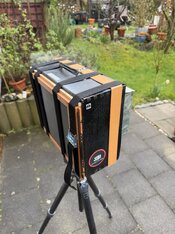
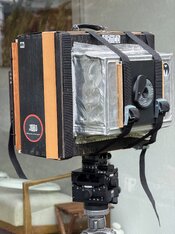
Obviously I was overthinking the pinhole precision requirements. Thank you your clarification! Consequently, I bought some small wooden boxes with lid to take up the Intrepid „lens“ board and plate film holders on opposite sides.

A cylindrical food supplement container wherein 3/4 of the circle perimeter can be covered by 8x10 film is another project.
 
This is my first iteration. I was able to learn that garden pictures on a windy day do turn out less sharp than expected.

You live to learn.
 

Attachments

  • IMG_9202.jpeg
    IMG_9202.jpeg
    380.5 KB · Views: 20
  • IMG_9198.jpeg
    IMG_9198.jpeg
    425.7 KB · Views: 25
And I had to learn that spray-painted plastic still lets light pass (so my strong flashlight said when held onto the front container of the camera), so I added the flashy aluminium foil.
 
There are several places to get laser drilled pinholes --- one is mentioned above. Get the thinnest metal possible. The size of the hole determines the focal length. MrPinHole explains it all. Or do it all yourself and enjoy the frustration.
 
There are several places to get laser drilled pinholes --- one is mentioned above. Get the thinnest metal possible. The size of the hole determines the focal length. MrPinHole explains it all. Or do it all yourself and enjoy the frustration.

The distance of the hole from the film/paper determines the focal length. The size and accuracy of the pinhole controls the sharpness. I think I'd be speaking for a lot of people though if I said that pinhole photography is not about sharpness.
 
You can define it however you want, but any pinhole produces it sharpest results -- even though most people would still call them"fuzzy" -- at one focal distance. There are on-line calculators that will tell you what this is -- based on the diameter of the hole. Anyone is free to ignore this if they want, but pinholes have focal lengths based on the diameter of the hole.

See page 124 in Eric Renner's "Pinhole Photography".
 
Last edited:
I do it by inserting the dull end of a #10 quilting needle in a pencil eraser. I use a small bit of foamcore or several layers of corrugated cardboard to hold the needle perfectly vertically while I drill with it. Use a small piece of .002 inch brass shim stock or drinking can aluminum. Place it on a hard surface the needle can't penetrate. For a .15mm pinhole place it on one sheet of paper. For a .2mm, two pieces of paper and for .3mm, on four sheets or thin cardboard like a matchbook cover.

Rotate the needle to drill into the metal. A burr will form on the opposite side. Sand the burr off with fine sand or emery paper, at least 400 grit. Dust from the sanding tends to end up in the hole, so if you can, blow it out with compressed air, or run in under the faucet at full blast. (Make sure it's completely dry before mounting it.)

I measure them with a cheap USB microscope. I easily get within a hundredth of millimeter of what I want. It's pretty easy.

1778768502414.png


Here's a .23mm hole.

roundpinhole.jpg


For comparison, here's a Gilder .15mm Electron Microscope Aperture.

1778769528125.png


In the last year, I've had about 25 people drill pinholes as good on the first or second try.

Anybody got a micro photograph of those laser drilled and RSS pinholes?
 
Last edited:
You can define it however you want, but any pinhole produces it sharpest results -- even though most people would still call them"fuzzy" -- at one focal distance. There are on-line calculators that will tell you what this is -- based on the diameter of the hole. Anyone is free to ignore this if they want, but pinholes have focal lengths based on the diameter of the hole
This is all a bit unnecessary for a fun thing like pinhole photography... but... focal length is literally the distance from the aperture to the film plane when focused at infinity (and pinhole cameras are always focused at infinity, due to fixed tiny apertures). That's the actual definition of focal length.
There's an optimum size of pinhole for a given focal length. If the hole is too big and too close to the film, things are softer than you might need, and if it's too small and too far away you'll get very long exposure times than you need (and more visible diffraction).
But *lots* of variable focal length cameras (like the Mania pinhole camera), use one pinhole for multiple focal lengths. Some don't, I have a zero45 that has 3 pinholes that you can switch between as you add/remove panels, if you get it wrong, you barely notice
So yes, from a *maths* point of view, there's an optimal pinhole.
From a "lets have fun and play with this crazy photographic process", especially when people are getting started, there is *zero* need to be accurate, and honestly, it's more fun if you aren't.
 
I agree. But it's also so easy it doesn't hurt to try if you want. I'm old school enough to think that it's a prime pinhole experience to drill your own image-making objective.

Absolutely! (my post wasn't a response to yours, but to the one before talking about optimal pinholes). I've seen the "make a bump, sand it down" thing before, it seems like a nice technique vs just punching a hole. I confess though, I've only ever bought my pinhole cameras. The zero45 is such a pretty object, and I got a good deal on a broken (but easily fixable), zero69.
One day I will DIY one. Maybe an 8x10 box, as I don't have an 8x10 camera at all.
 
Last edited:
From a "lets have fun and play with this crazy photographic process", especially when people are getting started, there is *zero* need to be accurate, and honestly, it's more fun if you aren't.

Unfortunately, the opposite often happens. Someone thinks they can simply punch a hole in a piece of cardboard -- and they end up so frustrated with the (lack of) results that they give up on pinhole completely -- unfortunately.

That's in the ballpark with giving a newbie a camera and not telling them the importance of the f-stop and the shutter speed. "Let's just have some fun!!!"

The original question was: "Any suggestions how or where to obtain the required 4x5 pinhole for 90-100 mm focal length? Thanks for advice!"

The answer is -- 0.35-0.37mm.
 
Last edited:
Thank you for all your advice! I learned a lot. For my next 2 wooden boxes I will use the Intrepid 4x5 and 8x10 inserts that indicate the best focal length for their hole sizes and the f-stop resulting from hole size and this focal distance. Both are confirmed by the pinhole calculator, as is the ultrawide Lerouge 45mm 4x5 pinhole camera.

However, taking into account the strong reciprocity failure of Fomapan 100 film, I obtained very dark negatives with both cameras I used, after messuring the light with an ambient light meter.

And I‘m thrilled by pinholes to be drilled - thank you Nick!
 
I made myself a little laminated card with exposure time (as metered at f/22) vs actual exposure time for my pinhole, adjusted for reciprocity. It means I don't have to mess with apps. (Not sure if this version is accurate, I don't have my latest to hand)
pinhole-fp4.png
 
However, taking into account the strong reciprocity failure of Fomapan 100 film, I obtained very dark negatives with both cameras I used, after messuring the light with an ambient light meter.

Any guess as to what "went wrong"? The exposure should only be accurate in the middle of the image. How was the f-stop determined?
 
The f-stop was indicated on the lensboard/camera. With my Chamonix 4x5, the shorter times measured in the same manner as for the pinholes with identical film led to quite dense, high contrast negatives. So I must have gotten the reciprocity compensation wrong (Chamonix: typically 0.5 to 1 second, pinhole cameras 20-30 minutes exposures).
 
Foma 100 is pretty bad for reciprocity failure. For large format pinhole, your time might indeed gets into many minutes.

On another note, I have also use those micro drill bits to make 0.2 - 0.5mm pinholes. They are pretty decent. You still need to do the gentle sanding, like with the sewing needle.
 
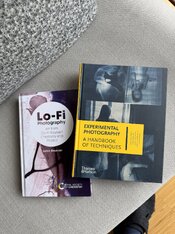
From another thread I got two good book recommendations. The Beaver with its scientific style and layout is a reminiscence of former times when I studied chemistry. Elaborate formulae on exposure times and reciprocity lead to a „trial and error“ resumee for practical application. q.e.d.
 

Attachments

  • IMG_9540.jpeg
    IMG_9540.jpeg
    661.1 KB · Views: 18
The only new thing in pinhole really is the actual pinhole manufacture and size calculation, and there's a limit to the final impact that really has.(or is required).
Exposure calculation is the same as for any other camera, though the numbers tend to be more extreme (and some people may never have encountered reciprocity failure. None of that is new, and a lot of people do it all in apps now.
The hard part of pinhole is the usually ultra wide focal lengths, and the fact that you've got mostly got to visualize it in your head with few, if any, visual aides. For me that's where the biggest challenges are, and where the most fun is too.
 
Photrio.com contains affiliate links to products. We may receive a commission for purchases made through these links.
To read our full affiliate disclosure statement please click Here.

PHOTRIO PARTNERS EQUALLY FUNDING OUR COMMUNITY:


Ilford ADOX Freestyle Photographic Stearman Press Weldon Color Lab Blue Moon Camera & Machine
Top Bottom