

• Welcome to Photrio!
    Registration is fast and free. Join today to unlock search, see fewer ads, and access all forum features.
    Click here to sign up

Help Requested: Black Specks Troubleshooting (A Strange And Confusing Tale)

Recent Classifieds

Forum statistics

Threads
204,274
Messages
2,866,513
Members
102,207
Latest member
gustavocf
Recent bookmarks
1

quigs

Member
Joined
Apr 22, 2026
Messages
28
Location
Kalamazoo, MI
Format
Multi Format
Hi folks,
Been lurking/learning for a while and joined to request some advice. I've shot and developed over 100 rolls of film, and am no stranger to the common mistakes and pitfalls, but lately have encountered an issue that I would like to run by you all before I invest more time, film, and chemicals into diagnosing and testing.

The short version of my story is that I am getting significant black specks all over my negatives. They did not stand out to me when I was shooting largely medium format last year (but they are present), however last fall I got into bulk rolling 35mm film and the enlargement of the smaller negatives revealed significant black specks all over the negative which appear as white "snow" on the inverted scans.

My development process has become about as clinical as I can make it at home. I started using distilled water for the entire process (chem mix [if powder], dilution, final rinse, and wash aid), spending almost a gallon of distilled water per roll of film (I use the ilford method, but the black specks appear with running tap water 10 minute rinses too). I rap the tank after inversions to clear bubbles. I switched to a 10 micron chemistry filter to filter both fresh and re-used chemistry. I started fixing longer, I tried hypo clear. I run the shower till the bathroom is completed fogged with steam and dry my negatives in the shower inside a zippered garment bag that was open and exposed to the steam. Although some rolls/frames were better than others nothing I did reduced the specks to a "normal" amount of dust (eg the same levels I see when I send my film off to a lab). When I inspect the negatives with an 8x loupe I can see the black specks all over. I have used over 7 different cameras, 5 different developers (Xtol, DD-X, Pyrocat-HD, Flic BW&G, Rodinal), and different brands of fixers (llford Rapid Fix, TF-4) and many film stocks (Foma, Kodak, Ilford, Lucky). I have loaded in a dark bag, a dark closet, and (for test rolls) in broad daylight. I deep clean my darkroom equipment and even ran them through the dishwasher by themselves (which had no effect--didn't make things worse or better).

I know this is a post in a B&W topic but this issue persisted (and in some cases was worse) for C-41 development. Digital ICE wasn't removing them (they're baked into the emulsion). Finally I noticed that on the home developed negatives done with plastic reels and tanks these specks are nearly completely absent. About mid-way through last year I switched from plastic to metal tanks and all of my negatives from that point onward have this issue. So I think I found the correlation but I can't determine the cause. I switched to metal to save money on developer and because the film stocks I prefer often get bunched up/creased in the "push" winding for loading it on the plastic reels. When I switched to metal reels (pull winding) I stopped ruining rolls of film during loading (particularly Svema, Foma, and Lucky which have very thin/curly bases), but have many almost unusable rolls of 35mm film due to the specks.

I have included some samples. The blacksmith is T-Max developed with DD-X 1+4. The owl and panda photo is Foma 400 developed with Eco Pro Xtol 1+1. Both were soaked in Kodak PhotoFlo 1.5:200 (which seems to leave the least amount of scum on the negatives but I have these specks whether I use PhotoFlo or not). I am also including an IR scan of a C-41 negative which exhibits the black speck issue most clearly. Out of desperation I squeegeed that roll (Fuji USA 200) and still experienced the black specks. The last image I have included is an IR scan of the last frame of a non-squeegeed roll of C-41 film (Kodak UltraMax 400) which has a ridiculous amount of gunk on it. I have noticed that the specks often (but do not always) accumulate on the lower frames of the roll (as they are hanging). For example the Fuji 200 roll's last frame is ironically nearly pristine. Re-rinsing and re-fixing does not remove the specks.

What do you think is causing this, and why is it worse for metal equipment vs plastic?
 

Attachments

  • quigsphoto_roll77_2025-09-07-04-positive.jpg
    quigsphoto_roll77_2025-09-07-04-positive.jpg
    481.4 KB · Views: 134
  • quigsphoto_roll120_2026-03-29-04-positive.jpg
    quigsphoto_roll120_2026-03-29-04-positive.jpg
    546 KB · Views: 131
  • IR scan.png
    IR scan.png
    1.3 MB · Views: 132
  • Screenshot 2026-04-21 at 01.23.17.png
    Screenshot 2026-04-21 at 01.23.17.png
    1.5 MB · Views: 151
Last edited:
Well... it's dirt. Given what you say, it's probably the reel, the tank, or both.

Do you use more than one metal tank? Which brand and model? And are they new or used?
 
I wondered about the garment bag you use for drying. Could it be shedding whatever it is made of?
 
Welcome aboard @quigs!
Sorry to hear about & see your dust & dirt problems - as that's what this is, evidently.
Sometimes, it can help to inspect the (scanned) dust / dirt closely to determine shape and size of the particulate contamination. This can contain clues as to the possible causes.

they're baked into the emulsion
You said this in relation to C41 and I can confirm this is the case; it's very frustrating indeed and usually the problem cannot be entirely resolved. It is possible to re-wash negatives, but it requires mechanical cleaning of the wet film (emulsion side) to get rid of (most of) the dust. This involves a large risk of scratching the emulsion. So once this problem happens, you're more or less stuck with digitally cleaning out the dust on scans, or using physical spotting of prints.

About mid-way through last year I switched from plastic to metal tanks and all of my negatives from that point onward have this issue. So I think I found the correlation but I can't determine the cause.
That appears to be a correlation, but (1) it's unclear how strong the correlation is and (2) whether correlation should be relied upon for causation.
Have you done any systematic testing of plastic and steel reels to see if the problem indeed follows the steel reels specifically? I don't expect it will, honestly, but it all starts with testing.

Potential causes for the kind of dirt issue you're showing here can include:
* Contaminated water; you use distilled water for making up the chemistry, but how about the wash? You mention tap water there. Small dirt can occur in tap water systems, for sure.
* Contamination in utensils or vessels that come into contact with your process water. To give you an example, I battled a really persistent contamination issue once and it turned out to trace back to scale buildup in a water cooker I used (for 'kick-starting' the warming up of the wash water for color film). I'm not saying the cause would have to be a boiler or heater; consider any vessel, utensil or pipe system your process water comes into contact with. Given the persistence of the problem, it will likely be a recurring or permanent issue.
* Dirt deposited during drying. You mention a zippered garment bag. That's a red flag to me (I agree with @Premier)! Was this bag ever used for garments in the past? What material is it made of? Either way, don't use this. Just hang the film in the shower area. Don't disturb the room until the film is dry. Ensure reasonable cleanliness of the rooms where you handle wet film in.

At least some of the dirt consists of fibrous contamination, so the garment bag would be at the top of my list to eliminate.
 
I can feel your pain. (I have a persistent issue of bubbles near the top edge of 120 films)
Did you try to change to a different brand of distilled water? Tricky because the same sloppy pruduction might be marketed under different brands.
I use tap water, but any water that touches film goes through a 5micron filter. If you do that you have everything under control.
Apart from contaminated "distilled" water I can only see precipitate in the fixer but you serm to have taken care of that.
 
Last edited:
If this was my issue (and I have had this issue) I would immediately eliminate all unnecessary variables. Just use your tank and reels, developer, tap water stop, fix, tap water wash, hang to dry in open without any circulating air like exhaust fans etc. Evaluate. To my mind the drying step has the highest potential for depositing dust. I solved this by taking a lesson from vinyl record days using a deionized water rinse before hanging. The DI water transfers film surface conductivity attracting dust into the water rather than the film surface. 2cc/liter photoflo in distilled water has same effect I have found, the 7.5cc/l is too much IMHO. Another step I have taken is to never let photoflo touch a tank or reel.
 
Some random thoughts about where your specks could be coming from.

First, though, feel the negative and determine if 1. you can actually feel the grit and 2. which side, or both, the dirt is on.

Of course, look for the usual airborne dust sources, but also check your developing solutions, especially the fix, for tiny floating particles. Fixer, especially, can precipitate out sulfur that sticks to the film. Check for degradation of the light seals in your camera as well as the material in your drying bag.

Good luck with the search.

Doremus
 
So I have some new info. I bought an ionizer and a reptile warming bulb and set that up in my garment bag. The film dried very quickly and and I scanned it but saw zero change to my negatives. The black specks are there. I stole my kids' handheld microscope and noticed that when the light shines on the black specks they reflect it, so it appears to be silver particles.
Given that I still see these with freshly diluted fixer, across multiple brands of fixer, fixed for 5-10 minutes, where could this contamination be coming from, and why isn't it coming out even with hypo clear and the Ilford rinse method (and the regular leave the tap running for 10 minutes method)?

I would prefer to see a scan of a negative.... Are you able to determine which side the black specs are on?

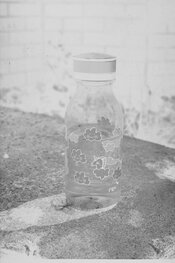
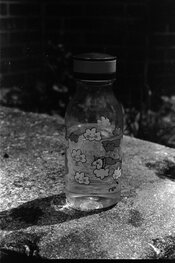
I've attached a raw scan from VueScan and the inversion. Foma 400, Xtol 1+1 9:30 @ 20C. The specks are in the emulsion as they do not wipe off the base side with IPA. They do sometimes wipe off when I wipe the emulsion side--often at the expense of the emulsion.
 

Attachments

  • quigsphoto_roll129_2026-04-29-06.jpg
    quigsphoto_roll129_2026-04-29-06.jpg
    353 KB · Views: 58
  • quigsphoto_roll129_2026-04-29-06-positive.jpg
    quigsphoto_roll129_2026-04-29-06-positive.jpg
    443.6 KB · Views: 58
Last edited:
Still sounds like particles of sulfur from old fixer. I'd check that again and carefully. FWIW it doesn't matter that the fixer is unused. If it has been stored too long, it can still sulfer-out.

If that's not the problem, then look for something similar in your other chemicals. Particles of undissolved chemicals in your developer, stop, hypo-clear, unfiltered tap water, etc. If that's all clear, then it's on to looking for airborne particles.

On the off-chance that it's a problem with the film, snip an unexposed piece or take an unexposed sheet and examine it carefully under magnification.

Then, there's always particles from degrading light seals, shutter curtains, etc. in the camera. Check those too.

If all that is good, I can't think of where else to look.

Good luck!

Doremus
 
Small crystals would also reflect light from their facets.

Then again, the only common element in your experiments is distilled water. As mentioned in #6 above.
Here's a terrible handheld macro extension photo of a handheld microscope eyepiece. The shape is very crystalline. I've used distilled water from different brands, and even make my own. Same same regardless. 🤔

Still sounds like particles of sulfur from old fixer. I'd check that again and carefully. FWIW it doesn't matter that the fixer is unused. If it has been stored too long, it can still sulfer-out.

If that's not the problem, then look for something similar in your other chemicals. Particles of undissolved chemicals in your developer, stop, hypo-clear, unfiltered tap water, etc. If that's all clear, then it's on to looking for airborne particles.

On the off-chance that it's a problem with the film, snip an unexposed piece or take an unexposed sheet and examine it carefully under magnification.

Then, there's always particles from degrading light seals, shutter curtains, etc. in the camera. Check those too.

If all that is good, I can't think of where else to look.

Good luck!

Doremus

Hmm. My two B&W fixers are 6-9 months old, but my C-41 fixer was freshly mixed from powder and the specks are just as bad with color film. I also see this with liquid C-41 Blix from Arista.
For undissolved chem, would that still be happening with liquid chem too? If I develop in Pyro or Rodinal I see these specks. I also tried filtering all chemistry with a 10micron filter.
Regarding film, I see this with FP4, Foma, HP5, Tri-X, Svema, etc.
Regarding cameras, I see this across 7 different camera bodies, even those with fresh seals.

Thanks for the troubleshooting!
 

Attachments

  • quigsphoto_QUIG2001.jpg
    quigsphoto_QUIG2001.jpg
    461.4 KB · Views: 47
It seems that FPP uses a standard formula based on sodium thiosulfate. I'm not sure what pH the working solution has (the other component is sodium metabisulfite), but I assume there shouldn't be any particular issues.
As for the spots - what is the temperature of the water you use for the final rinse? Is it possible that calcium is precipitating?
 
As for the spots - what is the temperature of the water you use for the final rinse? Is it possible that calcium is precipitating?

The rinse (distilled water) is between 19 and 20C. I don’t think temperature is causing this because when I process C-41 I have sometimes done the final rinse in the 41C tap water bath I use to keep the chemistry at the correct temperature and the specks show up then too.
 
Just one more thought.

Are you using a water softener? If so, the salts many water softeners use to replace the carbonate in the water will appear as crystals on the film when dry if you use the softened water for washing. The solution is a five-minute soak in wetting agent diluted with distilled water before hanging the film to dry.

I ran into that problem when I lived in San Antonio. Really hard water there.

Doremus
 
Just one more thought.

Are you using a water softener? If so, the salts many water softeners use to replace the carbonate in the water will appear as crystals on the film when dry if you use the softened water for washing. The solution is a five-minute soak in wetting agent diluted with distilled water before hanging the film to dry.

I ran into that problem when I lived in San Antonio. Really hard water there.

Doremus

I used to live in San Antonio as well! I moved to the midwest to a house with a well and still have hard water. We have a softener, so that is why I do my rinse in distilled water otherwise I get stains.
 
Thanks, @Doremus Scudder, @koraks and everyone else for the troubleshooting rubber ducking. Over the weekend I washed all my equipment first with 5% vinegar, followed by calcium carbonate, followed by household bleach, followed by fixer (the last two per Kodak's instructions) with a water rinse between each chemical (very important!).

I appear to have significantly reduced the particulates embedded in the emulsion on a B&W negative developed with DDX and my freshest (8-month old) fixer. The ones present here across two scans mostly wipe off with a dry antistatic cloth, and the remainder appear to just be micro dust on the surface (I can no longer see them with a loupe like I could before). I've scratched up the negative on the second image due to using the children's microscope on the base side (must be some hard plastic in that microscope! 😄). When I inspect the emulsion directly I see different specks compared to the base side. I'll now work on dust mitigation during scanning.
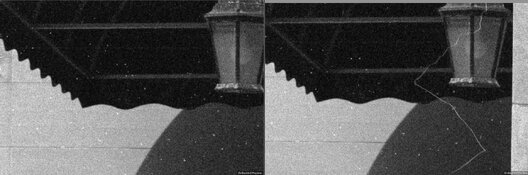

The next step will be to do a test roll in XTOL again and C-41 to see if there's any other contamination issues before concluding that I've identified and resolved everything, but this is the most promise I've had in weeks! I also plan to buy a finer paper filter to really comb out any sulphirization compounds in the C-41 kit (since it's reusable).
 

Attachments

  • Post-clean.jpeg
    Post-clean.jpeg
    216.5 KB · Views: 27
  • Pre-clean.jpeg
    Pre-clean.jpeg
    333 KB · Views: 27
I do not put the film inside any container or bag while it is still wet, and I make sure the forced air heating system is turned off for the first hour or so of drying. I also regularly clean around the general area of the hanging film with the vacuum hose attachment. Never found a need to increase the humidity while drying the film.
 
Photrio.com contains affiliate links to products. We may receive a commission for purchases made through these links.
To read our full affiliate disclosure statement please click Here.

PHOTRIO PARTNERS EQUALLY FUNDING OUR COMMUNITY:


Ilford ADOX Freestyle Photographic Stearman Press Weldon Color Lab Blue Moon Camera & Machine
Top Bottom