
• Welcome to Photrio!
    Registration is fast and free. Join today to unlock search, see fewer ads, and access all forum features.
    Click here to sign up

Zone VI Archival Print Washer 16"x20" - need plans / photos

Untitled

A
Untitled

  • 0
  • 0
  • 5
The Hot Waters

A
The Hot Waters

  • 0
  • 0
  • 32

Recent Classifieds

Forum statistics

Threads
204,316
Messages
2,867,073
Members
102,221
Latest member
GarMc
Recent bookmarks
0

andrewherrick

Subscriber
Joined
Mar 26, 2009
Messages
15
Format
8x10 Format
Hi everyone, I'd like to acquire a 16x20 Zone VI print washer but I live in Australia. They occasionally come up on ebay but many sellers won't ship to Australia and when they do, the shipping cost alone is likely to be US$400+. So US$700-$800 or more all in to Australia, which is a lot for a second hand washer. I therefore thought I might as well get one made here.

I'm just not sure about the design... I've never owned one so can't get my head around it. I've reviewed numerous photos online. There appear to be two vertical chambers, one at either end of the main washing chamber. The input flow seems to come in through the top of one of these. I think there are a series of holes in this chamber which allow the water to flow into the main chamber… just not sure where these are exactly, or how water gets into the outflow chamber.

Any drawings, measurements, or videos of one of these washers filling / in operation / emptying would be much appreciated!

Thank you so much!
 
The Zone VI is not as good a design as Fred Picker's sales copy would have you believe.

The Nova washers are more effective, and had input from Ilford in their design. The reality is that once you have enough agitation to get a good wash, the claims about fixer sinking become nonsense.

In essence, the washer is not that complicated, the best dividers are effectively prismatic diffusion material, and you need an input manifold that is effectively a box with the main inlet at one end and a small hole drilled to feed water into the bottom of each 'cell' defined by the dividers. At the top, you have one internal end wall a little lower and the water overflows/ waterfalls into an outlet channel and down the drain without mixing into other cells. 'In sink' washers don't have the containment area and just overflow directly into a sink. That's about the extent of it. Most of the complexity involves making something that can withstand 70+kg of water.
 
I had a Summitek 16x20 washer sent to me in Australia maybe 20 years ago and, yes, I can confirm that it's an expensive exercise. Then I had a new set of dividers made in a textured surface made up because the smooth ones were awkward. If you would like details of the unit I can measure and photograph it for you.
 
The Zone VI is not as good a design as Fred Picker's sales copy would have you believe.

The Nova washers are more effective, and had input from Ilford in their design. The reality is that once you have enough agitation to get a good wash, the claims about fixer sinking become nonsense.

In essence, the washer is not that complicated, the best dividers are effectively prismatic diffusion material, and you need an input manifold that is effectively a box with the main inlet at one end and a small hole drilled to feed water into the bottom of each 'cell' defined by the dividers. At the top, you have one internal end wall a little lower and the water overflows/ waterfalls into an outlet channel and down the drain without mixing into other cells. 'In sink' washers don't have the containment area and just overflow directly into a sink. That's about the extent of it. Most of the complexity involves making something that can withstand 70+kg of water.
another vote for the Nova∑asher. theyare a simple but effective design based on Ilford's diffusion was method. a look at a good picture of them should give you sufficient info to copy the design.
 
I like my own design better than any of them. But the only way to cost-effectively build one yourself is to sign on to a basic acrylic fabrication class at some local plastics dealer. Perhaps there are suitable U-Tube options as well. One needs to have the ability to make precisely straight and square-edged cuts in both 1/8" and 1/4" inch Plexiglas-style acrylic, and know how to solvent-weld the joints.

But one doesn't necessarily need a fancy expensive slot washer to obtain the same washing effect. The problem with most of the commercial units is that they try to cram too many prints into the washer at the same time, and use smooth plastic septums which prints tend to stick to. Use slightly textured acrylic plastic septum material instead - and they don't even need to glued in - just evenly spaced.

I don't think I need to go into much detail, since others have already given some good tips.
 
Last edited:
.................., and use smooth plastic septums which prints tend to stick to. Use slightly textured acrylic plastic septum material instead - and they don't even need to glued in - just evenly spaced.

..............

I absolutely agree about the textured/dimpled dividers. It makes it so much easier to handle the prints and I expect that contact with water would be much better.
 
Deep tray + change of water + time and you are good. No need to go to the expense of importing a print washer. If you live in an area where water is scarce you can even just leave the prints to soak for a bit with a change of water. No need to keep the water running.
 
Low but steady and even water flow is actually an advantage (versus turbulence). There are other ways to break up air bells. If anything, more turbulence due to excess flow creates more air in the water, not less! With any well-designed slot washer, air bells are pretty much a non-issue. Most of the air comes out from the fiber-base of the paper itself anyway. After the prints are placed in the slots and have had time to soak a little while, partially lift them up and drop them back in to free any bubbles. Some prints contain so much air they want to float, and have to be capped down with an accessory lid atop the septums.

In any event, washers can be tested for efficiency using food coloring dye - it should clear out of the water quickly and consistently.

In some locations, conserving rather than wasting excess water is a priority. But some darkroom tempering valves demand a certain amount of water pressure to work correctly. Temperature tolerances don't really need to be in a very tight range like film developing temperatures, just reasonably close. A fancy tempering valve is not really necessary, but sometimes both hot and cold water filters are, depending on your water quality.
 
Last edited:
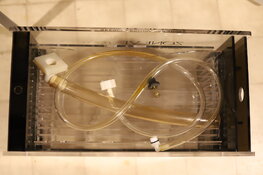
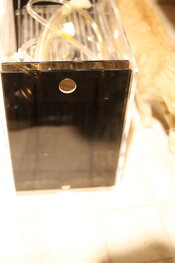
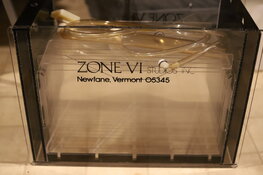
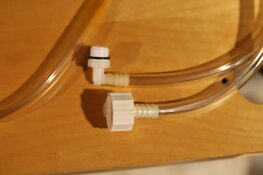
It turns out that mine is an 11x14. I highly doubt the design changed a lot as the size scaled up. You are correct in that water enters the top right and fills the narrow chamber first. The water then gets into the main wash chamber through a bunch of holes. On my sample it seems like there is one small hole per print space and a couple of larger holes to simply help with flow.
Most of these are designed so that the overall water flow is slow and gentle and simply overflows the print area and exits into the left chamber. I don't have the Fred Picker details for this device, he may have had ideas regarding the proper flow rate. At the schools and workshops I have attended they erred on the side of just enough flow to function properly.

IMG_0045.jpegIMG_0047.jpegIMG_0046.jpegIMG_0050.jpegIMG_0048.jpeg
 
Photrio.com contains affiliate links to products. We may receive a commission for purchases made through these links.
To read our full affiliate disclosure statement please click Here.

PHOTRIO PARTNERS EQUALLY FUNDING OUR COMMUNITY:


Ilford ADOX Freestyle Photographic Stearman Press Weldon Color Lab Blue Moon Camera & Machine
Top Bottom