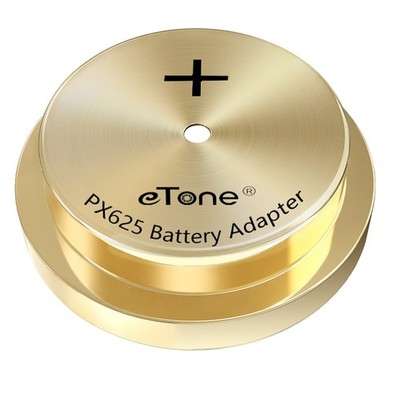
I believe you don't really need to use any adapter to lower the battery voltage from 1.55v to 1.35v. 1.55v is 115% of 1.35v. Why not just set the film speed on the Gossen meter to 15% slower? The reason this should work because the light meter contains linear components (resistive parts) only. The meter will respond linearly to give a 15% higher reading. This has the effect of a 15% higher speed set to the meter. I have done comparisons of several of my Gossen Pro with my Pentax p67-ii's meter. I feel I can just set the film speed 15% lower to my Gossen and get a decent exposure readings. I say I feel because analog meters are not made equal. There is a certain amount of error existing in them. But I do feel I can trust them by lowering the speed setting by 15%.
Not according to information on the web. The original Gossen Luna Pro (CdS model) cannot use 15.V batteries because it was designed for 1.35V mercury cells, and higher voltage will cause incorrect readings. To use 1.5V batteries, you must use a
Gossen Battery Adapter V207A, which was made by Gossen to lower voltage. Gossen's own web site mentions that adapter, or the use of the MR-9 voltage conversion adapter, or air cells, all as suitable alternatives.
https://www.gossen-photo.de/en/ersatz-fuer-quecksilberoxid-batterie-v625px/
"....cell voltages of 1.5 V and 1.55 V respectively are not suitable as replacements due to their higher voltage levels, and because the voltage level of alkaline manganese batteries decreases during the course of their service life...
"GOSSEN Battery Adapter V207A
The battery adapter replaces two no longer available mercury oxide button cells V625PX or PX13 with two silver oxide button cells IEC SR 43 and adapts them both mechanically and electrically to the characteristics of the original batteries. The battery adapter can be ordered via our webshop and, in addition to the adapter, also contains two matching silver oxide button cells IEC SR 43."
The use of an offset ISO value may or may not work, depending upon the metering circuit. Decades ago, while mercury oxide batteries were still available, I conducted a test of my Olympus OM-1n, using mercuric oxide vs. alkaline button cell, and found that the degree of meter error with the 'wrong' cell actually VARIED, based upon the
brightness of the light level...different degree of error in dim light than the degree of error in bright light, so a single offset could not be reaonably used to corrent meter error if 1.35V was not used. Other meters might or might not matter if failure to use 1.35V cell.






 Be careful when reading the product description in the eBay ad, when selecting a suitable product: