• Welcome to Photrio!
    Registration is fast and free. Join today to unlock search, see fewer ads, and access all forum features.
    Click here to sign up

My Nikon PB-4 Journey

Valencia

A
Valencia

  • 0
  • 0
  • 30
Tied to the dock

D
Tied to the dock

  • 4
  • 0
  • 82

Recent Classifieds

Forum statistics

Threads
203,089
Messages
2,849,694
Members
101,654
Latest member
Hannibal_Ektar
Recent bookmarks
1

grant.goodes

Member
Joined
Mar 16, 2026
Messages
49
Location
Ottawa, Canada
Format
35mm
I have always been interested in macro-photography, and after being gifted a Nikon model II bellows and having a bit of fun that and my 105/2.5, I sought out the legendary PB-4 swing/shift bellows and traded my 105/2.5 in for a Micro-Nikkor 105/2.8. For many years, this remained my setup for mostly field-photography (mushrooms being a particular "focus"), but I was never very happy with the results I got with the Micro-Nikkor, especially if I tried any movements. I think part of the problem with the 105/2.8 (aside from being designed to only cover 35mm) is its advanced CRC design, which gives you a kind of "dead zone" when you use more extension, since when shooting from 1:2 to 1:1, the CRC is effectively expecting you to be shooting at longer distances and not close-range.

To address coverage issue, I eventually bought a cheap medium-format lens (Wollensak 138/4.5 Graphic Raptar) to try out, and though this gave more coverage for the PB-4's movements (less vignetting), it was frankly a pretty crappy lens.

I recently got my dream macro lens, the large-format Nikkor 120/5.6 AM-ED (after hunting for MANY years for a sub $500 example), and the results are truly eye-opening. The 120/5.6 AM-ED is very compact mounted on the PB-4, and even allows movements at infinity focus. It takes 52mm filters which is very convenient for a Nikon shooter. It does seem susceptible to flare, but I took some advice from Bjørn Rørslett's old reviews of the lens and bought an HN-3 screw-in shade for it (designed for the 35mm lenses) which helps with the flare but still allows for movements without vignetting.

When deciding on the 120/5.6 AM-ED, I explored the (large) universe of macro-optimized Nikkors, ranging from the APO EL-Nikkors, Printing-Nikkors, short-mount Bellows-Nikkors, to industrial/process lenses generally. As great as all these other lenses sounded, I just couldn't justify their expense (the APO EL-Nikkor 105/5.6 being a particularly bad example of collectors driving up the prices), or else their rarity made them impossible to find. I did recently trip over a listing for a mint condition 105/4 Bellows-Nikkor for sale at $150, so that is on its way to me (to become the 8th 105mm Nikkor in my collection). I realize that the optical design of the short-mount 105/4 is the same as the later Micro-Nikkor 105/4 AiS (with the addition of modern coatings), but I'm curious to see if the coverage is better than my 105/2.8. I guess I will find out shortly, but I'd be interested to hear if any PB-4 users out there have any comments on the characteristics of the Bellows-Nikkors.
 
Last edited:
Thanks for sharing. I'd love to see some photos made with the setup.

Have you tried any enlarging lenses with the bellows?
 
I'll try to get some photos up, but we're still in Massive Snow mode here in the Great White North, so no mushrooms to shoot right now!

To your question: Before I found the 120/5.6 AM-ED, I bought a nice copy of the Schneider Kreuznach 135/5.6 Componon-S enlarging lens. The one I found is a somewhat older version of the lens, and there are updated designs, but they cost quite a bit more. I used this 135mm Enlarging Lens Test to help me choose what to hunt for (I wanted 120-135mm focal-length to allow infinity focus w. movements on my PB-4). Ultimately, the choice was made by finding the Componon-S at $100, far below the prices I found of the other well-reviewed lenses.

The Componon-S is a great performer, very compact, and it is super-easy to adapt to F-mount as it has an M42x1 thread (ie. T2 mount). It kicks my old Wollensak to the curb! However, I suspect it won't get much use now that I have the Nikkor. I paid 4x more for the 120/5.6 AM-ED, but it was totally worth it: (a) it's a very sexy looking Nikkor that I had been lusting over for years, and (b) it _does_ perform better IMO.
 
Last edited:
I have a PB 4 with the 105 bellows Nikkor. The setup will fit on my D850. I played with it a bit, but the 105 VRII micro nikkor calls me when I shoot in close. So many fun things to play with 👍
 
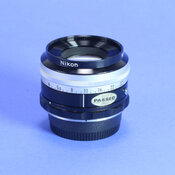
My Bellows-Nikkor 105/4 arrived yesterday, and I couldn't be more happy with it's condition: Basically no signs of use. I didn't realize it had the f-stop markings in the opposite order of normal Nikkors, but in actual use you turn the aperture ring in the same direction as normal (to the right to close the lens down): The f-stop markings are on the lens body rather than the aperture ring, which inverts the numbering order to maintain the traditional Nikkor stop-down direction. The aperture has detents every 1/3 f-stop which is very unusual, and goes all the way down to f/32 (diffraction!). It is of course not an Auto lens as it was intended for a bellows, and instead has a separate stop-down ring which allows for composing wide-open and then easily stopping down to the pre-selected aperture.

The Bellows-Nikkor aperture has 12-blades, and remains almost perfectly circular at every f-stop. Very few F-mount Nikkors had more than 9-blades as the body-activated Auto stop-down mechanism of the F-mount would struggle to handle the number of blades that S-mount (rangefinder) lenses often had. The older Bellows-Nikkor 135/4 (derived directly from an S-mount design) actually had 15-blades, but the 12-blades of the 105/4 seems more than adequate.

This is a very high quality lens, even nicer than my oldest Nikkor (a 105/2.5 P "Sonnar", probably from 1970). My Bellows-Nikkor is the last version (with lens data markings on the outside) from 1972, and is the 140th one manufactured. I will try it out on my PB-4 next, and in particular want to see how much coverage it provides with shift/tilt movements.
 

Attachments

  • 10.39.17-64f18670adb4d0a51b9e2bf0bcd2015f.jpg
    10.39.17-64f18670adb4d0a51b9e2bf0bcd2015f.jpg
    165.5 KB · Views: 25
Last edited:
My Bellows-Nikkor 105/4 arrived yesterday, and I couldn't be more happy with it's condition: Basically no signs of use. I didn't realize it had the f-stop markings in the opposite order of normal Nikkors, but in actual use you turn the aperture ring in the same direction as normal (to the right to close the lens down): The f-stop markings are on the lens body rather than the aperture ring, which inverts the numbering order to maintain the traditional Nikkor stop-down direction. The aperture has detents every 1/3 f-stop which is very unusual, and goes all the way down to f/32 (diffraction!). It is of course not an Auto lens as it was intended for a bellows, and instead has a separate stop-down ring which allows for composing wide-open and then easily stopping down to the pre-selected aperture.

The Bellows-Nikkor aperture has 12-blades, and remains almost perfectly circular at every f-stop. Very few F-mount Nikkors had more than 9-blades as the body-activated Auto stop-down mechanism of the F-mount would struggle to handle the number of blades that S-mount (rangefinder) lenses often had. The older Bellows-Nikkor 135/4 (derived directly from an S-mount design) actually had 15-blades, but the 12-blades of the 105/4 seems more than adequate.

This is a very high quality lens, even nicer than my oldest Nikkor (a 105/2.5 P "Sonnar", probably from 1970). My Bellows-Nikkor is the last version (with lens data markings on the outside) from 1972, and is the 140th one manufactured. I will try it out on my PB-4 next, and in particular want to see how much coverage it provides with shift/tilt movements.

hope you enjoy.
 
I saw one spec. sheet on that bellows lens with a 23°20' angle of view. Seems like that is only going to just cover the frame at infinity, if that is true.

Interested to know how it works with bellows movements at close range.
 
I saw one spec. sheet on that bellows lens with a 23°20' angle of view. Seems like that is only going to just cover the frame at infinity, if that is true.

Interested to know how it works with bellows movements at close range.

IC, I've had a PB-4 for, um, 56 years. The movements are pretty useless.
 
I saw one spec. sheet on that bellows lens with a 23°20' angle of view. Seems like that is only going to just cover the frame at infinity, if that is true.

Interested to know how it works with bellows movements at close range.
For using the PB-4's movements at infinity, I have my Nikkor 120/5.6 AM-ED, which has more than adequate coverage (even though it wasn't designed for infinity usage, and doesn't cover adequately cover 4x5 at that range), but want to try out the Bellows-Nikkor at higher magnifications, where it should have enough coverage for movements. Will let you know how it goes! In any case, the Bellows-Nikkor is a very nice little piece of glass-history.
 
Finally was able to quickly try out the Bellows-Nikkor with the PB-4, and as I had always suspected, it's of very limited use at infinity:
  • It _will_ focus to infinity..
  • ..but the bellows is almost entirely collapsed (maybe 2-3mm short of fully collapsed), so NO movements are possible at infinity
  • Even at closer distances where movements are possible, the image circle is pretty limited, so it will quickly vignette
  • The Nikkor 120/5.6 AM-ED is _much_ better for playing with the PB-4, and will even allow for (almost) full movements at infinity (though it is of course not optimized for that range)
That being said, the Bellows-Nikkor is a nice little piece of history and finely made. I will have to see if it can give good results (within its limitations)
 
Photrio.com contains affiliate links to products. We may receive a commission for purchases made through these links.
To read our full affiliate disclosure statement please click Here.

PHOTRIO PARTNERS EQUALLY FUNDING OUR COMMUNITY:


Ilford ADOX Freestyle Photographic Stearman Press Weldon Color Lab Blue Moon Camera & Machine
Top Bottom