
• Welcome to Photrio!
    Registration is fast and free. Join today to unlock search, see fewer ads, and access all forum features.
    Click here to sign up

Nikon AI conversion

Filling In

H
Filling In

  • 1
  • 2
  • 32
Painted Hills # 3.jpg

H
Painted Hills # 3.jpg

  • 4
  • 0
  • 79

Recent Classifieds

Forum statistics

Threads
203,208
Messages
2,851,415
Members
101,724
Latest member
Pituck
Recent bookmarks
0

RalphLambrecht

Subscriber
Allowing Ads
Joined
Sep 19, 2003
Messages
15,120
Location
K,Germany
Format
Medium Format
Possibly a dumb question, but important to me. Hence, I ask:
I got a perfect non-AI lens coming in the mail. Also, I have an otherwise defective AIS lens sitting around doing nothing. Can I remove the aperture ring from the defective AIS and mount it on the non-AI to convert it to AI, provided both lenses have the same aperture range?
 
I don't think that would work. When prices got low enough and there were different Nikkors to choose from, I just got both. When using a pre-AI lens with a Nikkormat FT3, I just flip up the AI tab. Using an AI lens with a prong on a Nikkormat FT2 is no problem. In the past, John White did some conversions for me. I have enough different Nikon film cameras that I don't think I would bother getting any more Nikkors converted. My 28/2 Nikkor is a 'K' model but I have used it in stop-down meteting mode with a Nikkormat FT3 successfully.
 
I don't think that would work. When prices got low enough and there were different Nikkors to choose from, I just got both. When using a pre-AI lens with a Nikkormat FT3, I just flip up the AI tab. Using an AI lens with a prong on a Nikkormat FT2 is no problem. In the past, John White did some conversions for me. I have enough different Nikon film cameras that I don't think I would bother getting any more Nikkors converted. My 28/2 Nikkor is a 'K' model but I have used it in stop-down meteting mode with a Nikkormat FT3 successfully.

I will continue to try converting because I like the simplicity of AI.
 
there is a way to hone- down a nitch on the aperture ring ----W/O changing nothing
 
Converting only increases usability, no degradation of optics.

Absolutely agree. That being said, I am not a fan of home-brew conversions (milling the non-AI aperture ring), even though it's not affecting the optics: I'm a bit of a purist and that old Nikkor metal itself seems a bit sacred, not to mention that the engraved ADR (Aperture Direct Readout) numbers won't be provided. Obviously, that's just my take, and other, more illustrious photographers disagree (see Bjørn/Birna Rørslett's heavily modified and tape-covered gear for example)!

Nikon made a lot of effort to provide factory AI conversion kits, and there are only a relatively small number of "cool" Nikkor lenses that were not covered (e.g. the oldest 105/2.5 P Sonnar lenses with the 9-blade aperture), and they are so rare that they should almost certainly be maintained in original (non-AI) condition. If I had a user non-AI, I would probably be fine with bastardizing the aperture ring with a file, but my only non-AI lens (the aforementioned 105/2.5 P Sonnar) was easily found already converted with the factory kit, so I have never had to violate the sacred Nikkor metal.
 
Last edited:
With sincere apologies can I hijack this thread which is highly pertinent to the question I was about to post?! Firstly I would just comment and say that my attitude is that very few if any of these lenses have sufficient monetary value to preclude even an amateur AI conversion so knock yourself out.

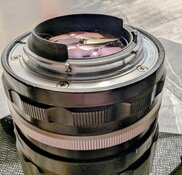
But my question is this... The attached photo is the back office end of a Nikkor PC Auto 105mm 2.5 lens Serial: 525011, which to my knowledge is a non-AI lens. So what is this large cutout in the black section about? My Nikkor Q 135mm 3.5 doesn't have it....has it been AI'd or is the cutout for some other reason?

Correct me if I'm wrong but it's the actual aperture ring - the very outer ring with the bat ears on that needs grinding isn't it?
 

Attachments

  • PXL_20260319_220851927~2.jpg
    PXL_20260319_220851927~2.jpg
    1.4 MB · Views: 38
I think the cutout is something from the late pre-AI lenses on, to prevent the rear element from getting scratched when being put down.
 
So what is this large cutout in the black section about? My Nikkor Q 135mm 3.5 doesn't have it....has it been AI'd or is the cutout for some other reason?
The black ring you're speaking of likely has two uses: as a baffle to reduce internal reflections within the camera body, and as mentioned above, to allow you to set the lens down on its base without scratching the rear element or damaging the aperture stop down lever that protrudes from the rear of the lens. The reason for the cutout is that there is a lever inside the camera body for stopping down the aperture that interfaces with the lever on the back of the lens; when you attach the lens and rotate it to lock it in place, that cutout keeps the baffle from damaging/interfering with the stop-down lever inside the camera body.

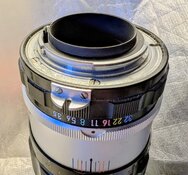
I also have both the 105 and 135mm lenses you have. I don't think the 135 needs the cutout, because its rear element is of smaller diameter than that of the 105. So that baffle is very, very slightly smaller in diameter than the one on the 105, which I assume means the stop down lever doesn't need the clearance to keep from hitting the baffle. According to my digital calipers, the outer diameter of the baffle on the 135mm is 36.2mm, while the one on the 105mm is 38.1mm. So that's probably why the cutout is necessary on that lens, but not the 135.
 
Last edited:
That makes a lot of sense! For the benefit of anyone wondering what we're talking about, herewith the same view of the Nikkor Q 135/3.5...

And now that I think about it, the only potentially difficult part of a DIY AI job is that the rabbit ears (no idea why I called them bat ears, it was late at night 😂) can sometimes be compromised if too much metal is removed.

I also have a UD 20mm which I'd love to convert but it actually needs a tab adding rather than metal removing and it's too nice a lens to want to butcher. Guess I'll stick with using it on my Sony a7ii with an adaptor.
 

Attachments

  • PXL_20260320_072709629~2.jpg
    PXL_20260320_072709629~2.jpg
    1.2 MB · Views: 30
The black ring you're speaking of likely has two uses: as a baffle to reduce internal reflections within the camera body, and as mentioned above, to allow you to set the lens down on its base without scratching the rear element or damaging the aperture stop down lever that protrudes from the rear of the lens. The reason for the cutout is that there is a lever inside the camera body for stopping down the aperture that interfaces with the lever on the back of the lens; when you attach the lens and rotate it to lock it in place, that cutout keeps the baffle from damaging/interfering with the stop-down lever inside the camera body.

Yes, this is the correct explanation. If you look at the original picture of your 105, at the 3 o'clock position you can see the aperture stop-down lever tucked into the bottom edge of the black baffle. If you look at an AI capable body, you will see the corresponding body-side stop-down lever at the 9 o'clock position. When mounting the lens you need to rotate it approximately 60 degrees counter-clockwise, so the cutout in the lens baffle is there to allow the body-side stop-down lever to clear the baffle and engage with the lens-side stop-down lever when fully mounted.

Later on, when Nikon brought out the AiS mount variant, these lens baffles got even more convoluted as there's another body-side lever to detect lenses with 135mm or longer focal length, and the baffle for shorter lenses needs an additional cutout to avoid engaging that lever. Only a few bodies even had the focal-length detection lever, notably the FA, but every lens got their rear-ends re-designed to support this feature.
 
Excellent thank you all!! I just wish someone in France did AI conversions 🥺
 
Very few AI conversion rings are remaining on the used market. So, AI adaptation, by filing the aperture ring is usually needed.

Seems like the utility of filing the aperture ring is limited because only a few manual focus Nikon bodies won’t mount these lenses. Mostly lower end cameras ( N2000, FM-10, etc.)
The higher end cameras all mount and meter with the lenses (F, F2, F3, Fm, Fm2, etc.)
 
Very few AI conversion rings are remaining on the used market. So, AI adaptation, by filing the aperture ring is usually needed.

Seems like the utility of filing the aperture ring is limited because only a few manual focus Nikon bodies won’t mount these lenses. Mostly lower end cameras ( N2000, FM-10, etc.)
The higher end cameras all mount and meter with the lenses (F, F2, F3, Fm, Fm2, etc.)

You _do_ need to AI-convert the lens for the prosumer FM2, FE2, and FM3a as the body's aperture follower-tab does not flip down on those cameras. If you try to mount a non-AI lens, it will likely damage the plastic aperture follower-tab, and may even jam the lens on the mount. The older F3, F4, FM, and FE all had metal, flip-down follower-tabs, so can directly mount a non-AI lens (as long as you remember to flip the tap down!). The F5 and F6 did not come with flip down tabs, but Nikon reportedly offered a modification to install a one, though I personally have never seen such a modded body in the flesh.
 
Possibly a dumb question, but important to me. Hence, I ask:
I got a perfect non-AI lens coming in the mail. Also, I have an otherwise defective AIS lens sitting around doing nothing. Can I remove the aperture ring from the defective AIS and mount it on the non-AI to convert it to AI, provided both lenses have the same aperture range?

I think the answer is yes. The aperture ring can be removed quite easily. However, the f/2.5 and f/2.8 are not the same aperture range.
 
I think the answer is yes. The aperture ring can be removed quite easily. However, the f/2.5 and f/2.8 are not the same aperture range.

Even if the two rings had the same aperture range, it is doubtful that rings from two focal-lengths would be interchangeable due to intricacies of the lens's internal design (e.g. layout of the aperture coupling lever). Even different versions (serial number ranges) of the exact same Nikkor had different factory AI conversion kits (see this very interesting table, and for example note three different kits for the 24/2.8), so you really need exact same ring if you want to do a transplant!
 
Last edited:
Yes there used to be a guy in the UK who would do AI conversions if you just posted him the aperture ring but after Brexit, sending anything to and from the UK into Europe is just an unbelievably messy and potentially costly exercise.

I did see one guy who used a Dremel to good effect. Dremel clamped horizontally to table top and aperture ring suitably shimmed (progressively if needed) to the right height.
 
Last edited:
Photrio.com contains affiliate links to products. We may receive a commission for purchases made through these links.
To read our full affiliate disclosure statement please click Here.

PHOTRIO PARTNERS EQUALLY FUNDING OUR COMMUNITY:


Ilford ADOX Freestyle Photographic Stearman Press Weldon Color Lab Blue Moon Camera & Machine
Top Bottom