• Welcome to Photrio!
    Registration is fast and free. Join today to unlock search, see fewer ads, and access all forum features.
    Click here to sign up

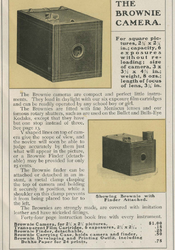
Early Brownie "Film"

Forum statistics

Threads
202,212
Messages
2,837,281
Members
101,196
Latest member
Hans85
Recent bookmarks
2

bewilson

Member
Joined
Sep 7, 2002
Messages
156
Location
Utah
Format
4x5 Format
Back in the early days of the Brownie you returned the camera to Kodak for processing. The film was actually emulsion on paper, and during processing the emulsion was floated off the paper and put onto glass for contact printing. I've never seen a sample of that paper. How was it made so that the emulsion wasn't permanently stuck as modern papers seem to be?

In short, can I float my paper emulsion off to a glass plate?

Bruce
 

Kino

Subscriber
Allowing Ads
Joined
Jan 20, 2006
Messages
8,016
Location
Orange, Virginia
Format
Multi Format
A special "stripping" paper was used, as you probably know. The subbing layer for the emulsion was probably a much softer bloom gelatin than the emulsion holding the silver and could be dissolved with mild heat and or additional chemicals.

I have often wondered how they managed to float off the emulsion and keep it from wrinkling on glass on an industrial scale.

Since the business model of Kodak was firmly grounded in patented processes, there might be a clue in searching the US Patent Office records for that time period. There might be a clue in some device used to strip the emulsion from the paper; the trick is to possibly find it!

I would think by the time a modern emulsion floated off a modern photographic paper, it would be essentially destroyed and unfit to print, but I could be wrong.
 

Hunter_Compton

Subscriber
Joined
Nov 20, 2019
Messages
275
Location
Oxford, MI
Format
Analog
You're conflating the 1888 Kodak and the 1900 Kodak Brownie.

The 1888 Kodak was the one that utilized stripping film. The alternative was paper base film which was treated with castor oil to make it more translucent, but the stripping film was superior in image quality.

The stripping film consisted of the silver-gelatin emulsion applied over a water-soluble gelatin layer, in turn applied to a paper base strip offering 100 exposure frames. When the exposed film was returned to the Eastman factory for processing, the film was first steamed to dissolve the soluble layer, and the emulsion layer was then transferred to a clear gelatin or glass base for further development and processing.

By 1890, stripping film had been supplanted by transparent nitrocellulose film.

By the time the Brownie was in production, only transparent film was available.

Screenshot 2026-02-10 152807.png

@laser Robert Shanebrook's Making Kodak Film Second Edition has details on the paper, stripping and transparent film types.
 

Kino

Subscriber
Allowing Ads
Joined
Jan 20, 2006
Messages
8,016
Location
Orange, Virginia
Format
Multi Format
Thanks, Hunter.

Not that up on very early Brownie facts; appreciated.
 
OP
OP
bewilson

bewilson

Member
Joined
Sep 7, 2002
Messages
156
Location
Utah
Format
4x5 Format
What I remember from a documentary I saw decades ago was a 100-photo paper strip being developed, I think cut into frames, then by hand underwater the emulsion placed on a glass plate for a contact print to be made, then washed and recycled. I thought the camera was a Brownie, because it was a simple box. I thought the 100-frame load was generous, but destroying the negative wasn't.
 

koraks

Moderator
Moderator
Joined
Nov 29, 2018
Messages
27,638
Location
Europe
Format
Multi Format
How was it made so that the emulsion wasn't permanently stuck as modern papers seem to be?

Relying on my experience with carbon transfer, I'm going to guess in the same direction as @Kino and @Hunter_Compton , but with a subtle difference/addition. The image-wise emulsion was likely hardened (with e.g. chrome alum), but an adhesion layer of unhardened gelatin might have been used between the paper and the image-wise emulsion. The unhardened gelatin would dissolve in warm water, allowing the image to simply float off.

In fact, instead of floating it off (which would involve massive problems with dimensional stability, frilling etc.), it's more likely in my mind that a transfer would be made to glass much like what we still do with carbon transfer. Gelatin has a good affinity to (very clean) glass. So the developed paper-film would be briefly soaked in water and squeegeed/stuck against a clean glass surface. This would then be brought into warm water, during which the image (hardened gelatin) would adhere to the glass, while the unhardened gelatin glue layer would dissolve, allowing the paper to float away. The image would be left on the glass and if done properly, this actually creates a very durable bond. The end result is essentially a glass negative very much like a dry plate glass negative.
 

Kino

Subscriber
Allowing Ads
Joined
Jan 20, 2006
Messages
8,016
Location
Orange, Virginia
Format
Multi Format
In fact, instead of floating it off (which would involve massive problems with dimensional stability, frilling etc.), it's more likely in my mind that a transfer would be made to glass much like what we still do with carbon transfer. Gelatin has a good affinity to (very clean) glass. So the developed paper-film would be briefly soaked in water and squeegeed/stuck against a clean glass surface. This would then be brought into warm water, during which the image (hardened gelatin) would adhere to the glass, while the unhardened gelatin glue layer would dissolve, allowing the paper to float away. The image would be left on the glass and if done properly, this actually creates a very durable bond. The end result is essentially a glass negative very much like a dry plate glass negative.

This should flip the orientation of the emulsion L-R, so contact and projection prints would have backward lettering.

Trying to remember if this was an issue with the very earliest cameras that used stripping film. Seems I might have read that somewhere...
 

Don_ih

Member
Allowing Ads
Joined
Jan 24, 2021
Messages
8,687
Location
Ontario
Format
35mm RF
This should flip the orientation of the emulsion L-R, so contact and projection prints would have backward lettering.

But you can shine the light through either side of the film. Assuming the light was collimated, and the glass was very thin, there wouldn't be much sharpness loss (no one would notice, anyway).
 
OP
OP
bewilson

bewilson

Member
Joined
Sep 7, 2002
Messages
156
Location
Utah
Format
4x5 Format
I found the video I saw. It's American Experience, "The Wizard of Photography" from 2000. Here is the YouTube link, starting to the scene I remembered:

Clearly they are pulling the emulsion off first, then floating it onto a plate. But it's a recreation, and might not be the way it was originally done. I favor the idea they squeegeed the paper backing onto a glass plate, then pulled the paper off.
 

film4Me

Subscriber
Allowing Ads
Joined
Feb 22, 2025
Messages
155
Location
Australia
Format
Medium Format
Fascinating, this thread

Regarding the video, I the found the follow up video very interesting also. (3/3)

When it gets to it, check out the wall of box cameras. 16mins 16secs

 
Photrio.com contains affiliate links to products. We may receive a commission for purchases made through these links.
To read our full affiliate disclosure statement please click Here.

PHOTRIO PARTNERS EQUALLY FUNDING OUR COMMUNITY:


Ilford ADOX Freestyle Photographic Stearman Press Weldon Color Lab Blue Moon Camera & Machine
Top Bottom