
• Welcome to Photrio!
    Registration is fast and free. Join today to unlock search, see fewer ads, and access all forum features.
    Click here to sign up

Raw chemical storage/separation

Forum statistics

Threads
202,626
Messages
2,843,212
Members
101,413
Latest member
USMC46
Recent bookmarks
0

MarkL

Subscriber
Allowing Ads
Joined
Jan 5, 2006
Messages
618
Location
Upstate NY
Format
4x5 Format
When I built my darkroom years ago, I went nuts and ordered lots of chemicals, ignorantly storing them together. I am now going to separate them. How does this scheme look? The ones at the end I’m not sure how to categorize.


Cabinet 1 – Acids

Hydrochloric Acid
Sulfuric Acid

Cabinet 2 – Bases
Sodium Hydroxide
Ammonium Hydroxide
Ammonium Carbonate
Sodium Carbonate

Cabinet 3 – Oxidizers & toxics
Potassium Dichromate
Potassium Ferricyanide
Selenium

Cabinet 4 – Developers & reducers
<Also packaged developers - Dektol etc.>
Metol
Hydroquinone
Amidol

Cabinet 5 – Fixers & salts
<Also packaged fixers>
Sodium Thiosulfate
Potassium Metabisulfite
Sodium Sulfite (Anhydrous)
Potassium Bromide
Potassium Iodide
Sodium Chloride
Copper Sulfate
Ammonium Thiocyanate

Cabinet X – Misc
<hypo clearing agent>
Sodium Sulfide
Benzatriazole
Thiocarbamide
Thiourea Dioxide
 
I'm evidently the wrong person to talk to. Everything is right next to each other in my cabinet. As long as the containers are suited to the purpose, in good condition and properly capped/shut, there's no practical problem. What are the contingencies you are trying to manage for? Massive earthquake with everything toppling over? Home fire? Darkroom riddled with .50 cal. ammunition? How does the overall impact of these events relate to the potential mixing of the contents of the sodium carbonate jar with those of the acetic acid bottle?
 
Looks fine to me if you have the space, but I've never had any problem storing chemicals together. I do sort them by their purposes however, like you listed. That makes them easier to find.

I make sure all containers are sealed after use.

The only problem I've had was a leaking plastic container once, but that was easily spotted by the darkening of the cardboard box it was in. So watch out for plastic containers with liquids!

And a few dry chemicals can expand with humidity -- ex., sodium hydroxide -- so make sure those containers are not over filled, and well sealed.
 
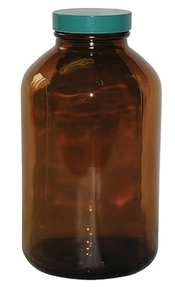
Thanks for the quick replies! A few years ago I noticed an increasing white powdery precipitate forming on all the containers, and some of their caps disintegrated. So I knew there was migration and potential fumes and/or cross contamination. So a couple years ago I got a stock of bottles (shown here), and once again a white residue formed on all the bottles, as well as the ink on some of printed bottle cap labels being destroyed! So in the interest of air quality I thought I'd separate them!
 

Attachments

  • Bottle.jpg
    Bottle.jpg
    13.6 KB · Views: 59
You either have a problem with mold/moisture in that cupboard, or you're still using bottles/containers that don't seal properly.
The cap on that bottle looks dodgy to me, but I can't judge from a photo how well it seals.

If you're storing chemistry in bottles that don't seal well, then fix that. Separating the bottles into different parts of the cabinets isn't the solution. It's like having a flat tire on your car and using black paint to paint the tire nice and black again. It's a cosmetic 'fix' that doesn't fix anything in reality.
 
On ALL containers? Sounds like bad caps. Upstate NY can be pretty humid, but with good caps, you should be OK, and chemicals usually come in good containers.

Are the chemicals in these containers turning into hard chunks? Not good, for several reasons.
 
I have found regular, clear canning jars with the sealing lids to work well for dry powders. Just place a layer of cling plastic between the sealing lid and screw it down tight.

No problems with clumping or moisture.

I then put them in a cardboard file box with butcher paper packing between the jars to cushion any sudden bumps. The lid assures a dark, dry storage environment and I place them on the floor on top of a sheet of Styrofoam to keep it from wicking any potential moisture. Storing them on the floor avoids my knocking them off a shelf, which I am known to do to things about waist high.

A list of what is inside is taped to the top for quick access.

I have 20+ year old Metol, Hydroquinone and other powders that are in perfect shape.
 
I just have all my chems together in 1 place lol
 
Yeah lids must be the problem. Here are the specs when I bought the jars so I thought the lids were OK. I may try adding an additional liner. But I like the idea of the canning jars, especially being clear so I can see the contents.

Thanks everyone!

About this item​

  • General-purpose glass bottle makes sampling and storage convenient
  • Features a PTFE foam-backed liner which resists most chemicals both liquid and solid contents
  • Design is for easy access to contents and for easy cleaning
  • Wide mouth amber glass bottle protects light or UV-sensitive solutions
 
I hope your chemicals are OK. If they have been exposed to high humidity for a long time, it might affect their function/usefulness to some degree -- but that depends on what it is.
 
I’ve been through this. At that time, the plastic caps of the hydrochloric acid and ammonia bottles in the lab were all cracked, and there was white powder everywhere—which we assumed was ammonium chloride but didn't dare to investigate. Organic solvent bottles with cheap PVC caps also frequently leaked odors, and the latex stopper will expand and become sticky. The lesson we learned was to use glass or fluorinated polyethylene (FPE) bottles if possible, paired with good PE/PP caps and Silicone-PTFE gasket. Perhaps others have better suggestions on what kind of bottles are safest to use for reagents in North America. I've heard of wine bottles or wine bag?
 
Last edited:
Yeah lids must be the problem. Here are the specs when I bought the jars so I thought the lids were OK. I may try adding an additional liner. But I like the idea of the canning jars, especially being clear so I can see the contents.

Thanks everyone!

About this item​

  • General-purpose glass bottle makes sampling and storage convenient
  • Features a PTFE foam-backed liner which resists most chemicals both liquid and solid contents
  • Design is for easy access to contents and for easy cleaning
  • Wide mouth amber glass bottle protects light or UV-sensitive solutions

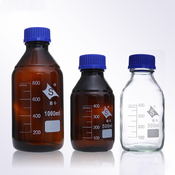
I remember these reagent bottles have one small-mouth style, which makes them easier to seal and convenient for filling with liquids, looks like this:
 

Attachments

  • O1CN01Ue1ymC1V5lJ2ap0Td_!!2772562602.jpg
    O1CN01Ue1ymC1V5lJ2ap0Td_!!2772562602.jpg
    73.4 KB · Views: 24
Most of my chems are on a single shelf in their original bottles. Glycin and Catechol live in the freezer (Glycin because its room-temperature shelf life is short, and Catechol just because).

The only things I store far apart from each other (different rooms on different floors) are Potassium permanganate and Glycerine as these react very energetically if mixed.
 
I'm glad you straighten us out on the Catechol.
 
Separation like this is standard in research labs. Actually, the proposed scheme is better than typical. Also, fuels (paper, etc) are kept from oxidizers and acids and anything that might ignite.

I do think this scheme is way beyond most home darkrooms, but I am impressed with its professionalism.
 
Separation like this is standard in research labs. Actually, the proposed scheme is better than typical. Also, fuels (paper, etc) are kept from oxidizers and acids and anything that might ignite.

I do think this scheme is way beyond most home darkrooms, but I am impressed with its professionalism.

Brendan, thank you. Actually it was ChatGPT I submitted the chemical list to and which cautioned against storing chemicals closely together.

Can you tell me whether I should throw the following chemicals in with any of the other groups?

Sodium Sulfide
Thiourea Dioxide
Thiocarbamide
Benzatriazole
 
On ALL containers? Sounds like bad caps. Upstate NY can be pretty humid, but with good caps, you should be OK, and chemicals usually come in good containers.

Are the chemicals in these containers turning into hard chunks? Not good, for several reasons.

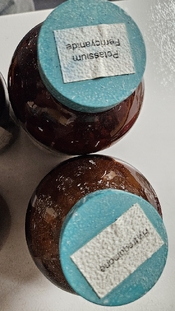
Here's a picture showing what the vapors did to the labels. The bottles had more residue than this. I had already wiped them with a damp paper towel.
 

Attachments

  • bottle residue.jpg
    bottle residue.jpg
    257.6 KB · Views: 39
You might even get away with using the existing bottles by adding a layer or cling film over the open mouth of the bottle and screwing down the cap firmly. That is, if the existing caps have not been compromised too much already...
 
Separation like this is standard in research labs. Actually, the proposed scheme is better than typical. Also, fuels (paper, etc) are kept from oxidizers and acids and anything that might ignite.

I do think this scheme is way beyond most home darkrooms, but I am impressed with its professionalism.
Totally agree. The OP is to be commended for doing it right.

Good chemical storage habits should be SOP (standard operating procedure). Sure, the containers are supposed to isolate the chemicals, but can you really always count on it?

In the clinical lab where I worked, we kept the chemicals organized by type -- and we also had a fire cabinet for flammables (probably not an issue for photographic cnemicals).

A couple of other considerations:
- Don't put acids and caustics on high shelves (above shoulder height); keep them lower to the ground to reduce splashing if dropped.

- Keep goggles, gloves, mask and apron handy, and use them when aliquoting from the storage containers.

- Download MSD sheets and keep the files on your computer where they can be easily found. If you do not have easy access to your computer from the storage area, I'd advise printing the MSDs and keeping them in a binder in or near the storage area.
 
Standard Separation:
Acids from Bases: To prevent neutralization reactions which creates salt and water.
Acids from Oxidizers: Oxidizing acids (which there are many in photography) must be separated from organic acids (acetic acid comes to mind) and flammables.
Oxidizers from Flammables: Prevent fire risks.
 
When I built my darkroom years ago, I went nuts and ordered lots of chemicals, ignorantly storing them together. I am now going to separate them. How does this scheme look? The ones at the end I’m not sure how to categorize.


I store my chemicals together, except for my sodium sulfide, which is in the garage.
 
Photrio.com contains affiliate links to products. We may receive a commission for purchases made through these links.
To read our full affiliate disclosure statement please click Here.

PHOTRIO PARTNERS EQUALLY FUNDING OUR COMMUNITY:


Ilford ADOX Freestyle Photographic Stearman Press Weldon Color Lab Blue Moon Camera & Machine
Top Bottom