• Welcome to Photrio!
    Registration is fast and free. Join today to unlock search, see fewer ads, and access all forum features.
    Click here to sign up

Kodak films direct from Eastman Kodak (was: Kodacolor 100. New)

Recent Classifieds

Forum statistics

Threads
204,274
Messages
2,866,525
Members
102,207
Latest member
gustavocf
Recent bookmarks
1
I have wondered if there might be an agreement with CineStill Film that Eastman Kodak won't sell the motion picture film packaged for photography. If there is, of course it could potentially change at some point, but I have wondered if this might have something to do with it.

Also, you can get Eastman Double-X film packaged for 35mm and 120 format from CineStill as BWXX.

I assumed there had to be some sort of arrangement with Kodak since Cinestill was so open about what they were doing. On the other hand, if Cinestill wasn’t getting their film directly from Kodak it isn’t clear to me what Kodak/Alaris could have done. I’d love to be able to buy 100’ rolls to save some money.
 
Late to this thread but I had to answer issac7.

A typical roll of VISION3 Color Negative will yield around 460 units at 400 ft. There still is sufficient volume for those films that the company can profitably produce that many in a given production run, but please remember a production run within coating would have to be more than one or two large rolls to remain profitable. A coating machine where upwards of 16 layers are being coated simply cannot create one or two rolls without start and end waste on the film and in the kettles, so volumes are required.

Within any company's production system there has to be both manufacturing and financial accounting and how those streams are designed is very important whether they are split up by business units, product families, etc. Although it sounds very easy to "go grab a few rolls of film X and make them for a different customer base", within the manufacturing systems that may be in place, that is not so easy. Entire product data streams for both financial and manufacturing as well as inventory management and real dollars in inventory all are required to create a "product Y" from a "product X". Sarbanes Oxly and good accounting practices mandate such.

So, going back to my beginning, say you want VISION3 50D in 135 spoools direct from Kodak. The company would have to create a manufacturing bill of materials, computer routing to get the roll through the manufacturing systems, inventory management to get the made film from finishing plant to distribution centers, update / change component supply testing to include the new product to screen for things like photohgraphic activity, update the requirements / potential size changes for coating of many master rolls, update all specification, manufacturing & testing documentation to include the new product, and finally any internet documentation, technical sales training and information for customer interface. All new packaging and graphic arts materials would be required for the suppliers, updates to labeling systems and inventories of those components would be required.

It makes a simply request for a product much more complex than meets the eye for one who may not have worked in a complex manufacturing business. And what about that volume? Looking at the example, spooling an entire roll into 135 36 exposure units would yield over 32,000 units per roll. Would sales be enough to cover that make?

Within the new Kodak, post bankruptcy, many of the internal systems designed for different business units could not be changed because of the Alaris split and the costs associated with reprogramming many complex systems in production and accounting. Perhaps that has changed but I would wager it still is a very costly endeavor to create product Y from product X.


This all makes absolute sense to me. I've been involved in manufacturing, now retired. Seems like the way to get cine films in a 135 or 120 size if from Cinestill. The option that existed during the pandemic mess of Kodak selling 400' "units" of 35mm cine film through vendors like B&H just makes no sense now. And equally makes no sense for Kodak to try and do what you described.

I wonder IF. What if Cinestill could convert some of the Eastman cine film stocks FOR Eastman Kodak, in Kodak exclusive packaging etc??. No one would have to know 😎 No 100' bulk rolls just very expensive single rolls.
Of course I wouldn't buy it, it's not Ektacolor or Ektar.
 
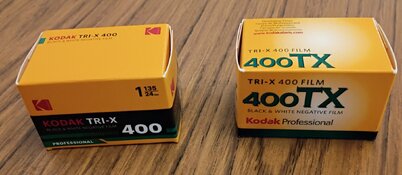
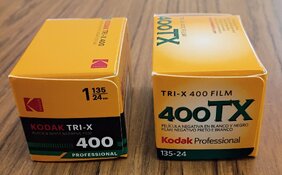
So I just received some 24-exp Tri-X I bought from Midwest Photo Exchange (at a very good price)... and was surprised that it's in the new domestic packaging from Great Yellow Father. Comparison of the new Kodak box and existing Alaris box (sorry that I had the Spanish side showing in the first one):

USAkodakVsAlarisTX2026a.jpgUSAkodakVsAlarisTX2026b.jpgUSAkodakVsAlarisTX2026c.jpg

They both say manufactured in the USA on the side I didn't show. Same film, different boxes.

Frankly, I never liked it being called "400TX" anyway.
 
This all makes absolute sense to me.

Fortunately, there are people without common sense that just get Kodak cine rolls, pay a German wage to have it respooled into cassettes and pretty boxes and sell the film for 50% less than Portra 400.

I hope they never learn that this can't possibly be done.
 
@isaac7 I've learned to take what @FredK says very seriously.

I have no doubt he is very knowledgeable and experienced. It is still hard to believe that what Cinestill and others are already doing would be too expensive or difficult for Kodak to do themselves. Again, if selling a product that they already make, packaged with processes they already use, distributed through their existing network is too expensive or difficult then that is a searing indictment of Kodak’s management.

So no, I don’t think repackaging Vision film for the still market is being held back by manufacturing issues. My guesses as to why:

1) They don’t want to dilute their current color film sales with extra products. That could be solved by replacing one or more current still products with Vision. Portra is an old product that replaced VPS and VPH. Weddings shot on film are a thing of the past. I’m pretty sure Vision films could replace what Portra is being used for these days.

2) Vision films are designed for ECN-2 processing and most still labs don’t offer that. By all accounts, the new Vision films without the remjet coating are “fine” run through C-41. I suspect that using C-41 does shift the colors and that could lead to issues with using them with RA-4 printing materials. Would it still be a problem with digital workflows? I don’t know but suspect not.

3) There is still a hard divide between motion picture and still photography teams and they don’t work together. I would be very surprised if this was still the case. Once upon a time Kodak was big enough that different divisions wouldn’t have any need to interact with each other. I’m sure the chemistry and coating folks were the same but everything else from PR to distribution to packaging would be completely different. Is this still the case? If so it should be easily corrected.
 
Fortunately, there are people without common sense that just get Kodak cine rolls, pay a German wage to have it respooled into cassettes and pretty boxes and sell the film for 50% less than Portra 400.

I hope they never learn that this can't possibly be done.

China counterfeits all sorts of products as well including Rolex watches. How do you know you're actually buying Portra film from that German? Caveat emptor: "Let the buyer beware"
 
I have no doubt he is very knowledgeable and experienced. It is still hard to believe that what Cinestill and others are already doing would be too expensive or difficult for Kodak to do themselves. Again, if selling a product that they already make, packaged with processes they already use, distributed through their existing network is too expensive or difficult then that is a searing indictment of Kodak’s management.

So no, I don’t think repackaging Vision film for the still market is being held back by manufacturing issues. My guesses as to why:

1) They don’t want to dilute their current color film sales with extra products. That could be solved by replacing one or more current still products with Vision. Portra is an old product that replaced VPS and VPH. Weddings shot on film are a thing of the past. I’m pretty sure Vision films could replace what Portra is being used for these days.

2) Vision films are designed for ECN-2 processing and most still labs don’t offer that. By all accounts, the new Vision films without the remjet coating are “fine” run through C-41. I suspect that using C-41 does shift the colors and that could lead to issues with using them with RA-4 printing materials. Would it still be a problem with digital workflows? I don’t know but suspect not.

3) There is still a hard divide between motion picture and still photography teams and they don’t work together. I would be very surprised if this was still the case. Once upon a time Kodak was big enough that different divisions wouldn’t have any need to interact with each other. I’m sure the chemistry and coating folks were the same but everything else from PR to distribution to packaging would be completely different. Is this still the case? If so it should be easily corrected.

Kodak sells movie film directly. Their still films are sold through Alaris, adding another markup and raising the final prices. As Matt King once explained, still film requires additional process, including marking the rebate with numbers and separately boxing each film cassette for each roll, adding production costs.
 
China counterfeits all sorts of products as well including Rolex watches. How do you know you're actually buying Portra film from that German? Caveat emptor: "Let the buyer beware"

I'm confused, I thought that Kodak's cinematic film was the Vision 3 series of films, ECN2 processed ... not Portra?

As for the China "counterfeits" remark, it would be great if one or more Chinese companies made colour films. Lucky is already on that path with a perfectly respectable ISO200 CN/C41 product (not Portra quality ... yet) and the word is that they will produce a slide film soon. What's not to like?
 
I have no doubt he is very knowledgeable and experienced. It is still hard to believe that what Cinestill and others are already doing would be too expensive or difficult for Kodak to do themselves. Again, if selling a product that they already make, packaged with processes they already use, distributed through their existing network is too expensive or difficult then that is a searing indictment of Kodak’s management.

So no, I don’t think repackaging Vision film for the still market is being held back by manufacturing issues. My guesses as to why:

1) They don’t want to dilute their current color film sales with extra products. That could be solved by replacing one or more current still products with Vision. Portra is an old product that replaced VPS and VPH. Weddings shot on film are a thing of the past. I’m pretty sure Vision films could replace what Portra is being used for these days.

2) Vision films are designed for ECN-2 processing and most still labs don’t offer that. By all accounts, the new Vision films without the remjet coating are “fine” run through C-41. I suspect that using C-41 does shift the colors and that could lead to issues with using them with RA-4 printing materials. Would it still be a problem with digital workflows? I don’t know but suspect not.

3) There is still a hard divide between motion picture and still photography teams and they don’t work together. I would be very surprised if this was still the case. Once upon a time Kodak was big enough that different divisions wouldn’t have any need to interact with each other. I’m sure the chemistry and coating folks were the same but everything else from PR to distribution to packaging would be completely different. Is this still the case? If so it should be easily corrected.

Most still photographers shoot still film.

Most movies that use film use cine film

There's always been a modest number of still shots made on cine stock.

Volume reduces impact of fixed costs

Unless Kodak would see an increase in the total volumes and profit makes no sense. Cinestill is a good customer, wouldn't want to mess that up.

This is all conjecture on my part. I have no idea what Kodak is planning to do.
 
Last edited:
I'm confused, I thought that Kodak's cinematic film was the Vision 3 series of films, ECN2 processed ... not Portra?

As for the China "counterfeits" remark, it would be great if one or more Chinese companies made colour films. Lucky is already on that path with a perfectly respectable ISO200 CN/C41 product (not Portra quality ... yet) and the word is that they will produce a slide film soon. What's not to like?

More competition is always good to push prices down. When Kodak owned the American film market thirty years ago (90%), it made a 70% gross profit.
 
I have no doubt he is very knowledgeable and experienced.
Me neither. Esp. regarding #3.
However, I do agree that there are additional reasons why Kodak doesn't sell cine film for stills use. It would cannibalize their regular still film lines, so I agree with #1.
In due course, I can see a future (but that's speculation of the wildest kind) where they further rationalize the product portfolio and merge the still & motion picture lines into a single offering, with an overall reduced number of SKU's.
 
The fact Eastman is selling new emulsions under their name means that they see a future in film. That's great for us film users. The fact that they're doing this apparantly without Alaris's objections tells me the new owners of Alaris and Eastman have sat down and planned out a new future that would be of advantage to both companies. That good for us film users as well.
 
I doubt they are new emulsions.
I expect that it may be like Gossen meters and Manfrotto tripods in the USA in days of yore - they have different names in different markets, depending on the distributor and the geographic market they are trading into.
 
Me neither. Esp. regarding #3.
However, I do agree that there are additional reasons why Kodak doesn't sell cine film for stills use. It would cannibalize their regular still film lines, so I agree with #1.
In due course, I can see a future (but that's speculation of the wildest kind) where they further rationalize the product portfolio and merge the still & motion picture lines into a single offering, with an overall reduced number of SKU's.

I thought of another possible reason they may not want to release the Vision product for still photography, different formats. I think everything I listed holds for 35mm but there would be some non-trivial costs and complexity if they wanted to offer Vision film in 120 and large format like they do with Portra. I’m not sure if they would be content business wise with a 35mm only emulsion. Maybe they would! It would certainly be easier to leave things they way they were if they think multiple formats are important.
 
I doubt they are new emulsions.
I expect that it may be like Gossen meters and Manfrotto tripods in the USA in days of yore - they have different names in different markets, depending on the distributor and the geographic market they are trading into.

Lester Bogen 😂

1778893977468.jpeg
 
Sorry, I do not find that at all convincing. Kodak has a limited number of film products these days. In decades past they had thousands of SKUs and were a behemoth of a company. Modern supply chain automation simplifies things dramatically compared to the way things were done even in the 90s. As in years past, still photography uses far less film than cine does.

How much experience do you have managing companies that once had global monopoly power and now manufacture niche products? When the physical plant, chemical design, and R&D were optimized for massive global sales? After a major bankruptcy, decades of layoffs and brain-drain, and wild shocks in material prices during multiple global economic crises? With the need to generate enough positive cash flow to pay off decades of debt, absorb unpredictable commodity material costs, and still maintain enough consistent quality to protect their remaining business?

Things that seem more obvious and easy to those of us from other fields are usually based on a lack of experience. When you’re operating on the razors edge, distractions are often fatal.

You can look at the financial results Kodak just announced to see many of the inputs they have to balance carefully and conservatively to stay alive - let alone to slowly improve.

I will admit that Kodak is in a lot better position to judge that than I am lol.
I suspect that’s the case for most of us, with the exception of people like @FredK who actually worked there.
 
How much experience do you have managing companies that once had global monopoly power and now manufacture niche products? When the physical plant, chemical design, and R&D were optimized for massive global sales? After a major bankruptcy, decades of layoffs and brain-drain, and wild shocks in material prices during multiple global economic crises? With the need to generate enough positive cash flow to pay off decades of debt, absorb unpredictable commodity material costs, and still maintain enough consistent quality to protect their remaining business?

Things that seem more obvious and easy to those of us from other fields are usually based on a lack of experience. When you’re operating on the razors edge, distractions are often fatal.

You can look at the financial results Kodak just announced to see many of the inputs they have to balance carefully and conservatively to stay alive - let alone to slowly improve.


I suspect that’s the case for most of us, with the exception of people like @FredK who actually worked there.

I started asking these questions because I wondered if Kodak would offer cine films to still photographers now that they no longer have to worry about competing with Alaris. They seem to have more flexibility than they did previously for whatever reason. If they decide that they want to expand and/or update their offerings for still photography I still maintain that the new Vision stocks and Double x would be the easiest way to do that. Whatever complexity I am missing surely wouldn’t be more than developing new stocks from scratch. I’d be happy with 100’ bulk rolls. Hell, I’d seriously consider a 400’ roll if they would sell me a single one.

Like you said, Kodak has to tread carefully so it wouldn’t surprise me if things stay the same. On the other hand I wouldn’t be surprised if they consolidated their color stocks between cine and still eventually. Ditching the remjet coating makes it seem like it is possible. In the meantime I guess we’ll still be able to trawl the internet for short ends if we want to shoot cine films
 
You can look at the financial results Kodak...

Good point. EK sold $100M of film to Alaris alone in 2025. And the man with insider information is wondering whether there is a market for a 32,000 rolls of Verita in 35mm cassettes? Seriously?! It would sell out on day one.

As for the impossible undertaking of using existing film and creating a "new" SKU (cassette/box design, marketing...). Sorry, that's ridiculous, since EK just did that for a large number of their films that were previously (and still are) sold to Alaris.

The wildly more possible reason why we probably won't see Verita (or other cine films) available directly from Kodak for still film users is that Kodak is happy with their product mix and see no big opportunity for price or volume gains by adding cine film line to their existing still film lineup.
 
And the man with insider information is wondering whether there is a market for a 32,000 rolls of Verita in 35mm cassettes? Seriously?! It would sell out on day one.

I suspect the actual demand for respooled cinema stock is a lot lower than you think. All told, outside of CineStill, it might equate to maybe one (perhaps two) minimum coating runs or so per annum (which produces several master rolls), split over something like 7 products. Significant parts of the customer base in question seems to like to scream histrionically about their oh-so-delicate price sensitivity (and entitlement to 1990s priced film) and yet don't actually buy or use much film.

Spooling down a 1000ft can in a home darkroom and running off some labels on a desktop printer is a very different thing from what would need to be done to do it right.
 
Last edited:
Maybe Kodak will cut off Cinestill 🤔 The whole mystique of cinema film without anti-halation layer is Cinestill claim to fame. Who knows.

 
Spooling off a 400’ roll and saving a few bucks felt like being part of an underground movement. It was fun while it lasted to take advantage of confusion in the marketplace, but it’s over. Kodak is now strong enough to restore order to its product mix and coherence to its distribution.

I’m all ready to move on and start feeling nostalgic.
 
I suspect the actual demand for respooled cinema stock is a lot lower than you think.

I sure hope you’ll tell us how much do I think that demand is… (or at least when I pretended to know that).

Although, clumsy with your words, you are right, of course. Not even Kodak knows exactly what the demand for cine film by still film community is. What we do know is that suppy is more than they want it to be.
 
Photrio.com contains affiliate links to products. We may receive a commission for purchases made through these links.
To read our full affiliate disclosure statement please click Here.

PHOTRIO PARTNERS EQUALLY FUNDING OUR COMMUNITY:


Ilford ADOX Freestyle Photographic Stearman Press Weldon Color Lab Blue Moon Camera & Machine
Top Bottom