• Welcome to Photrio!
    Registration is fast and free. Join today to unlock search, see fewer ads, and access all forum features.
    Click here to sign up

Tri-Color... Cyanotype

Self-Portrait: Hands

H
Self-Portrait: Hands

  • 3
  • 1
  • 16
22897.jpg

A
22897.jpg

  • 1
  • 0
  • 29

Forum statistics

Threads
204,391
Messages
2,867,883
Members
102,251
Latest member
archgen
Recent bookmarks
0
The fact that cadmium is involved should be sufficient reason to think twice about the desirability to pursue this as a hobby.

Cadmium can possibly be eliminated from this process by using the Yellow Toner that is described in Mike Ware's book:

Yellow – Trisodium phosphate
Immerse a heavily printed cyanotype in a bath of 5% w/v trisodium phosphate solution, to bleach it to a golden yellow colour - probably iron(III) phosphate, a fairly stable pigment.
 
Eliminating Cadmium is probably easier than Nickel which also needs proper care while handling. So this is mostly an academic curiosity for me at this point. But I'll watch the thread to see the progress.

That's definitely like that. And that's what I'm working on currently.

I definitely don't recommend using trisodium phosphate for yellow, because it's even less yellow than iron hydroxide. But I currently calibrate the colors to be used with iron hydroxide, so it could be a least more acceptable to use for most of people. Hopefully, I'll figure out a safer and good yellow later.

About nickel: I tried using nickel acetate, it worked. Just don't forget that replacing iron with nickel us the first step. Later I convert it into nickel dimethylglioximate, which is a nice magenta pigment. And you can also discard your nickel solution by converting it into this complex, which is stable and insoluble. I mean, it's even used as a pigment in lipsticks, so it's definitely safe.
 
That's definitely like that. And that's what I'm working on currently.

About nickel: I tried using nickel acetate, it worked. Just don't forget that replacing iron with nickel us the first step. Later I convert it into nickel dimethylglioximate, which is a nice magenta pigment.

Yes, even Nickel Sulphate should be good for this purpose if Nickel toning is followed by dimethylglyoxime treatment. Nickel toning alone will shift the tone slightly towards greenish-blue and the tone shift being subtle might not even be noticed by some.
 
Tri-Color Cyanotype
(Chemical Toning Method)

During my experiments, it was possible to find a method by which iron in Prussian blue is replaced by ions of other metals, which allow for the corresponding reactions to produce pigments of different colors, very interesting ones.
For example, yellow is produced by lead and cadmium, iron, magenta by nickel, green by cobalt, etc.
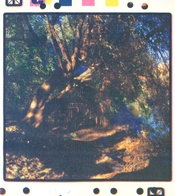
Due to the presence of all the basic CMY colors, tri-color printing in natural colors becomes possible.

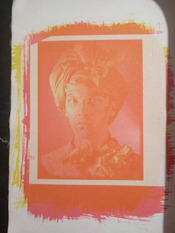
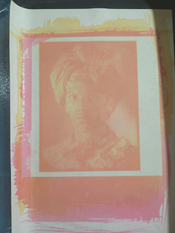
Tri-color cyanotype is printed layer by layer:

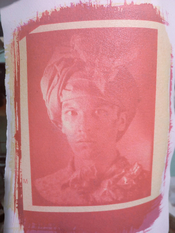
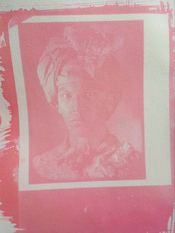
Magenta layer.

A 1+1 citrate cyanotype solution is applied to the paper, dried naturally and exposed behind the G(M) negative.

In my case, the exposure time was 5 minutes (if you plan to use a cadmium-based yellow layer later) and 2 minutes (if you plan to use an iron hydroxide-based yellow toner for your next layer).

After developing in citric acid, the image is washed for a couple of minutes and toned in a solution of nickel acetate and ascorbic acid (1 g + 1 g per 500 ml of water).

Then follows a 15-minute wash in warm (45C) water.

The conversion of nickel dimethylglyoximate to magenta is carried out in an alkaline solution of dimethylglyoxime (2 g DMGO + 1 g NaOH per 500 ml of water, the solution is one-shot).
uF0v2G48a8MsTQ3evWgSkZH7nyPvel96VgvF4UPa1CInRIIr8rP61RbjudhSIBZKSuppEjSNbJMlnFtOGwUqkDrw.jpgphoto_2025-04-22_12-54-04.jpg

Then follows a 5-minute wash in warm water and drying.

 
The next layer is yellow.

Steps 1-2 are repeated. (coating)

The layer is exposed, in my case, for 3 minutes. Behind the negative B(Y).
The image is developed in a weak solution of citric acid, washed from yellowness and toned in a solution of cadmium nitrate and ascorbic acid for 3 minutes (1 + 1 g per 500 ml of water).
Wash in warm water for 10 minutes.
Toned to bright yellow cadmium sulfide in a warm solution of thiourea (1 g) and NaOH (2 g) for 3 minutes, and then washed in warm water for 5 minutes and dried.

DJiMmf4fou8.jpg

An alternative toning option is possible - the blue image obtained in this step is toned in a 5% solution of sodium carbonate until a golden yellow color is obtained. The image should be overexposed several times (the printing time, in my case, was 15 minutes). Rinsed for 5 minutes in cold water and dried.

photo_2025-04-22_12-54-04 (2).jpg
 
For the blue layer:

You need to coat the paper sheet with a solution of pure ferric ammonium citrate in a 1:1 ratio with water. Let it soak in well and dry. Use the negative R(C).
The exposure time, in my case, was 3 minutes.

Then follow in an 8% solution of potassium ferrocyanide and wash in a solution of citric acid until the yellow color disappears.
This method is used if you make a yellow layer with cadmium sulfide.
dSnGyMkxXhI.jpg

If you used iron hydroxide toner, then coat with the standard citrate cyanotype solution 1+1. The exposure time, in my case, was 1:30 minutes.

photo_2025-04-22_12-54-05.jpg

The final wash is 5 minutes in cold water.
The tri-color cyanotype is completed!
 
Colour chart.JPG
this is work I have done recently showing gum over palladium top row and gum over cyanotype bottom row. In both cases we used the same separated film , Far left is
first coat of base material followed by yellow, magenta , cyan, then retouch and finally an inkjet of the image.
 
View attachment 396881this is work I have done recently showing gum over palladium top row and gum over cyanotype bottom row. In both cases we used the same separated film , Far left is
first coat of base material followed by yellow, magenta , cyan, then retouch and finally an inkjet of the image.

That's a really nice work! Gum over such processes is a pretty much classic thing
 
IMG_20250423_032503_123.jpg
Used CMY negatives for CMYK separation, so I got definitely better shadows and almost perfect black. Only the blue color by itself better be lighter. But I think it's pretty much possible. In any case, look at the color swatches on the top! They are so clear. And considered the fact, those weren't negatives I prepared for this process, it all seems even more impressive!
 
Nice work! Thanks for sharing the details of your process.

Since you do magenta layer before the yellow layer, isn't there a risk of thiourea used for the yellow layer reacting with Nickel Dimethylglyoximate and forming Nickel Sulphide?
 
Nice work! Thanks for sharing the details of your process.

Since you do magenta layer before the yellow layer, isn't there a risk of thiourea used for the yellow layer reacting with Nickel Dimethylglyoximate and forming Nickel Sulphide?

Thank you very much. There isn't any problem about it. The magenta color remains clear. You can do yellow first, but the colors should be balanced differently then, so I decided to use the order I described, because I'm simply used to it already.

The only color which can be affected is yellow, that's why you should coat the ferric ammonium citrare solution separately. I think cadmium sulfide works as some kind of catalizer in the reaction of forming the prussian blue pigment. Can't be sure about the Ware's cyanotype, haven't tested it yet
 
The only color which can be affected is yellow, that's why you should coat the ferric ammonium citrare solution separately. I think cadmium sulfide works as some kind of catalizer in the reaction of forming the prussian blue pigment.

Cadmium Sulfide is light sensitive and could be messing up Cyanotype exposure. In the light of this, it definitely makes sense to follow your layer sequencing.
 
The result is impressive, let me preface with that.
Only the blue color by itself better be lighter.

The discussion on the layer order is interesting from (at least) two perspective. You've touched with @Raghu Kuvempunagar above on the technical reasons for a certain layer order. There's also the perspective of transparency, which is especially important in prints like these. Ideally, you'd want to have the most transparent pigments on top and any opaque pigments at the bottom. It's maybe not possible to optimize for this aspect due to technical limitations. In pigment processes like gum, carbon etc. we pick pigments that are as transparent as possible for this reason. With metal-based processes, it's of course all the more challenging.
 
The result is impressive, let me preface with that.


The discussion on the layer order is interesting from (at least) two perspective. You've touched with @Raghu Kuvempunagar above on the technical reasons for a certain layer order. There's also the perspective of transparency, which is especially important in prints like these. Ideally, you'd want to have the most transparent pigments on top and any opaque pigments at the bottom. It's maybe not possible to optimize for this aspect due to technical limitations. In pigment processes like gum, carbon etc. we pick pigments that are as transparent as possible for this reason. With metal-based processes, it's of course all the more challenging.

Yes this is why I do the yellow first as it is semi transparent and the mag, and cyan are transparent.
 
Yes this is why I do the yellow first as it is semi transparent and the mag, and cyan are transparent.

Yes, precisely; yellow pigments are the hardest (impossible) to find that are both transparent and lightfast. For cyan and magenta there are always options like PB15 and PR122 that combine both characteristics.
 
Can't be sure about the Ware's cyanotype, haven't tested it yet

If you're talking about New Cyanotype, it uses weak mineral acid to develop the exposed print. And that could potentially cause damage to the magenta layer as Nickel Dimethylglyoximate is soluble in mineral acid. Of course one wouldn't know for sure till tests are done, but something to keep in mind.
 
IMG-20250424-WA0000.jpg
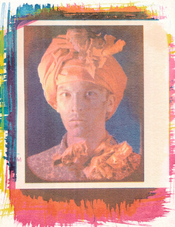
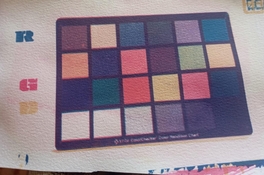
A very good color checker sample done with an iron hydroxide (double coated) as the yellow layer. All the colors are pretty much bright and close enough to the original ones. The blacks are a bit violet, but can be balanced more if you need.
Baohong 200 g/m3 grain fin paper, 100% cotton, pre-soaked in hot water with citric acid twice. It definitely helped to improve the paper for this process!
 
LYd8TB-IsnI.jpg
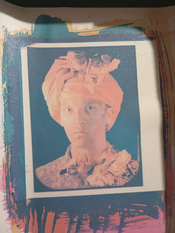
Final version of the print. With iron hydroxide. The colors are pretty much fine and accurate.
 
IMG_20250425_143107_323.jpg
Another final version of the print, but with cadmium yellow this time. It definitely allowed me to print other colors darker, resulting in a more saturated print. But I still think it's possible to improve colors with iron hydroxide as well.
 
color example.jpg

But I still think it's possible to improve colors with iron hydroxide as well.

You can try using NaHCO3 and wheat grass as a yellow colorant. Based on my tests, this combination produces a more vibrant and natural-looking yellow compared to iron hydroxide.
 
Photrio.com contains affiliate links to products. We may receive a commission for purchases made through these links.
To read our full affiliate disclosure statement please click Here.

PHOTRIO PARTNERS EQUALLY FUNDING OUR COMMUNITY:


Ilford ADOX Freestyle Photographic Stearman Press Weldon Color Lab Blue Moon Camera & Machine
Top Bottom