


• Welcome to Photrio!
    Registration is fast and free. Join today to unlock search, see fewer ads, and access all forum features.
    Click here to sign up

Kodak 5243 Color Intermediate Film - color balance, usable for pictorial use?

Weed

A
Weed

  • 2
  • 3
  • 40
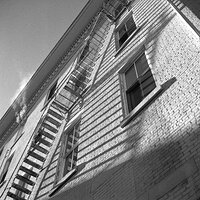
Fire escape.

H
Fire escape.

  • 2
  • 3
  • 37

Recent Classifieds

Forum statistics

Threads
204,351
Messages
2,867,448
Members
102,232
Latest member
redhossu
Recent bookmarks
0

tanner

Member
Joined
Jan 14, 2013
Messages
25
Location
Bulgaria
Format
Multi Format
I did some tests a while back and remember it was maybe ~ISO 3 in daylight with no filtration, strong blue cast. What I can't seem to find information on is what color temperature was this stock designed for. Is it just a tungsten film, is it meant to be exposed through the mask of color negative film or both? I won't be printing it chemically, but would like to get the filtration close while shooting. It would be put through somewhat exhausted C-41 chemistry after I've done my C-41 films, so as not to contaminate them with rem-jet residue.

Any tips on shooting these types of film stocks in general would be most welcome too. Thanks.
 
Is it just a tungsten film,

Yup. And of course not intended for scene capturing, so contrast may be way off compared to C41. This doesn't have to be a problem if you scan, process digitally and aim for "Lomo" results.
I'd stick a daylight balance filter for tungsten film onto the lens and give it another go.
 
Thanks. I will have to track down a filter then.

I was under the impression that these films are used in contact printers and necessarily the illumination would have to pass through a negative's mask, unless this stock is meant to copy a positive.

BTW, I found your blog yesterday and would be going through all of it. Good stuff!
 
Movie intermediate films are exposed in a movie contact printer to tungsten light moderated by a colour lamp-house. They may also be used as part of a "special Effects" process.
unlike the CYM filters we tend to use in Still protography, the Movie printers have dials for RGB, which are calibrated in what are called "printer points" Bell and Howel was the major supplier of these machines which stand an the floor and take up at least 3 standard 19 inch equipment racks worth of space. One commom one used a DDB 750W projector lamp running on 90Volts as the light source. (even more orange than just a tungsten lamp)

the traditional process was the camera negative would be printed to make a "master positive" and that would in turn be printed to make a duplicate negative. the Duplicate negative (s) would then be used to make projection prints on a stock like 3383.

I would guess that no one at Kodak imagined that anyone might use them in a camera directly, although it is fun to use materials in a way that Kodak did not intend.
 
Basically the problem is not, or less, colour balance, but spectral continuity, resp. the lack of it. But we had discussions on this here before, and there may be an Agfa "school" versus a Kodak one, so I leave it at this.
 
unlike the CYM filters we tend to use in Still protography, the Movie printers have dials for RGB, which are calibrated in what are called "printer points"

So the mask is nulled out with filtration and the image is printed with just tungsten light? Maybe I would need a warmer tungsten correction than standard tungsten film due to the lower temp lamp?


Basically the problem is not, or less, colour balance, but spectral continuity, resp. the lack of it. But we had discussions on this here before, and there may be an Agfa "school" versus a Kodak one, so I leave it at this.

That would be due to differently formulated spectral sensitivity of the emulsio and absorption spectra of the dyes I guess? I'm ok with alien planet pictures, I just want to avoid an alien planet under an alien sun situation.
 
The absorbtion spectra of the imaging dyes would be standard, it is about the bandwith of the sensitizing dyes.
 
So the mask is nulled out with filtration and the image is printed with just tungsten light? Maybe I would need a warmer tungsten correction than standard tungsten film due to the lower temp lamp?

the Mask is NEVER nulled out. what happens is the mask ONLY appears where dyes which absorb too much are NOT formed. for the layers that it is aimed at, it just cancels out what would otherwise be an error. It is a Magic way to avoid what otherwise would cause strange colour casts.

now trying to shoot any of the tungsten movie films in daylight, you can START with the good old #85 filter. One can try to "correct in Post" but using an 85 will get you closer. the intermediate film is NOT intended to be used out of a lab, So you will probably need more filtration.
 
Photrio.com contains affiliate links to products. We may receive a commission for purchases made through these links.
To read our full affiliate disclosure statement please click Here.

PHOTRIO PARTNERS EQUALLY FUNDING OUR COMMUNITY:


Ilford ADOX Freestyle Photographic Stearman Press Weldon Color Lab Blue Moon Camera & Machine
Top Bottom
